Introduction: OmniMint AI Review

What if you could take a handful of proven AI tools, wrap them in your own branding, connect payments, and launch a complete software business across Apple, Android, Desktop, and Web… in under an hour?
No developers.
No $50k+ dev budgets.
No months of back-and-forth.
No separate builds for each platform.
That’s exactly what OmniMint AI Suite promises — and what thousands of entrepreneurs, agencies, and creators are now doing in 2025–2026.
In this in-depth OmniMint AI review, we’re pulling back the curtain on the first-ever white-label PWA platform that lets anyone create revenue-ready, multi-platform AI applications using nothing but pre-built modules and a few clicks.
You’ll discover:
- How OmniMint turns one project into four separate businesses (mobile app + web SaaS + desktop app + more)
- The exact 3-step process that took one user from zero to $1,117 in documented revenue — with no ads, no email list, and no existing audience
- Real niche examples (real estate, e-commerce, fitness coaches, authors, consultants) you can copy today
- How the built-in credit system, subscription billing, and ad placements create multiple income streams
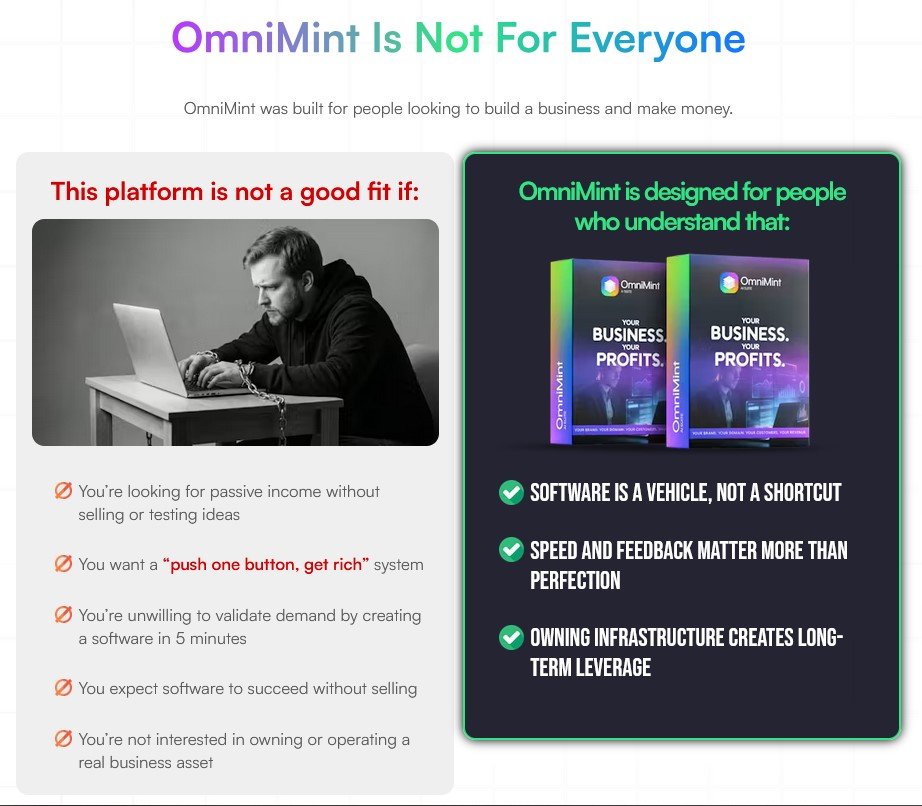
- Who this platform is perfect for — and who should probably skip it
If you’ve ever wanted to own a real software business under your own brand, reach customers on every device they use, and start collecting recurring payments faster than ever before… this might be the most important review you read this year.
Let’s dive in.
Overview: OmniMint AI Review
Vendor: Neil Napier
Product: OmniMint AI Suite
Launch Date: 2026-Jan-08
Front-End Price: $47
Niche: Affiliate Marketing, Artificial Intelligence, Passive Income, Digital Marketing, AI Platform, AI Software
Recommendation: Highly recommended
Support: neil@kvsoical.com
Contact Info: https://www.facebook.com/neil.napier.07


OmniMint AI Review: What Is OmniMint AI Suite?
OmniMint AI Suite is a white‑label PWA platform builder designed to help you create and sell fully branded AI software businesses—without writing code, hiring developers, or spending months in development.
Instead of starting from scratch (UI design, database, auth, payments, hosting, app store builds), OmniMint focuses on a faster path:
- You choose from pre-built AI modules (the “tools” inside your app),
- brand the app like it’s your own product,
- connect payment processing,
- then deploy the same business across multiple channels.
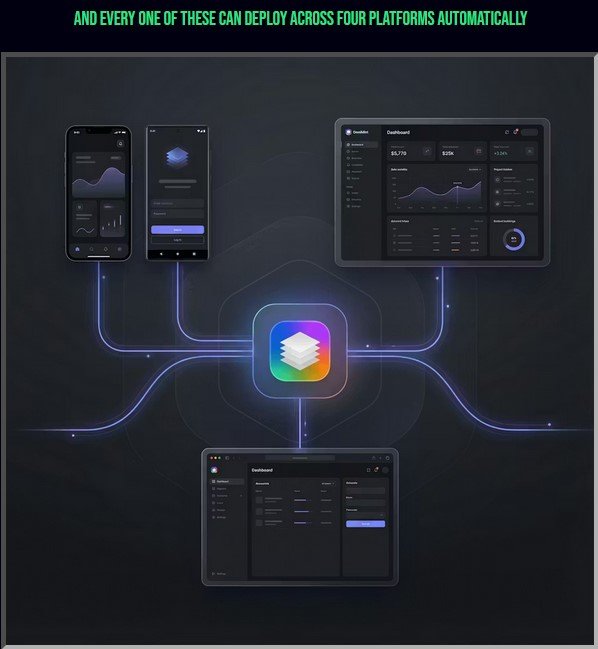
The standout claim is distribution: one project can be deployed across four platforms, typically positioned as:
- Mobile PWA (works on Apple iOS and Android via installable web app)
- Web SaaS (on your custom domain)
- Desktop app (Windows, Mac, Linux)
- Often also positioned alongside browser-based distribution (such as Chrome extension style reach), depending on the build options offered in the platform’s ecosystem and deployment outputs.
If you’ve ever tried to build and launch software the “normal” way, you already know the bottlenecks:
- development costs
- long timelines
- platform-by-platform builds
- payment integration friction
- ongoing maintenance and iteration
OmniMint’s goal is to remove those bottlenecks and replace them with a module + branding + deploy workflow.
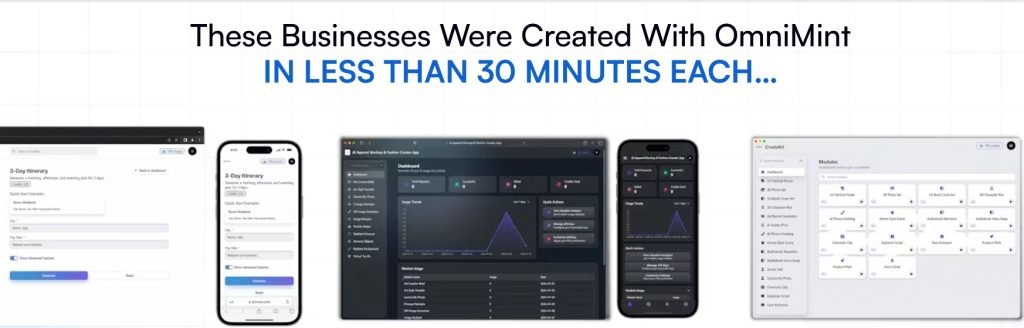
The Core Hook (In Plain English): OmniMint AI Review
Here’s the key idea OmniMint AI is built around:
Build & sell your fully branded AI software business across Apple, Android, Desktop & Web—without coding, developers, or technical skills.
That’s not just a productivity promise. It’s a business-model promise.
Because the moment you can launch quickly, you can:
- test niche ideas faster,
- sell to real customers sooner,
- and refine based on what actually gets paid for.
The platform is positioned less as “make a pretty app” and more as make a revenue-ready AI product.
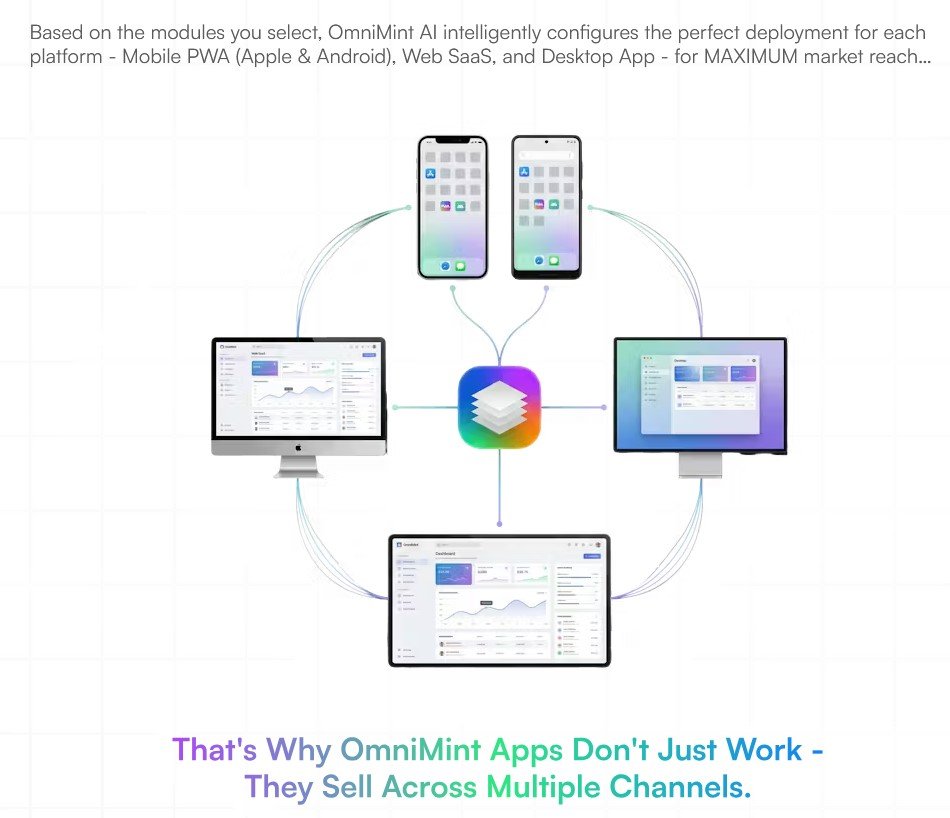
Why Multi‑Platform Matters Now (Web + Mobile + Desktop): OmniMint AI Review
One of the most important parts of OmniMint’s positioning is that it doesn’t treat distribution as an afterthought.
1) Users don’t live on one platform anymore
Some buyers want:
- web access at work,
- mobile access on the go,
- desktop convenience for repetitive workflows.
If your tool only exists in one place, it creates friction:
- “Do you have a mobile version?”
- “Can my team use this without installing anything?”
- “Does it work on Mac?”
- “Can I access it from my phone during appointments?”
Every “no” can lose a sale.
2) Focused tools beat generic platforms
There’s been a quiet shift in SaaS: many winners aren’t huge all-in-one systems. They’re small, vertical tools with clear outcomes.
A vertically focused tool is easier to:
- explain,
- price,
- demo,
- and sell through direct outreach.
OmniMint leans into this by offering many pre-built modules that can be combined into niche-specific toolkits.
3) Speed beats perfection (especially at the start)
When launching a new software idea, the highest risk is building something nobody buys.
A fast launch lets you validate:
- the niche,
- the pricing,
- the offer,
- and the positioning.
OmniMint’s entire pitch is built around compressing time-to-market so you can ship, sell, and iterate quickly.
Watch The Demo Video: OmniMint AI Review
How OmniMint AI Works – 3 Simple Steps: OmniMint AI Review
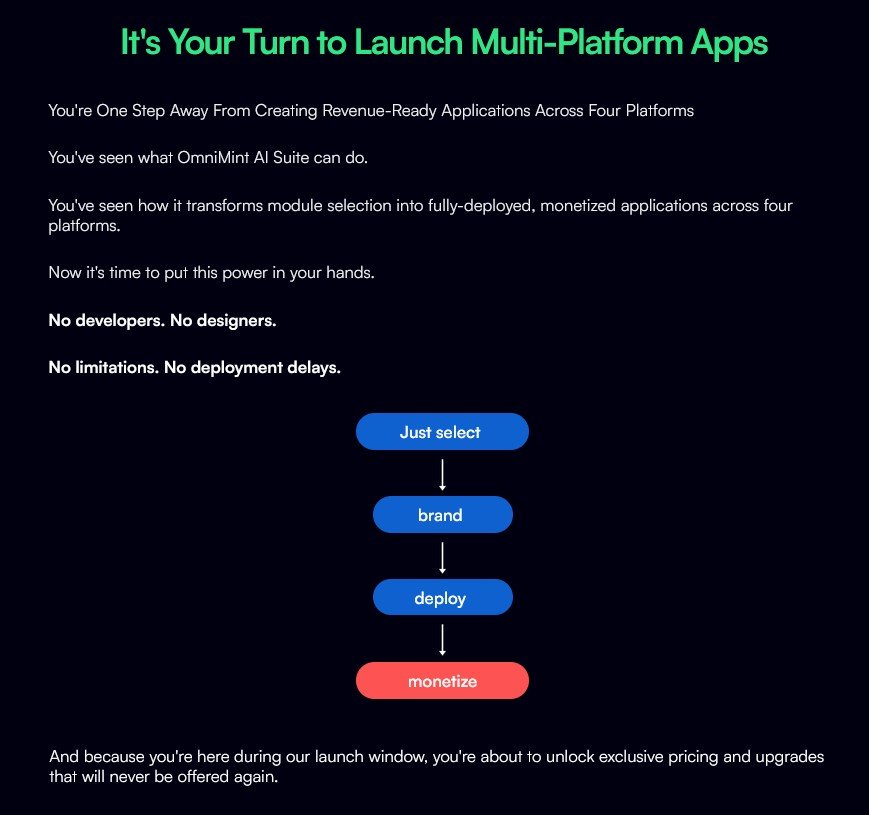
OmniMint’s workflow is intentionally simplified into a three-step process.
Step 1: Select Your Modules
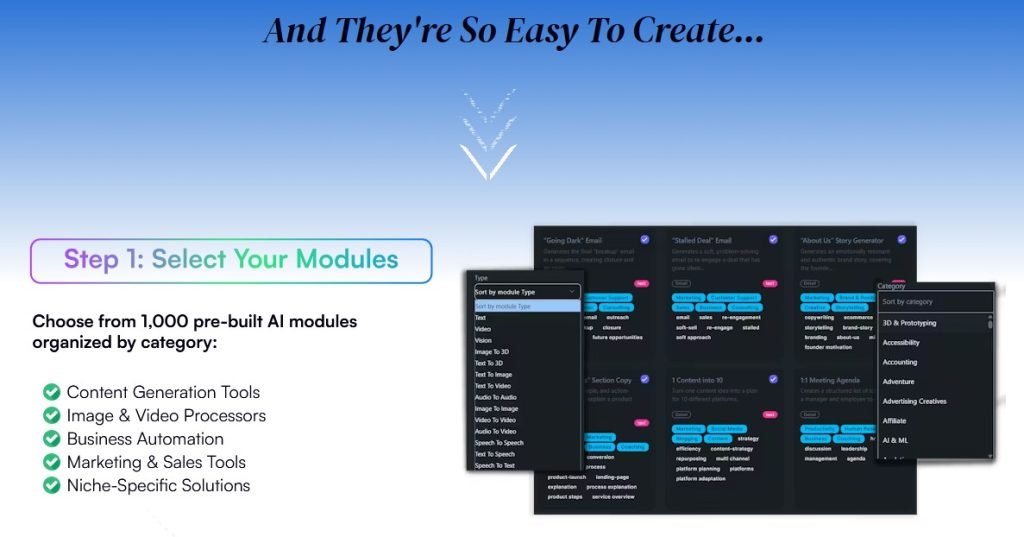
Instead of building features one by one, you choose from a large library of pre-built AI modules. These are organized by category (as described in the prompt), such as:
- content generation tools
- image/video processors
- business automation
- marketing & sales tools
- niche-specific solutions
The big claim here is volume and variety: up to 1,000 modules available, designed to let you build apps that aren’t just “one AI prompt,” but full toolkits.
Why this matters: a single-feature tool can be hard to price. A toolkit with multiple outcomes supports subscription pricing.
Step 2: Brand Your Application (White‑Label)

This is the part most “AI tool builders” don’t do well. OmniMint is positioned as white-label, meaning the end user experiences it as your product, not a generic builder template.
Branding options described include:
- upload your logo
- set brand colors
- choose app name and tagline
- connect a custom domain
- select from professional templates/themes
- connect Stripe and/or PayPal
Practical benefit: if you’re selling to businesses, branding is not optional. Buyers trust “real products,” not generic demo pages.
Step 3: Deploy to Multiple Platforms

After the modules and branding are set, OmniMint generates deployments for multiple platforms. The prompt highlights:
- iOS Apple PWA app
- Android PWA app
- Web SaaS app on your domain
- Desktop app (Windows, Mac, Linux)
Then you click deploy, and the system generates builds optimized per platform.
This is the core differentiator: many no-code tools help you build one version of an app. OmniMint is positioned as building once and deploying everywhere.

Key Features Explained (What You Actually Get): OmniMint AI Review
Let’s break down the big claims and what they mean in real-world use.
1) White‑Label Ownership (Brand-First)
OmniMint is built around the idea that you are building a business asset you own:
- your brand
- your domain
- your pricing model
- your customer relationships
This is important if your goal is to create something sellable long-term (not just a quick tool).
2) PWA Approach (Why It’s Chosen)
A Progressive Web App (PWA) is a web app that behaves like an installed app:
- users can “install” it on their phone
- it can appear on the home screen
- it runs in a standalone window
- updates are easier than app store pushes in many cases
PWAs can reduce friction because:
- you don’t always need a complex native build for iOS and Android separately
- you can maintain one core codebase
OmniMint leans into this because it makes multi-platform deployment feasible without a dev team.
3) Themes and Templates (Speed + Conversion)
The prompt mentions 35+ professional themes plus templates. That matters because:
- design affects trust,
- trust affects conversion,
- conversion affects your ability to charge.
A “working tool” that looks unpolished often gets treated like a hobby project. Templates help avoid that.
4) Built-In Monetization (Not Just Features)
OmniMint emphasizes “optimized for revenue—not just pretty interfaces.”
That typically means:
- user accounts
- payment integration
- usage limits
- credit deduction
- subscription gating
- possibly ad placements (as described)
This is the difference between “a tool” and “a business.”
5) Credit-Based Billing (Sell Credits, Auto-Deduct)
One standout monetization mechanism described is a credit system:
- users buy credits
- credits are deducted when features are used
This model fits AI especially well because AI costs often scale with usage.
Why it’s powerful: you can offer a low entry point and still monetize heavy users.
6) Ad Placements for Passive Revenue
The prompt highlights built-in ad placements across apps. That can be useful when:
- you target consumers instead of businesses,
- you price low or offer freemium,
- you want a secondary revenue stream.
Important note: ads can reduce perceived premium value in B2B. For business clients, subscriptions tend to feel cleaner than ads.
7) Multi-Channel Product Potential
OmniMint is positioned as a system where one build can become multiple “businesses,” because each platform can be marketed differently:
- web SaaS for teams and desktops
- mobile PWA for on-the-go usage
- desktop app for power users
- extension-style distribution for browser-centric workflows
Even when the core product is the same, distribution creates multiple acquisition angles.

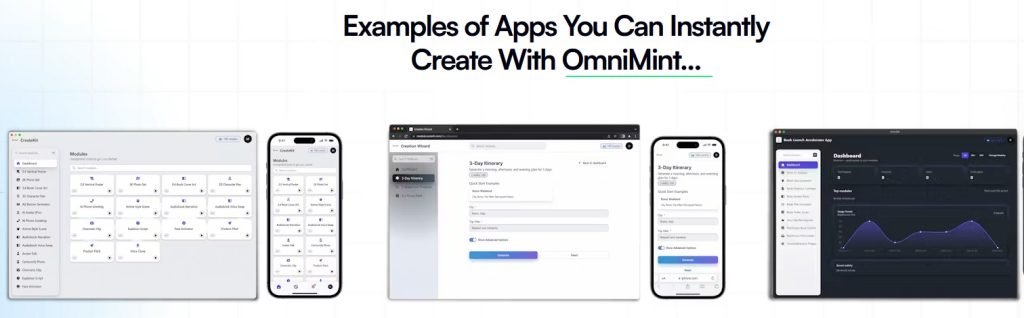
What Can You Build? Real Niche App Ideas: OmniMint AI Review
Below are examples aligned with the prompt’s niche toolkit concept. These are compelling because they’re:
- specific,
- outcome-driven,
- easy to pitch,
- subscription-friendly.
Example 1: Book Marketing Toolkit

Target niche: self-published authors and indie publishers
What it does: helps authors produce marketing assets faster and launch books with a plan
Typical modules: descriptions, title generator, blurb optimization, launch planner, email templates, review requests, pricing strategy
Suggested model: subscription (example given: $29/month)
Why it sells: authors don’t want “AI.” They want:
- more readers,
- more reviews,
- better conversion on Amazon pages.
Position it as “sales enablement for authors.”
Example 2: E-commerce Marketing Suite
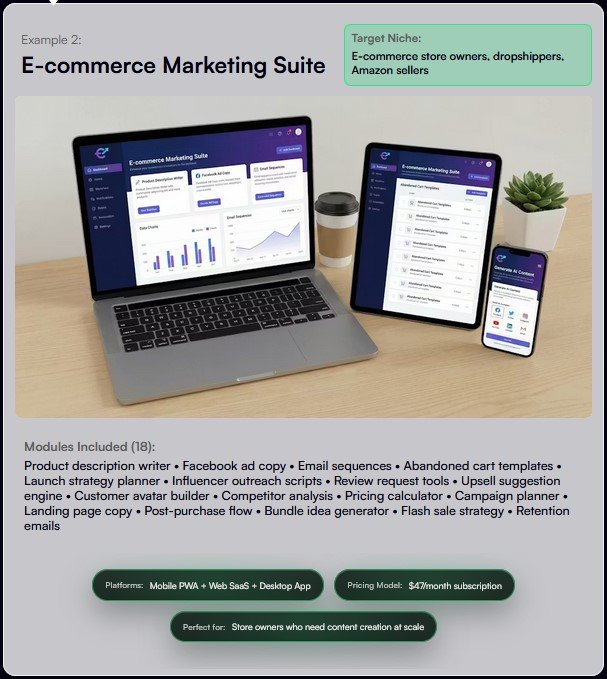
Target niche: Shopify sellers, Amazon sellers, dropshippers
What it does: generates high-volume marketing assets for products and campaigns
Typical modules: product descriptions, ad copy, email flows, upsell ideas, bundles, promo plans
Suggested model: subscription (example given: $47/month)
Why it sells: e-commerce owners live in a loop of:
- product listing updates,
- ads testing,
- email campaigns,
- seasonal promotions.
A multi-tool suite saves them hours weekly.
Example 3: Real Estate Lead Generation Toolkit
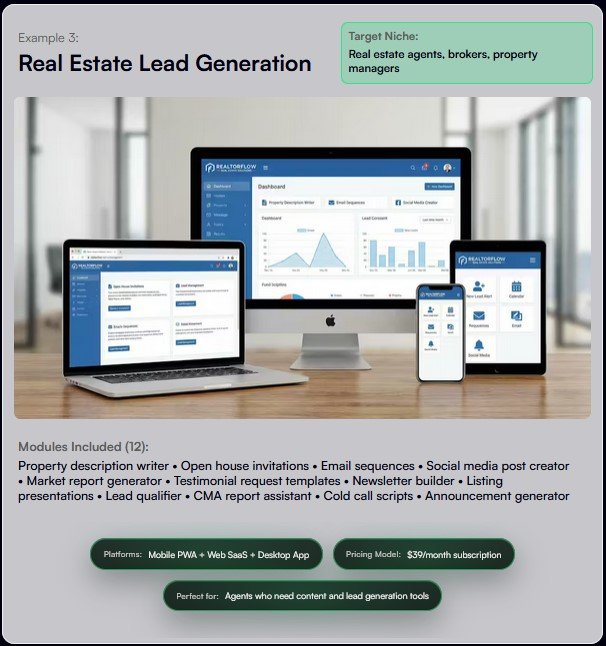
Target niche: agents, brokers, property managers
What it does: supports consistent lead gen content and follow-up
Typical modules: listing descriptions, open house invites, email sequences, social posts, scripts, reports
Suggested model: subscription (example given: $39/month)
Why it sells: real estate is relationship-driven, but consistency wins. This toolkit becomes a “daily driver” for agents.
Example 4: Fitness Coach Content Engine

Target niche: trainers, gym owners, online coaches
What it does: produces workouts, meal plans, daily content, onboarding and retention messaging
Typical modules: workout generator, meal plans, check-ins, posts, challenges, onboarding sequences
Suggested model: subscription (example given: $34/month)
Why it sells: coaches lose time creating content. They also need retention systems (check-ins, follow-ups) more than they need “cool AI.”
Example 5: Consultant Proposal & Pitch Toolkit
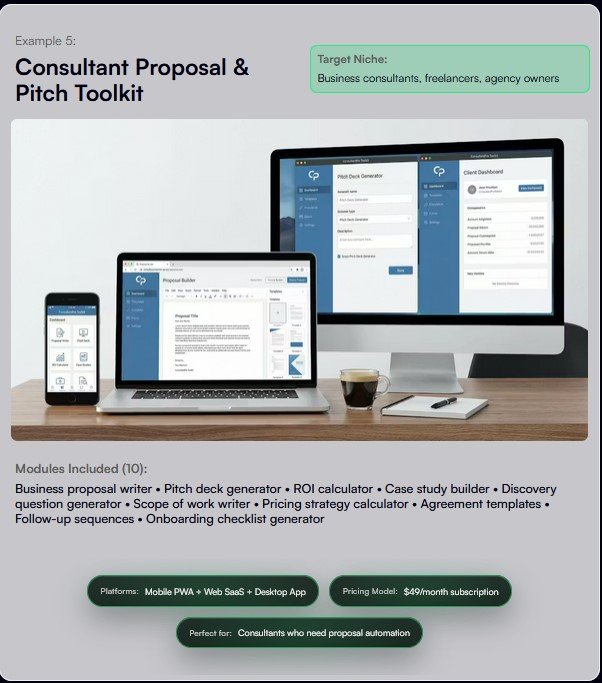
Target niche: consultants, freelancers, agency owners
What it does: generates proposals, scope docs, pitch outlines, onboarding assets
Typical modules: proposal writer, ROI calculator, case study builder, follow-ups, pricing strategy
Suggested model: subscription (example given: $49/month)
Why it sells: proposals are repetitive, time-consuming, and directly tied to revenue. Any time savings here feels valuable.
Monetization: Subscriptions, Credits, Ads, and Licensing
OmniMint’s monetization pitch is one of the strongest parts of the concept because many builders stop at “publish your app,” leaving you to stitch together:
- payment processing
- login/auth
- plan limits
- usage tracking
- checkout pages
Here are the monetization paths implied by the feature set you provided.
1) Subscription SaaS (Monthly or Annual)
This is the cleanest model for B2B niches:
- predictable revenue
- easy upgrades
- long customer lifetime if the tool is used weekly
Best for:
- real estate
- e-commerce
- authors
- coaches
- consultants
2) Credit Packs (Pay-as-You-Go)
Credits are ideal if:
- some users use it occasionally
- other users are heavy users
- you want to avoid “unlimited” plans that get abused
Credit packs also work well for:
- agencies buying usage for their team
- clients who only run campaigns seasonally
3) Client Work (Done-For-You Builds)
If you don’t want to build a SaaS brand, OmniMint can be used as a delivery mechanism for client services:
- “I’ll build you a branded AI app for your practice.”
- “I’ll deploy it on your domain.”
- “We’ll connect payments so you can sell access.”
This turns OmniMint into an agency accelerator.
4) Licensing (Build Once, Sell Many Times)
Licensing is one of the most overlooked models.
The concept:
- build a toolkit for one niche (e.g., dentists)
- license it to many local providers in different regions
- each gets their own branding and domain
This is how some “vertical SaaS” businesses scale without building new features constantly.
5) Ads (Freemium + Passive)
Ads can work if you build:
- consumer-facing tools
- high-volume usage tools
- “lite” utilities where users expect free access
For premium B2B, ads can reduce trust. But for broad, free utilities, it can be a useful secondary revenue stream.
Who OmniMint AI Is Best For (And Who Should Skip It): OmniMint AI Review
OmniMint AI is best for:
1) Entrepreneurs validating SaaS ideas quickly
If you want to launch, sell, and iterate fast, the module approach fits.
2) Agencies building vertical solutions
You can deliver branded apps to clients faster than traditional dev.
3) Creators turning expertise into tools
Instead of selling only a course, you add an app that increases retention and perceived value.
4) Coaches and consultants adding deliverables
A branded toolkit makes your service feel more “productized,” which supports higher pricing.
5) Non-technical founders who still want ownership
White-label branding + monetization + multi-platform deployment is a strong mix for founders who don’t code.

You should skip OmniMint AI if: OmniMint AI Review
1) You need a fully custom, complex product
If you’re building a unique system with custom data models, deep integrations, or proprietary workflows, a module builder may feel limiting.
2) You want native App Store-only distribution
OmniMint’s PWA emphasis is a plus for speed, but some businesses need fully native builds and app store-centric growth. (PWAs can still be installed and used on mobile, but the distribution model differs from classic app store marketing.)
3) You’re not willing to sell
No platform can fully replace go-to-market. OmniMint can reduce build time, but you still need outreach, positioning, and a niche.
About The Creator: OmniMint AI Review
OmniMint AI Suite is the creation of Neil Napier, an experienced member of the digital marketing and SAAS software, who has been developing useful tools that are put in the hands of entrepreneurs over the years. Neil has a history of bringing to market products that literally benefit every-day users – products such as agency platforms, local marketing tools, and AI-driven products that strip away complexity.
He has assisted more than 100, 000 individuals to establish businesses on the internet through clear-cut training and programs that are result-oriented. The nice thing about what Neil writes is that it is never hyped excessively on theory; instead, it is about actual implementation. He has already hit in the past with tools aimed at making marketing and SaaS development easier, and OmniMint AI Suite seems like the logical extension, not just of all his experience of launching faster products but also of everything he has learnt about the power of a fast launch to the booming AI market.
It gives me confidence knowing that there is a proven creator of it. Neil is not a fly-by-wire developer he has created a reputation of producing working tools and helping users in all the right ways.
Pricing & OTOs: OmniMint AI Review
🔥 OmniMint AI Studio – Funnel, Pricing & Links
| Offer | Price | What You Get | Links |
|---|---|---|---|
| Pre-Launch (Presell Page) | Free Access | Early product overview and launch details | 🔗 https://getomnimint.com/welcome |
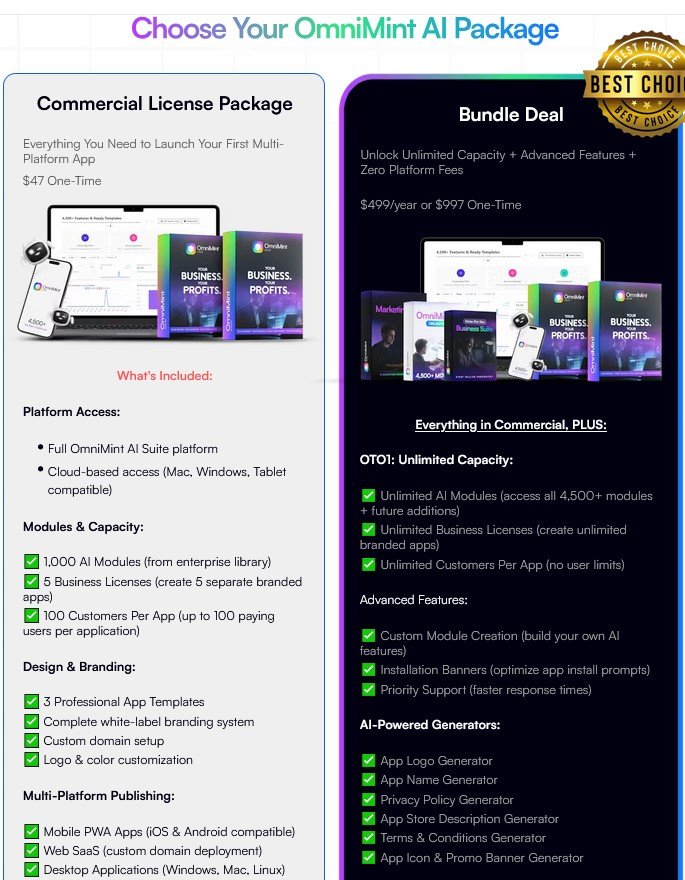
| FE – OmniMint AI Studio | $47 one-time 50% Commission | • 1,000 AI modules • 5 business licenses • 100 customers per app • 3 pro app templates • Apple, Android, Web & Desktop publishing • Stripe & PayPal payments • 3-day training • White-label branding • Custom domains | 🔗 Sales Page: https://getomnimint.com/main 🔗 Affiliate Link (Promote): https://www.jvzoo.com/affiliate/affiliateinfonew/index/431341 |
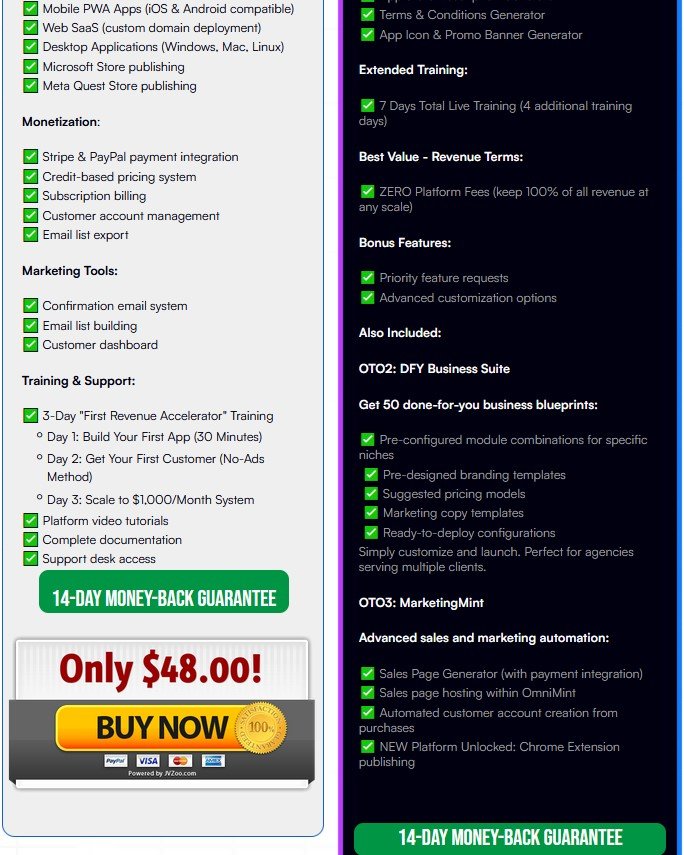
| OTO 1 – OmniMint Unlimited | $297 one-time 50% Commission | • 4,500+ unlimited modules • Unlimited licenses & customers • Unlimited templates • Create custom modules • Ad monetization • 7-day advanced training • ZERO platform fees forever • 6 AI-powered generators | 🔗 Sales Page: https://getomnimint.com/unlimited 🔗 Request Link: https://www.jvzoo.com/affiliate/affiliateinfonew/index/431351 |
| OTO 2 – MarketingMint | $197 one-time 50% Commission | • AI sales page generator • Lifetime hosting • Chrome Web Store publishing (NEW) • Payment integration • Customer management • Auto account creation | 🔗 Sales Page: https://getomnimint.com/marketing 🔗 Request Link: https://www.jvzoo.com/affiliate/affiliateinfonew/index/431357 |
| OTO 3 – DFY Business Suite | $97 one-time 50% Commission | • 50 DFY business blueprints • Pre-built apps • Branding templates • Proven pricing models • Ready-to-deploy setups | 🔗 Sales Page: https://getomnimint.com/dfy 🔗 Request Link: https://www.jvzoo.com/affiliate/affiliateinfonew/index/431353 |
| BUNDLE (All-In-One Deal) | $499/year or $997 one-time 50% Commission | • All FE features • All OTO 1 unlimited features • All OTO 2 MarketingMint features • All OTO 3 DFY businesses • 7-platform deployment • ZERO fees forever | 🔗 Sales Page: https://getomnimint.com/bundle 🔗 Request Link: https://www.jvzoo.com/affiliate/affiliateinfonew/index/431377 |
Pros and Cons (Honest Review): OmniMint AI Review
Pros
1) Multi-platform deployment from one build
This is the headline advantage: build once, deploy across web/mobile/desktop.
2) White-label branding supports real ownership
Custom branding + domain is essential if you want to sell to businesses.
3) Built-in monetization reduces technical headaches
Payments, accounts, gating, and usage-based billing are where many launches stall.
4) Module library supports vertical niche toolkits
Toolkits are easier to price and retain customers than single-feature apps.
5) Faster validation = lower risk
When build time drops, you can test more ideas without betting months of effort.
Cons
1) You’re still responsible for positioning and demand
A builder doesn’t create product-market fit. You need niche clarity.
2) Template/module systems can feel similar across competitors
Branding helps, but you still need a clear offer, outcomes, and specialization.
3) Not ideal for highly bespoke enterprise requirements
If a client needs complex internal integrations, custom workflows, or unique UX, you may outgrow module-based building.
4) Claims like “1,117 in 30 minutes” should be treated as anecdotal
The prompt references a documented case study result. Treat this as an example of what’s possible, not a guaranteed outcome—results depend on niche, offer, pricing, and outreach.
OmniMint AI vs Traditional Dev and Typical No‑Code Tools
OmniMint AI vs Traditional Development
Traditional dev typically requires:
- UI/UX design
- frontend + backend development
- deployment pipelines
- platform-specific builds
- QA/testing cycles
- payment integration
- maintenance and updates
OmniMint’s promise:
- replace most of the above with modules + templates + automated deployment
If your goal is speed-to-market, OmniMint’s approach is naturally attractive.
OmniMint AI vs Standard No‑Code App Builders
Most no-code builders:
- focus on one platform at a time (web app OR mobile app)
- require significant manual setup for payments and gating
- are “builders,” not “business launch” systems
OmniMint is positioned more like:
- a multi-platform deployment engine
- plus a monetization-ready app system
- plus a white-label productization tool
That combination is what makes it different in concept, assuming the platform delivers on the workflow described.
How to Sell Your OmniMint App (Practical Outreach Plan): OmniMint AI Review
Even a perfect tool doesn’t sell itself. OmniMint’s best-fit selling method—based on the niches provided—is direct outreach with a clear offer.
Below is a simple approach you can use even with zero audience.
Step 1: Pick a niche with money and urgency
Good signs:
- they already pay for software (SaaS spending is normal)
- they sell high-ticket services (agents, consultants)
- they need constant content/marketing (e-commerce, fitness)
Step 2: Productize one outcome (not “AI tools”)
Bad pitch:
- “I built an AI app with 18 modules.”
Better pitch:
- “I built a system that generates your weekly listings, follow-up emails, and open-house promos in 15 minutes.”
People buy outcomes, not features.
Step 3: Offer a simple pricing ladder
A clean ladder might look like:
- Starter: limited credits or limited modules
- Pro: full toolkit + higher usage
- Agency/Team: multi-user access + highest usage
Even if you don’t have those exact tiers, the concept matters: let customers self-select.
Step 4: Outreach (20 messages/day for 10 days)
Where to find prospects:
- LinkedIn (role-based search)
- Facebook groups (niche communities)
- local directories (real estate, dental, legal, fitness)
- Upwork or freelancer marketplaces (service buyers)
A basic outreach script:
- Identify niche
- One sentence outcome
- Offer a short demo link
- Ask a yes/no question
Example (real estate):
“I built a branded tool that generates listing descriptions, open house invites, and follow-up sequences in minutes. Want me to send a quick demo link?”
Step 5: Close with a fast demo and “setup included”
For non-technical buyers, the close often hinges on:
- “Will you set it up for me?”
- “Will it match my brand?”
- “Can my team use it easily?”
This is where white-label + multi-platform deployment becomes a selling point.

Beginner Setup Checklist (Fast Launch Plan): OmniMint AI Review
If you want the shortest path from “idea” to “live product,” use this checklist.
Phase 1: Offer & Niche (30–60 minutes)
- Choose a niche you can describe in one sentence
- Pick 1–3 outcomes your app will deliver
- Decide your pricing model (subscription or credits)
Phase 2: Build (Modules + Branding)
- Select modules that match the outcomes
- Remove anything that feels “nice to have”
- Add your logo, colors, name, and tagline
- Connect custom domain
- Connect Stripe and/or PayPal
Phase 3: Monetization Rules
- Set plan limits (modules/credits/usage)
- Create a simple plan naming structure
- Make sure the checkout flow is frictionless
Phase 4: Deploy
- Deploy to web + mobile PWA + desktop
- Test onboarding from a new user perspective
- Test payment + access gating end-to-end
Phase 5: Sales (Same day)
- Build a one-page landing page: niche, outcomes, pricing
- Create a 60-second screen recording demo
- Start direct outreach to 50 prospects

Final Verdict: OmniMint AI Review
Is OmniMint AI Worth It?
OmniMint AI Suite is designed for a specific type of builder: someone who wants to launch a real, branded, monetized AI software business quickly—without developers, without coding, and without being trapped on a single platform.
The strongest angles—based on the information you provided—are:
- Multi-platform deployment (web + mobile PWA + desktop) from one project
- White-label branding that supports selling to real clients
- Built-in monetization (payments, subscriptions/credits, potential ads)
- Vertical SaaS potential using niche toolkits built from pre-made modules
If you’re trying to validate ideas fast, productize services, or sell vertical tools to businesses through outreach, OmniMint’s approach is compelling—because it reduces the two biggest bottlenecks in software: time and technical complexity.
If you want, I can also create:
- a fully optimized landing page copy for your OmniMint-built app (headline, sections, pricing, FAQs),
- a niche selection guide (top 20 verticals + what modules to bundle),
- or a 30-day outreach plan tailored to your target audience.
Frequently Asked Questions: OmniMint AI Review
Do I need any coding experience to use OmniMint?
Not at all. OmniMint handles module configuration, deployment, and payment integration automatically. If you can select options from a menu, you can create multi-platform apps.
How long does it take to create an app?
Most apps can be configured and deployed in MINUTES – we have numerous proof of doing this AND making money without a list – we talk about it in our 3-day training.
Can I use my own branding?
Yes. Complete white-label control is included. Upload your logo, set your colors, use your domain. OmniMint is completely invisible to your end users.
How many apps can I create?
Commercial License: 10 business licenses (10 separate branded apps)
Bundle: Unlimited business licenses
What types of apps can I build?
Any niche that benefits from AI-powered tools: marketing agencies, consultants, e-commerce, real estate, fitness coaches, authors, course creators, local businesses, and more.
Do my customers need their own API keys?
You have two options:
- Customers connect their own API keys (they pay AI providers directly)
- You provide API keys and charge customers per use via the credit system
This protects you from runaway costs.
Can I use OmniMint for client work?
Yes – 100%. Commercial rights are included, so you can build and sell apps to clients, charge setup fees, or offer monthly management services.
What platforms can I deploy to?
- Mobile PWA Apps (iOS & Android compatible)
- Web SaaS Applications (custom domains)
- Desktop Applications (Windows, Mac, Linux)
- Chrome Extensions (Chrome Web Store)
All from one project configuration.
Is there a money-back guarantee?
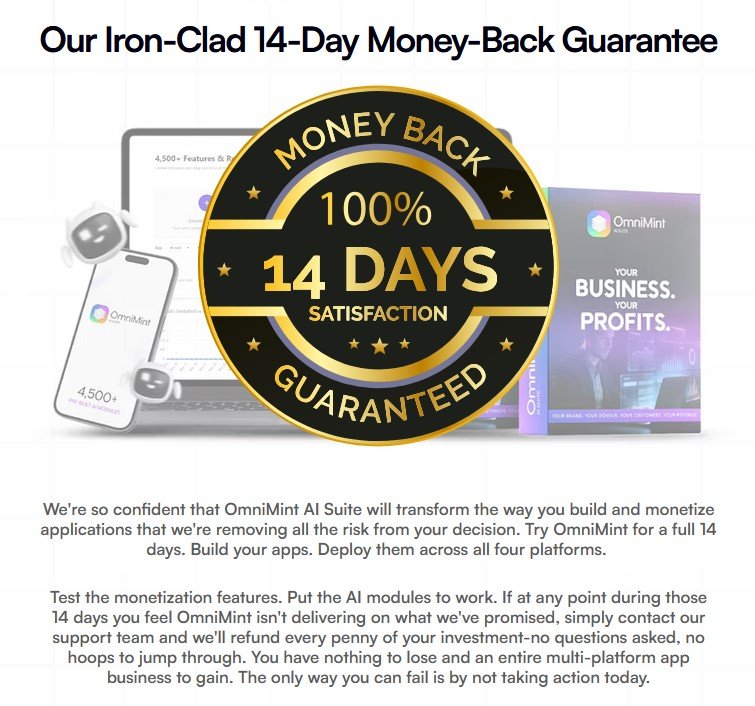
Yes, you’re protected by a 14-day money-back guarantee. Try it, build apps, deploy them – if it isn’t for you, you get a full refund.
What happens after I collect $50,000 in revenue?
Commercial License: 10% platform fee applies after $50,000 collected
PRO Bundle: ZERO platform fees at any revenue level (keep 100%)
Will the price increase later?
Yes. Launch pricing is only available for a limited time. After launch window closes, prices increase and some bonuses disappear.
What makes OmniMint different from other app builders?
OmniMint is the only platform that:
- Deploys to FOUR platforms simultaneously (not just one)
- Includes 1,000-4,500+ pre-built AI modules
- Has built-in monetization with Stripe + 5 payment gateways
- Offers complete white-label control with zero platform branding
Nice Review.
Thanks for sharing.
This answered all my questions. Nice work.