Introduction: AudioMint Review
What Makes AudioMint So Talked About?
If you’ve been looking for an AudioMint review, you’ve probably already seen the kind of bold claims that surround it.
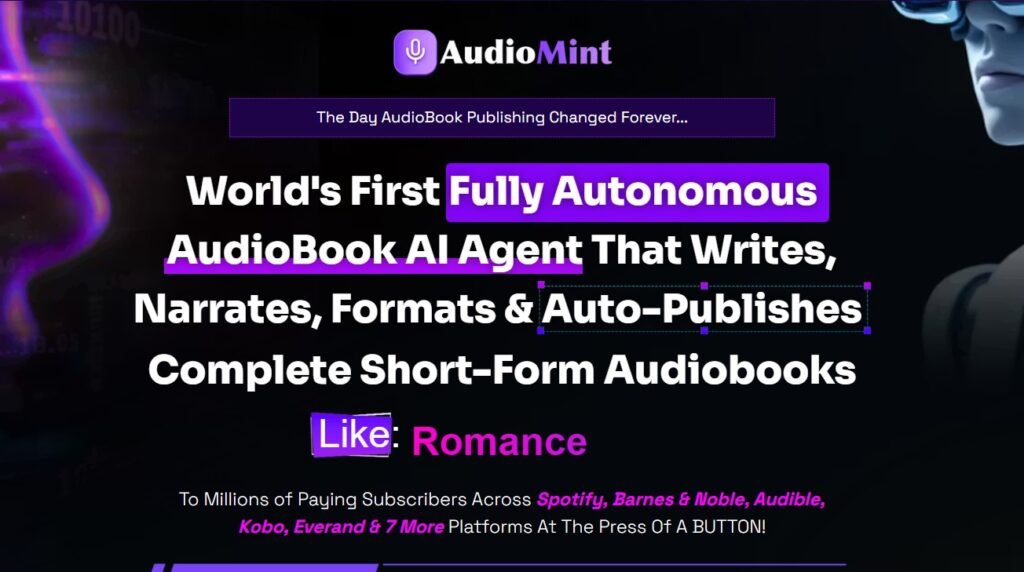
It’s marketed as a fully autonomous audiobook AI agent that can write, narrate, format, package, and distribute short-form audiobooks with very little human input. According to the sales material, you can choose a genre, press a button, and watch the system generate content for platforms like Spotify, Audible, Apple Books, Kobo, Barnes & Noble, Everand, and others.
That is a huge promise.
And to be fair, it is also the kind of promise that makes people stop scrolling.
Because if a system truly handled the full audiobook workflow—from idea generation to final distribution—it could remove some of the biggest barriers in self-publishing:
- writing time
- narration costs
- editing and mastering
- formatting headaches
- technical uploads
- platform optimization
That’s why AudioMint is getting attention. It is not being sold as a simple text generator or a basic voice app. It is being positioned as an end-to-end audiobook production machine.
In this review, I’m going to break it down in plain English:
- what it is
- what it claims to do
- how it works
- what the strengths are
- where the limitations may be
- and whether it seems worth your attention
I’ll keep this honest, detailed, and beginner-friendly.
Overview: AudioMint Review
Vendor: Seun Ogundele
Product: AudioMint
Launch Date: 2026-Apr-10
Front-End Price: $17
Discount:Grab Your Early Bird 30% Discount with Coupon Code: AMT30OFF
Niche: Affiliate Marketing, Artificial Intelligence, Digital Marketing, AI Audio book Agent, AI Audio book Publishing, Audio book Automation, Publish Audio books Online, Passive Income Online
Guarantee: 30-days money-back guarantee
Recommendation: Highly recommended
Support: https://fpsupportdesk.com
Contact Info: https://www.facebook.com/oluwaseunsteven l Skype: Shegdirect

AudioMint Review: What Is AudioMint?
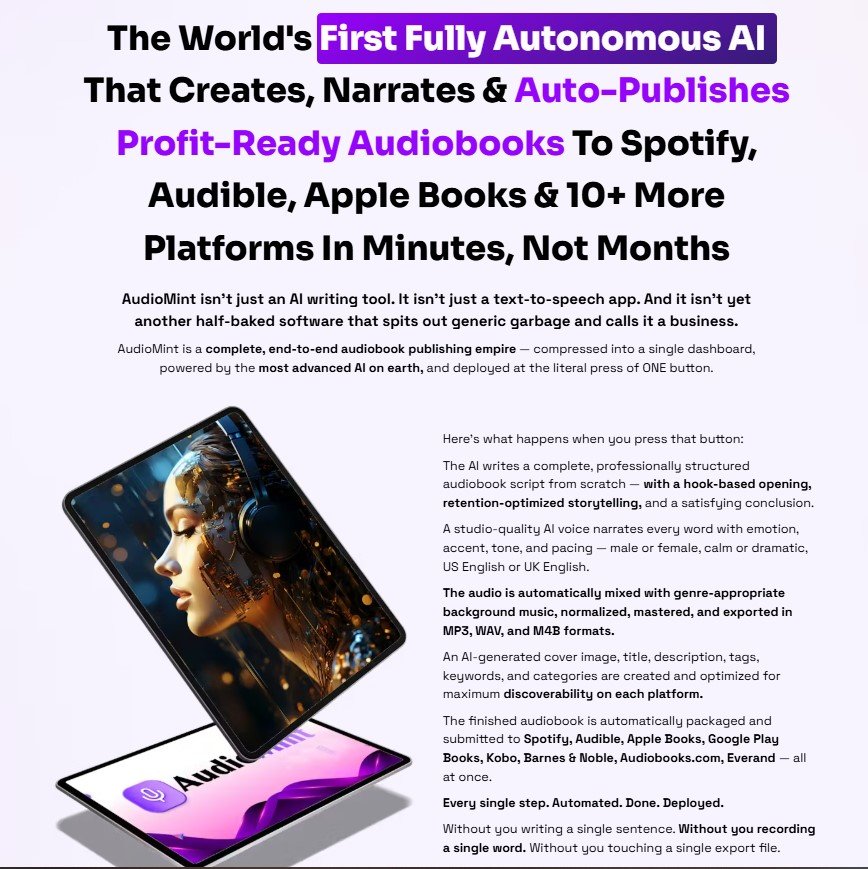
AudioMint is presented as an AI-powered audiobook publishing system designed specifically for short-form audiobooks.
Instead of manually building an audiobook from scratch, the system claims to automate the full process:
- choose a niche or genre
- generate a script
- convert it into narration
- add production polish
- prepare metadata and packaging
- distribute to multiple platforms
The key selling point is that AudioMint does not just “assist” the creator. It aims to replace a large part of the traditional audiobook production workflow.
That makes it different from:
- standard AI writing tools
- basic text-to-speech software
- audio editing apps
- freelance narration marketplaces
- manual publishing workflows
The focus here is automation at scale.
The platform is especially designed for content types that are popular in audio:
- sleep stories
- romance
- true crime
- children’s stories
- self-help
- finance
- horror
- history
- science
- parenting
- cozy fiction
- psychological thrillers
- romantasy
- cottagecore-style storytelling
So, in simple terms, AudioMint is being positioned as a shortcut for people who want to create a catalog of short, bingeable audiobooks without building a full production team.
About The Creator: AudioMint Review

Through AudioMint, one of the men who have been quietly making ripples in the digital marketing and software arena over a decade is Seun Ogundele. Seun did not just wake up one day and determine to create another gimmicky AI application. He began with digital marketing and software development, building useful tools that assist ordinary people to start and expand their businesses on the Internet. He may be familiar to you with his previous work, such as MarketSuite, ChannelAgent, SearchAI, RankAgent and WebMint, all in the effort to automate and eliminate the busywork.
One thing that is conspicuous about Seun is that he is no-nonsense. He is not a flaunty guru who lives on fads. He develops tools on things that he has encountered and experienced in real life and also those things that he has seen people having difficulties with. He is also a coach of online business and online marketing, simplifying complicated matters into steps that can be easily remembered and implemented. In AudioMint, that pragmatic attitude is reflected. It does not have a lot of bells and whistles that you will never want to use. Each feature is designed to leave the logistics to you, so you can concentrate on performance – or more precisely, checks in your pocket.
I used the support channels when I was testing and the responsiveness was supportive of the impression of a real person behind the product. No corporate runaround. Nothing more than simple assistance in need. Such a high creator engagement makes me sure that AudioMint will continue to be updated with the changes in the audiobook world.
Why Short-Form Audiobooks Are a Big Opportunity Right Now
One of the smartest parts of AudioMint’s positioning is that it focuses on short-form audiobooks.
That matters more than many people realize.
A lot of creators assume audiobooks must be long, traditional, and heavily produced. But modern listening habits are changing.
People now consume audio in short sessions:
- on commutes
- during walks
- before sleep
- while cleaning
- at the gym
- while doing repetitive work
That means shorter listening experiences can fit the real world better than long, demanding ones.
Short-form audiobooks can work especially well because they are:
- easier to produce
- faster to publish
- easier for listeners to finish
- more suitable for niche content
- more repeatable as a content strategy
A big part of the appeal of AudioMint is that it tries to serve this exact market.
Instead of competing with long-form, expensive, studio-produced audiobooks, it focuses on faster, lighter, high-demand listening formats where speed and volume may matter more.
That is a strong strategic angle.
If the platform can really help users create good-quality short audiobooks quickly, it could be useful for:
- solo creators
- digital publishers
- agencies
- authors
- coaches
- content marketers
- niche marketers
- faceless brand builders
Watch The Sales Video: AudioMint Review
How AudioMint Works: AudioMint Review
The Basic Process
According to the product messaging, AudioMint works in three simple steps.
Step 1: Choose a Genre or Idea
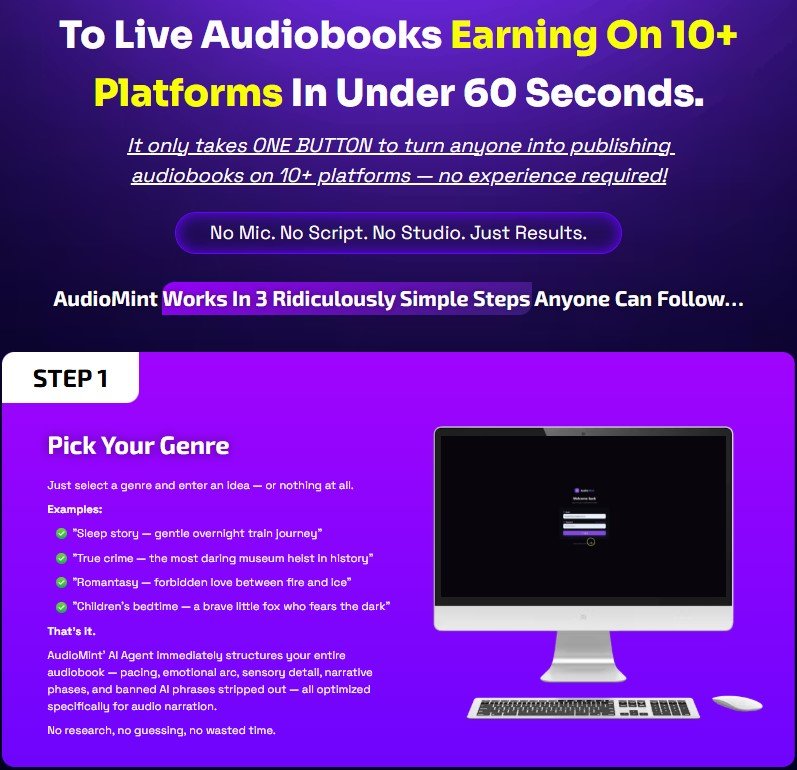
You select a category such as:
- sleep story
- romance
- true crime
- children’s bedtime
- finance
- self-help
- horror
- romantasy
You may also enter a seed idea or prompt.
Step 2: Let the AI Build the Audiobook
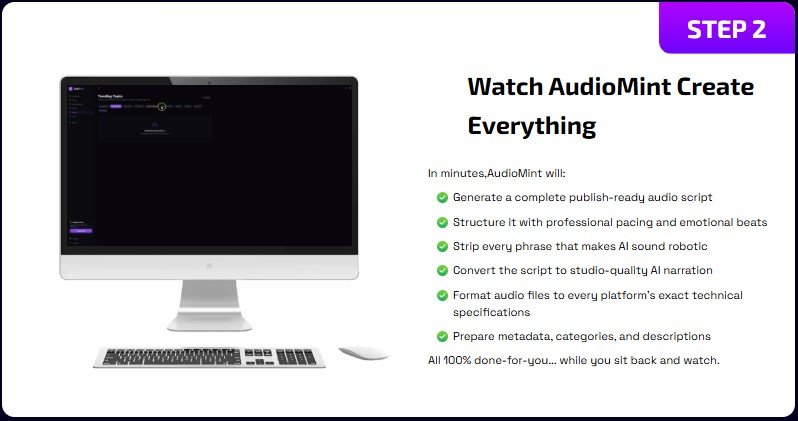
AudioMint is said to:
- write the script
- structure it for audio pacing
- create narration-ready content
- generate a human-like voiceover
- add production elements
- prepare metadata and cover assets
Step 3: Publish Across Multiple Platforms
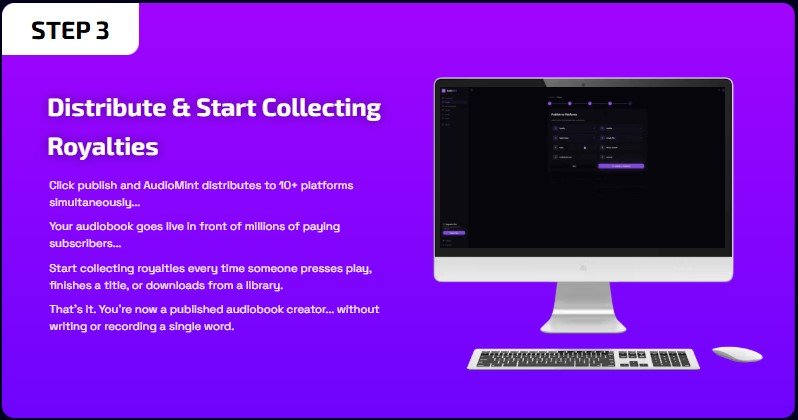
Once the audiobook is ready, the system supposedly pushes it to a network of audio and book platforms automatically.
That means you are not just getting a file. You are getting a workflow that aims to end in distribution.
This is important because many tools stop at content generation. AudioMint is trying to go much further.
Watch The Demo Video: AudioMint Review
Features Breakdown: AudioMint Review
Now let’s look at the core features one by one.
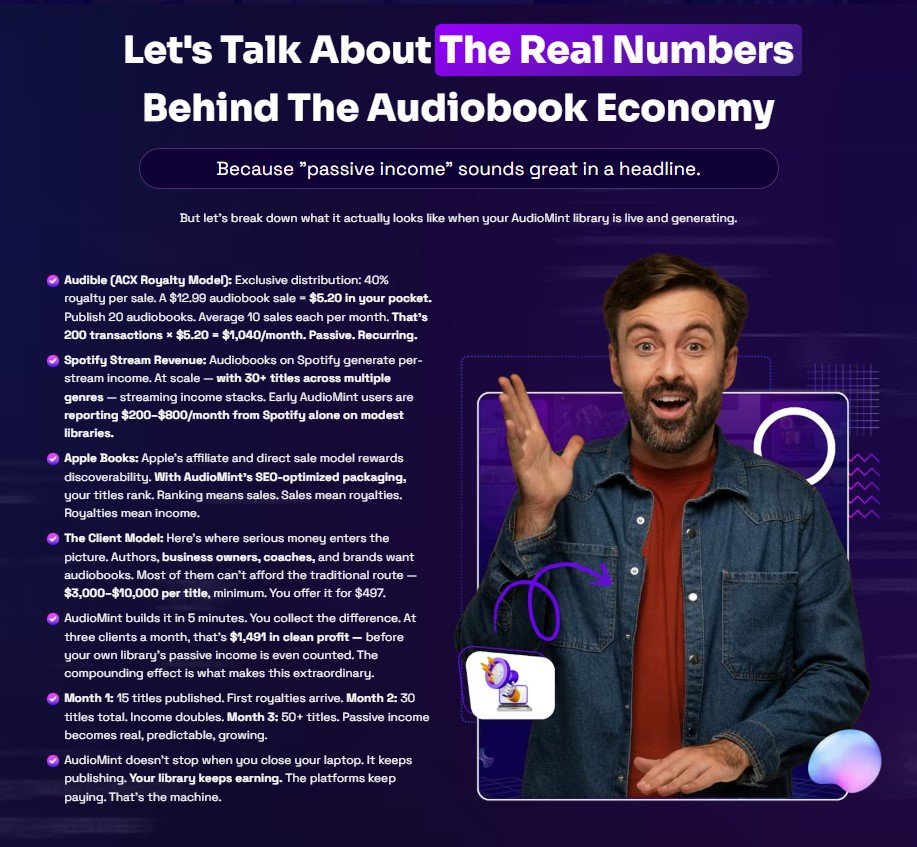
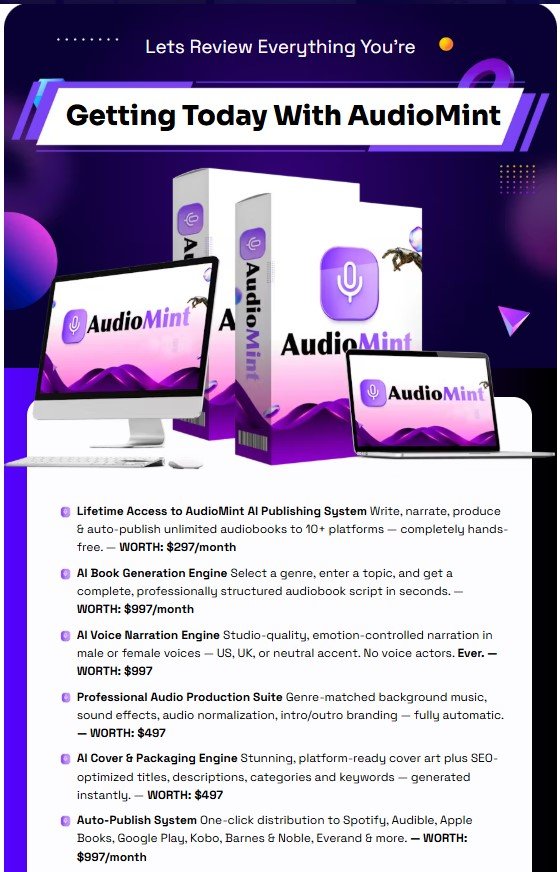
1) AI Book Generation
One of the biggest features is the script-building engine.
The idea is that you don’t start with a blank page. You start with a genre, a topic, or a theme, and the system helps create a full audiobook script.
This is attractive because a lot of people struggle at the very beginning:
- What topic should I choose?
- How long should the script be?
- What structure works best for audio?
- How do I keep people listening?
AudioMint claims to solve this by using prebuilt frameworks for different niches.
That is useful, at least in theory, because a sleep story should not be written like a true crime script, and a children’s bedtime story should not sound like a finance guide.
Genre-specific structure matters.
If the system really adapts its writing style to the format, that could help create more listener-friendly content.
2) AI Narration
Audio narration is one of the biggest expenses in traditional audiobook production.
You usually need:
- a voice actor
- recording equipment
- a quiet space
- editing software
- mastering skills
- time
AudioMint claims to bypass all of that with built-in AI narration.
According to the sales copy, the voices are designed to sound human-like and natural rather than robotic.
That is critical, because poor narration ruins even strong content.
The main question is not whether AI narration exists. It does.
The real question is whether the narration quality is good enough for commercial audiobook use.
That can vary by:
- voice model
- genre
- pacing
- emotional tone
- audio cleanup
- platform expectations
If AudioMint can produce narration that feels smooth, clear, and emotionally appropriate, that would be a serious advantage.
3) Audio Formatting and Mastering
A lot of first-time audiobook creators underestimate the technical side.
It is not enough to record audio and upload it.
You need:
- proper file formats
- volume normalization
- mastering
- clean chapter structure
- platform-compliant specifications
- sample requirements
- metadata accuracy
AudioMint claims to handle this automatically.
That is a strong selling point for beginners because technical formatting is one of the biggest friction points in publishing.
If the tool truly handles file prep correctly, it may save users a huge amount of time and frustration.
4) Cover Creation and Packaging
Audiobooks do not sell on audio alone.
Presentation matters:
- cover art
- title
- subtitle
- description
- genre tags
- keywords
- categories
AudioMint says it generates these elements too.
That makes sense because discoverability is a major part of success on any marketplace. Even a good title can underperform if the cover looks weak or the metadata is poorly optimized.
If the platform helps generate professional-looking packaging, that gives users a better shot at standing out.
5) Multi-Platform Distribution
This is one of the biggest claims.
AudioMint is marketed as a system that can publish to major platforms such as:
- Audible
- Spotify
- Apple Books
- Google Play Books
- Kobo
- Barnes & Noble
- Everand
- Audiobooks.com
- library networks
- and more
If true, this is where the product becomes much more than a content tool.
It becomes a distribution system.
That matters because many creators can make content, but very few can easily distribute it across multiple platforms without a mess of manual uploads, formatting requirements, and account setup.
For a beginner, that could be a very attractive advantage.
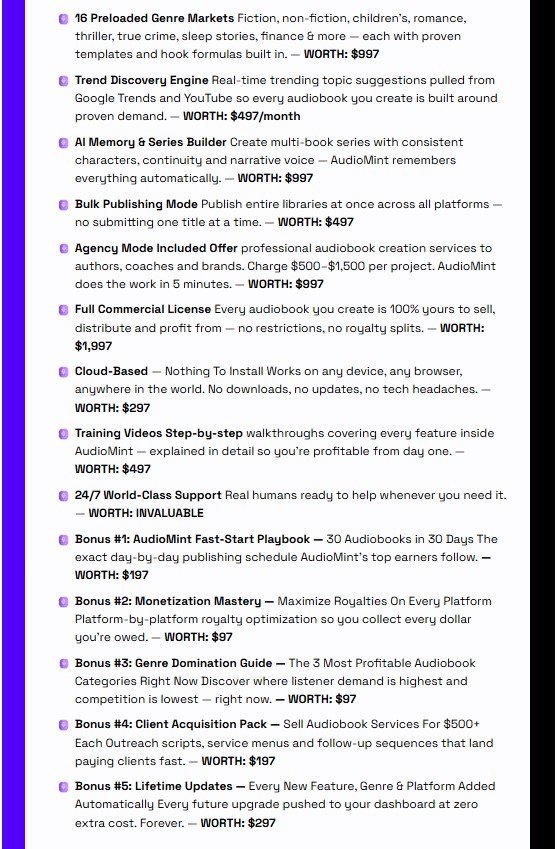
6) Genre Frameworks
AudioMint claims to include multiple genre-specific frameworks.
This is a smart feature on paper because different genres have different listener expectations.
For example:
- sleep stories need soft pacing and soothing language
- true crime needs tension and structure
- romance needs emotional rhythm and payoff
- children’s stories need age-appropriate language and simple flow
- self-help needs clarity and practical value
- horror needs atmosphere and buildup
The concept of built-in frameworks is better than relying on generic prompts.
Why?
Because generic AI output often feels flat.
A good framework can help shape:
- pacing
- tone
- structure
- emotional arc
- hook quality
- retention
That is exactly what short-form audio needs.
7) Trend Discovery
Another interesting claim is the trend discovery feature.
This is meant to help users identify topics that people are already searching for.
That could be useful because many beginners fail not because they create bad content, but because they create content nobody wants.
If the tool can help users spot rising topics, that may improve the odds of publishing something with demand behind it.
Still, trend tools should always be treated carefully:
- trends can be temporary
- keyword interest does not always equal buyer intent
- high-demand niches can also be competitive
- platform-specific demand can differ
So yes, trend discovery is helpful, but it should not be used blindly.
8) AI Memory and Series Building
AudioMint also claims to help creators build series and maintain continuity.
That is important because series-based content tends to perform better than one-off uploads in many publishing models.
Series can encourage:
- repeat listeners
- stronger catalog value
- more predictable publishing
- brand consistency
If AudioMint remembers characters, tone, or story patterns well, it could help creators produce interconnected content without manually tracking everything.
That would be a useful feature for fiction and recurring niche content.
9) Commercial License and Agency Mode
One of the most interesting elements is the claimed commercial use angle.
That means users may be able to create audiobooks not only for themselves, but also for clients.
That could open the door to a service model such as:
- audiobook creation services
- publishing services
- content packaging services
- AI-assisted audio production for authors and coaches
This is important because many business buyers want audiobooks but do not want to learn the technical process.
If the system genuinely reduces production time, a service provider could potentially offer a done-for-you audiobook package.
That said, anyone planning to sell services should still be careful:
- understand platform rights
- clarify licensing
- know what the client owns
- ensure the output is unique
- confirm compliance with platform rules

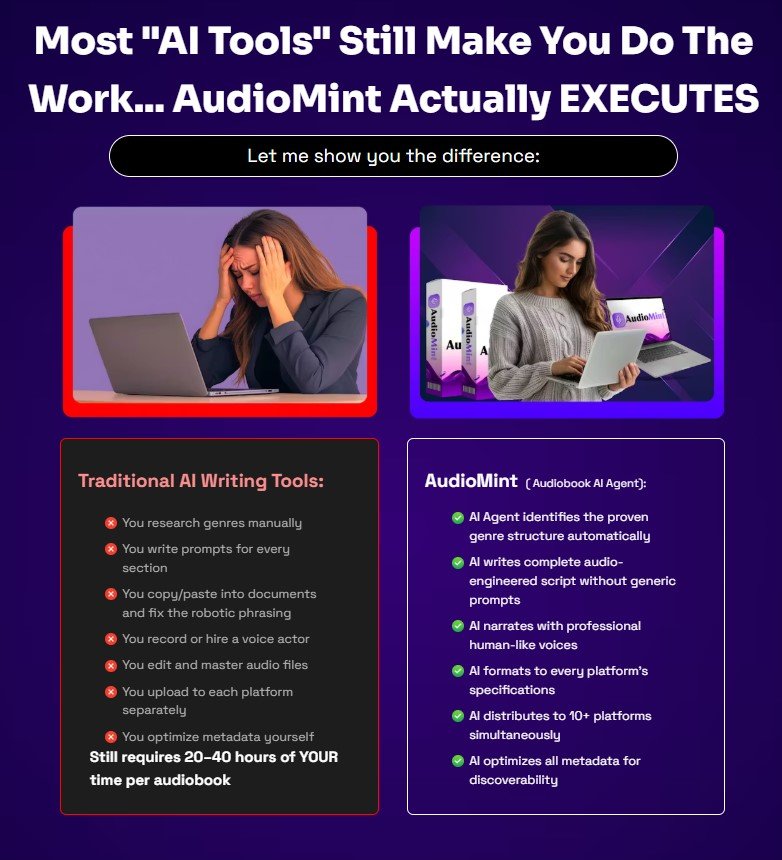
What Makes AudioMint Different From Ordinary AI Tools?
This is the part where the product tries to separate itself from the crowd.
A lot of tools call themselves “AI-powered,” but in practice they only do one part of the job:
- one tool writes
- one tool narrates
- one tool edits
- one tool creates cover art
- one tool handles upload prep
That still leaves the creator doing everything else.
AudioMint’s core promise is that it works more like an agent than a tool.
In other words:
- you do not micromanage every step
- you do not stitch together multiple software products
- you do not manually run a production pipeline
- you do not depend on a team of freelancers
Instead, the system tries to automate the entire workflow.
That is the big selling idea.
If it truly works as marketed, then its value is not in one feature. It is in the chain of features working together.
And that is often what users are really paying for:
- less friction
- less learning curve
- less decision fatigue
- less manual labor
- faster publishing cycles

The Monetization Angle: AudioMint Review
How People Might Use AudioMint to Make Money
Let’s talk about the money side carefully and realistically.
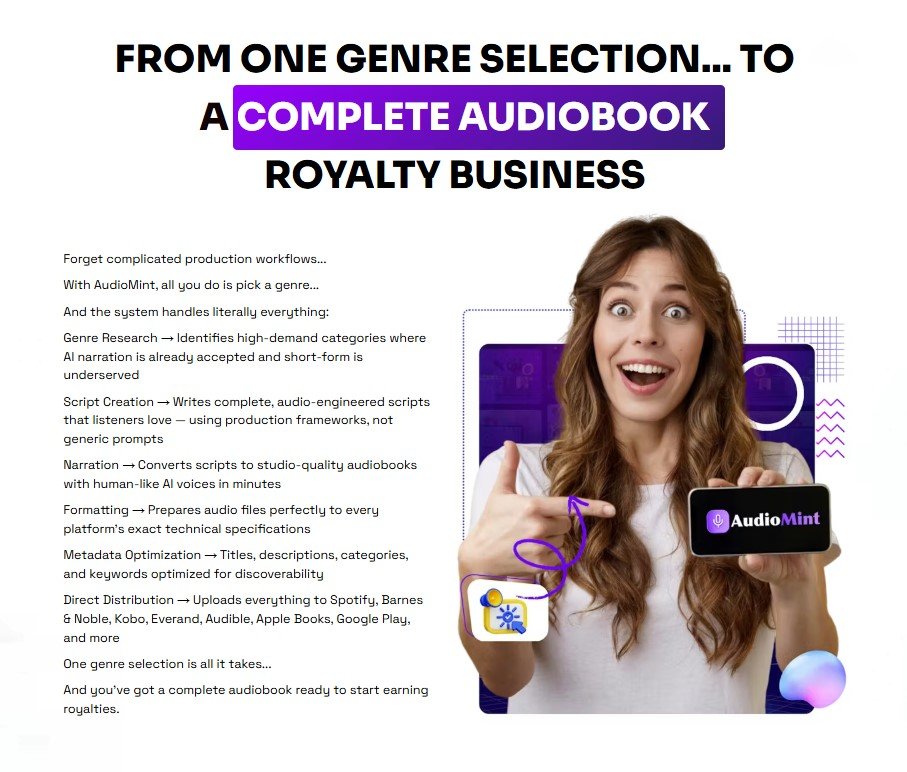
The marketing material suggests several monetization paths:
- publish your own audiobook catalog
- earn platform royalties
- publish across multiple platforms
- offer audiobook services to clients
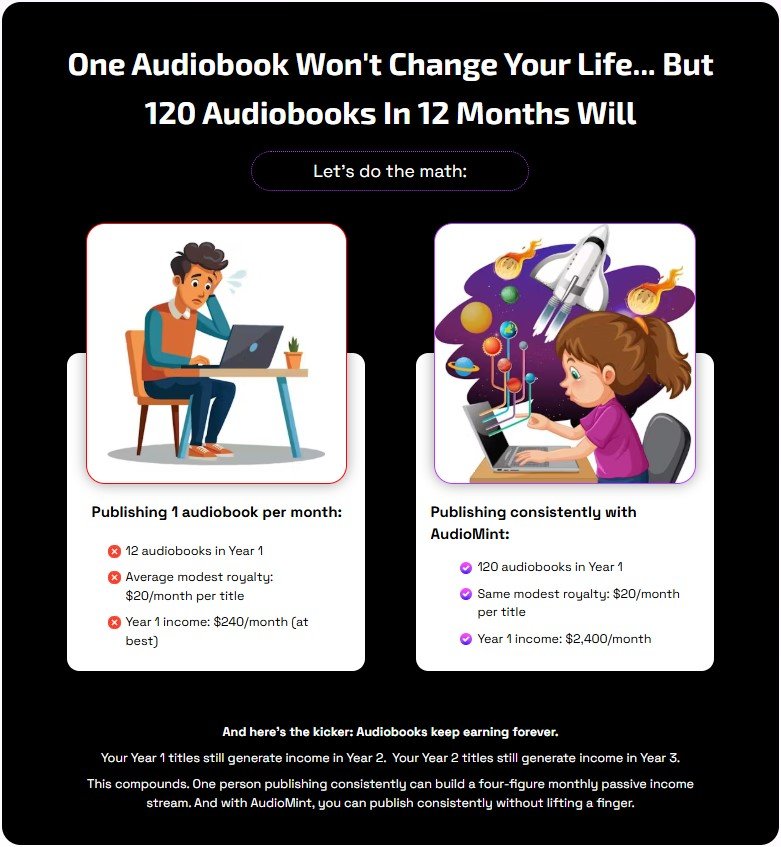
- build a catalog that compounds over time
That is the general idea.
1) Catalog-Based Royalty Income
The simplest model is to publish audiobooks and collect royalties.
This works best when:
- you publish regularly
- your topics are in demand
- your packaging is strong
- your audio quality is acceptable
- your listings are discoverable
The power of a catalog is cumulative. One title may earn little, but many titles can create a steady flow over time.
2) Service-Based Income
If you create audiobooks for clients, you may be able to charge a project fee.
This is often attractive because it can produce quicker cash flow than waiting on royalties.
Potential clients may include:
- authors
- coaches
- educators
- brands
- niche publishers
- course creators
3) Multi-Platform Distribution
Publishing to more than one platform can improve exposure.
But remember: different platforms behave differently. What works well on one may not work as strongly on another.
4) Niche Testing
AudioMint may also be useful for niche experiments.
Instead of spending weeks testing one idea, users can explore several genres and see what sticks.
That is powerful if the tool truly lowers the cost of publishing.
Important Reality Check: AudioMint Review
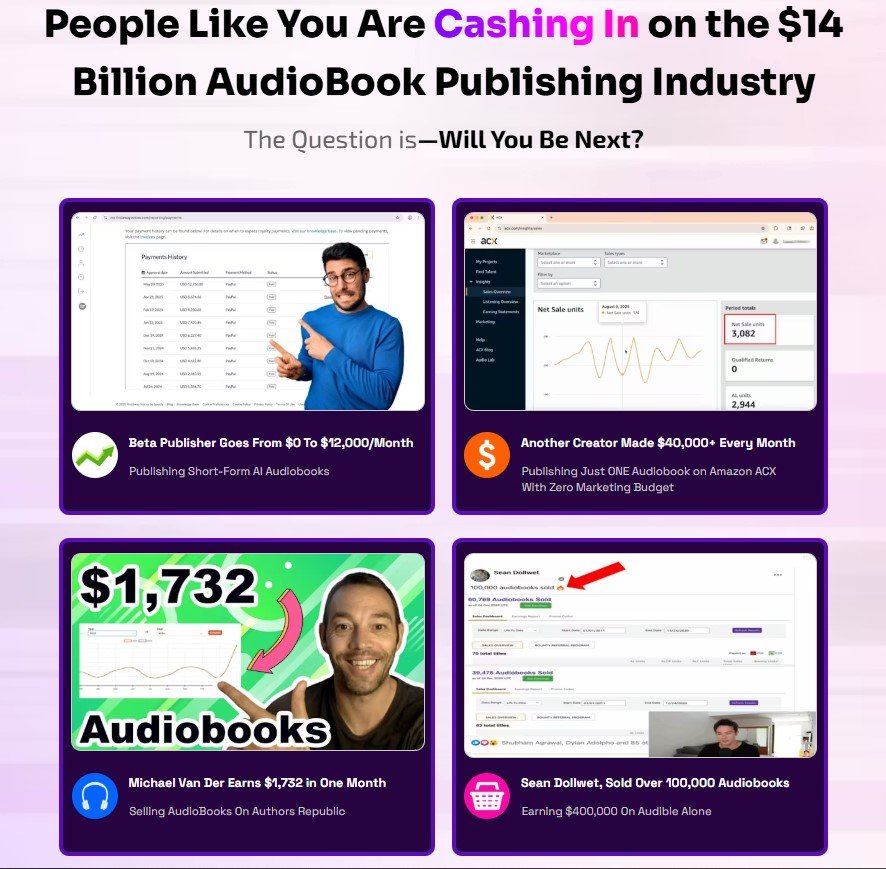
Revenue Claims Should Be Treated Carefully
The marketing for AudioMint makes strong income claims.
That is common in product launches.
But a good review should be honest: results are never guaranteed.
Income depends on:
- topic selection
- quality of output
- listener demand
- platform approval
- competition
- metadata quality
- pricing
- audience behavior
- consistency
- platform rules
So while the tool may help reduce production barriers, it does not automatically guarantee income.
It is a publishing system, not a money printer.
That distinction matters.

Pros of AudioMint: AudioMint Review
Here are the strongest potential advantages based on the available product information.
1) Massive Time Savings
The biggest benefit is automation.
If the workflow actually works as described, it could save hours or even days per project.
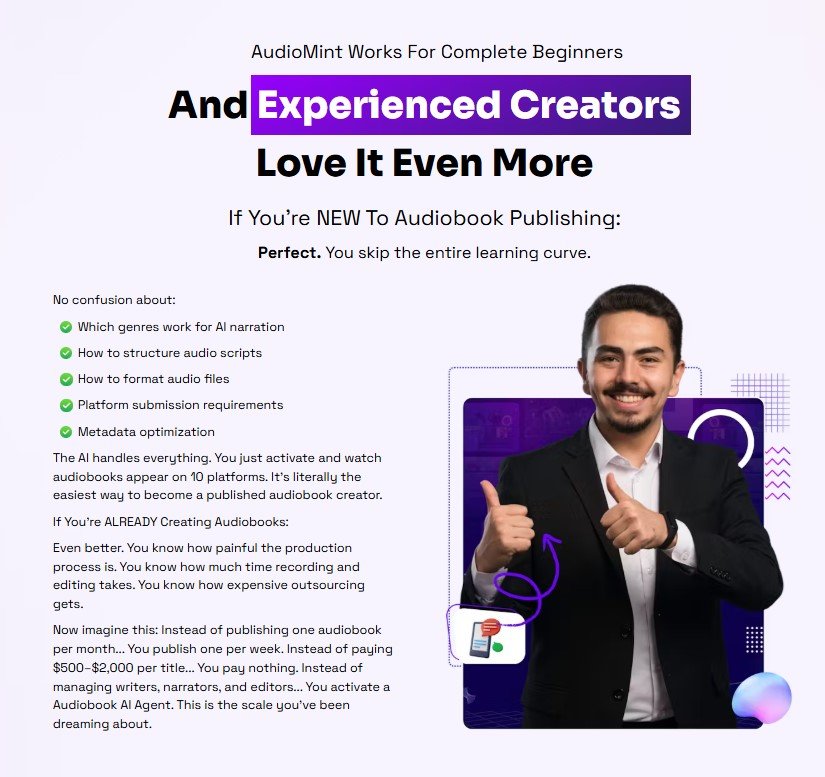
2) Beginner-Friendly
No mic. No studio. No editing experience. No technical publishing background.
That makes it appealing to beginners.
3) Short-Form Focus
A lot of creators ignore short audio formats. That leaves room for faster production and experimentation.
4) Multi-Platform Reach
Publishing in multiple places from one system is convenient and scalable.
5) Reduced Production Costs
Traditional audiobook production can be expensive. Automation could reduce that burden significantly.
6) Built-In Genre Frameworks
This is a practical feature because different audio categories need different structures.
7) Commercial Potential
If the licensing is as described, users may be able to use it for services, not just personal publishing.
8) Scalability
Once a workflow is streamlined, users may be able to publish more frequently.
Cons and Possible Concerns: AudioMint Review
No review is complete without the downsides.
1) Quality May Vary
AI output quality can vary based on the model, prompt, genre, and editing layer.
2) Platform Approval Is Never Guaranteed
Even if a tool prepares files, final acceptance depends on platform standards.
3) Overpromising Is a Risk
Sales pages often sound more dramatic than real-world results.
4) AI Narration May Not Suit Every Genre
Some audiobook categories may still benefit from human narration.
5) Market Saturation Is Possible
If many users create similar titles, competition could rise.
6) You Still Need Strategy
Automation does not replace niche strategy, good packaging, or good topic selection.
7) Ethical and Disclosure Issues
Creators should pay attention to rights, disclosure expectations, and content originality.
Who Is Best For: AudioMint Review
AudioMint may be a good fit for people who want to:
- publish audiobooks faster
- avoid recording themselves
- create short-form audio content
- build a catalog
- test multiple niches
- offer audiobook services
- use AI to reduce production costs
- focus on quantity and speed
It may especially appeal to:
- beginners
- marketers
- indie publishers
- agency owners
- content entrepreneurs
- authors with no narration setup
- side hustlers looking for scalable digital assets
Who Is Probably Not For: AudioMint Review
AudioMint may not be ideal for people who:
- want complete creative control over every sentence
- prefer human narration for artistic reasons
- dislike AI-generated content
- are looking for a fully passive “set it and forget it” miracle
- expect instant income without testing or iteration
- want traditional, premium, long-form audiobook craftsmanship
If you want a deeply literary, award-level audiobook production process, this probably is not the right fit.
If you want speed, automation, and catalog building, it may be more relevant.
AudioMint vs Traditional Audiobook Production: AudioMint Review
This comparison is where the appeal becomes obvious.
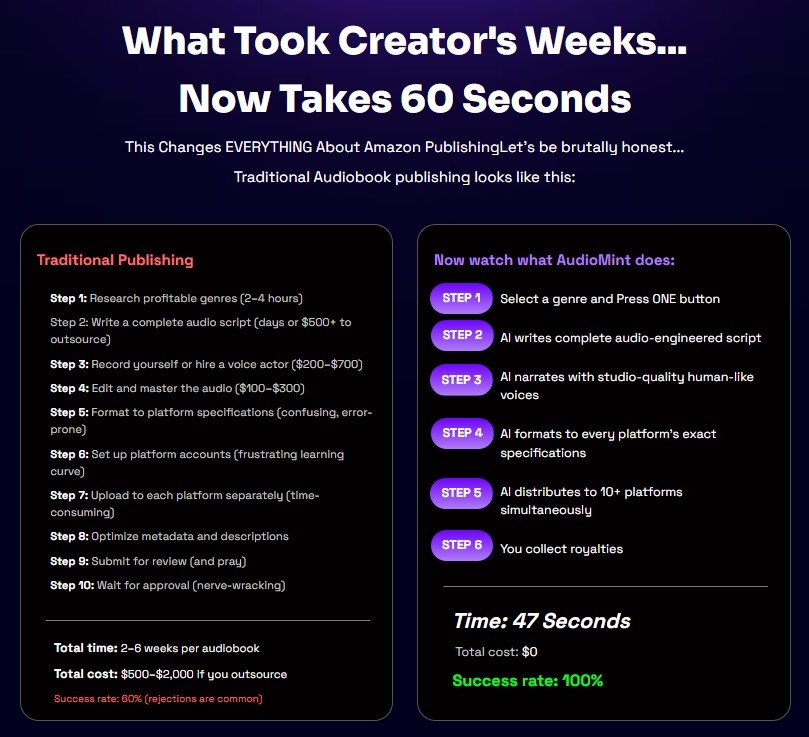
Traditional Workflow
Traditional audiobook production usually involves:
- research
- writing or hiring a writer
- recording
- retakes
- editing
- mastering
- cover design
- metadata work
- platform uploads
- approvals
- waiting
That takes time and money.
AudioMint Workflow
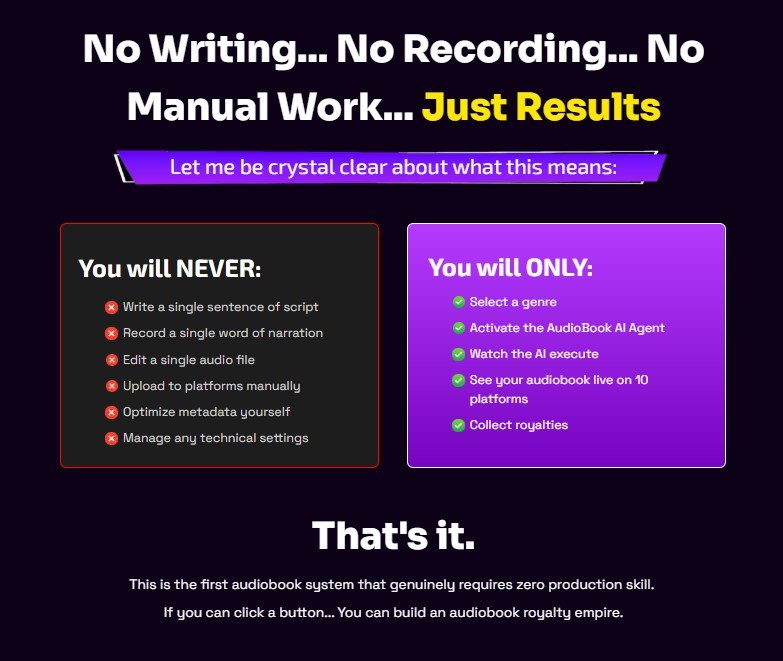
AudioMint tries to compress the whole process into a much simpler pipeline:
- choose a niche
- generate content
- narrate automatically
- package automatically
- publish automatically
The difference is not small. It is structural.
Traditional production is labor-heavy.
AudioMint is trying to be automation-heavy.
AudioMint vs Generic AI Writing Tools: AudioMint Review
This is another important comparison.
A generic AI writer can help you draft content, but it usually does not:
- understand audiobook pacing
- format for narration
- generate a complete production workflow
- create audio files
- handle publishing
- manage platform specs
So if AudioMint truly combines those steps, it is more specialized than a normal AI writer.
That specialization may be its biggest strength.
Bonuses: AudioMint Review
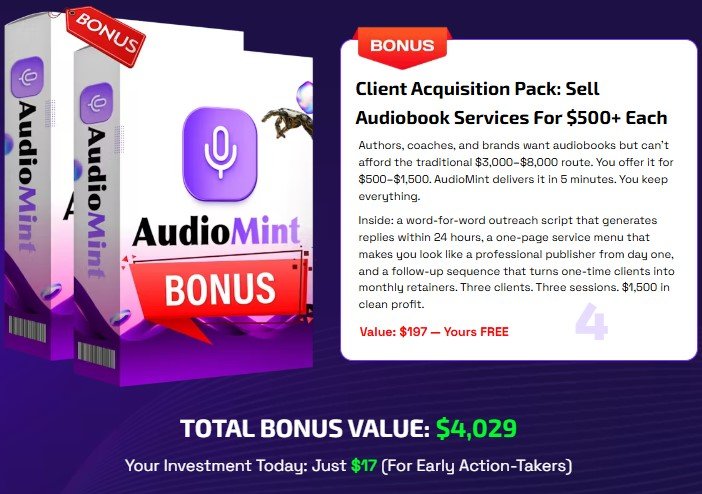
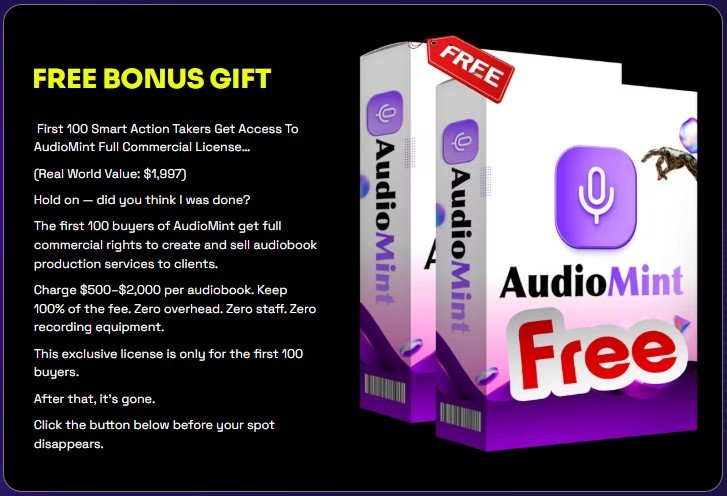
Pricing and Guarantee: AudioMint Review
According to the promotional material, AudioMint is sold as a one-time payment rather than a recurring subscription, and it includes a money-back guarantee.
That is attractive because many tools in this space rely on monthly fees.
If the product is indeed a one-time purchase with commercial rights included, then the value proposition becomes easier to understand:
- pay once
- use the system
- keep the upside
- avoid ongoing software bills
However, pricing can change, and offers can be time-sensitive. Always confirm the current checkout terms before purchasing.
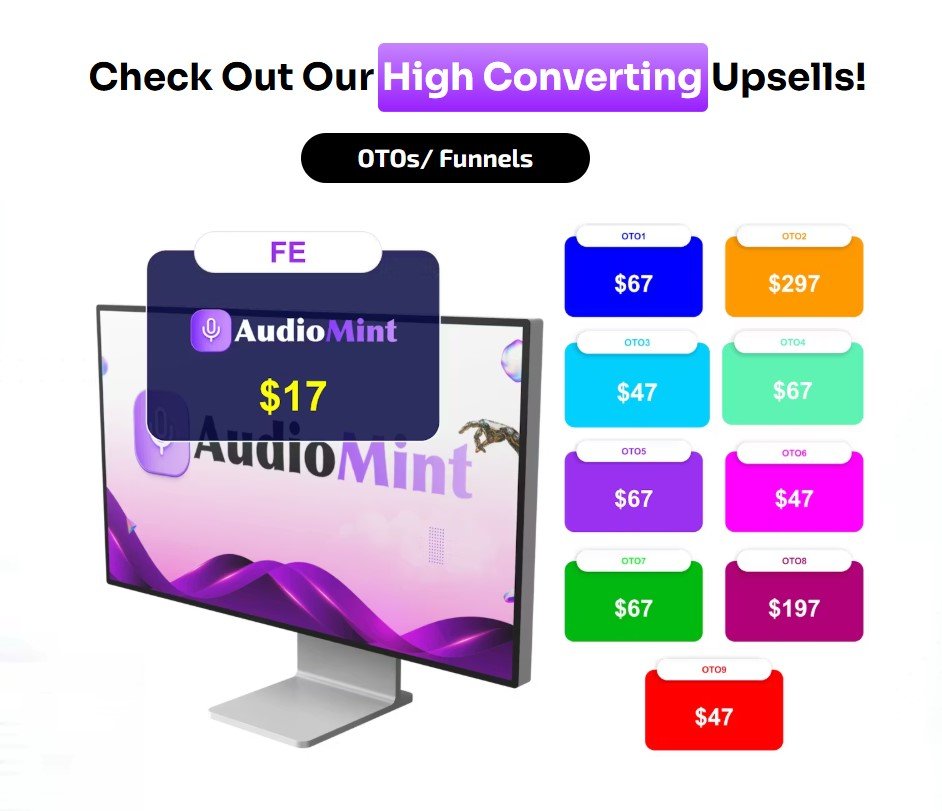
💰 AudioMint Pricing & OTO Funnel
🟢 Front-End Offer
| Plan | Price | Details |
|---|---|---|
| AudioMint (FE) | $17 (One-Time) | Full access to AudioMint core features during launch |
🎟️ Discount Coupons
| Coupon Code | Discount |
|---|---|
| AMT3OFF | $3 OFF |
| AMT5OFF | $5 OFF |
| AMT20OFF | 20% OFF |
🚀 AudioMint OTOs (Upsells Breakdown)
| OTO | Name | Price | What You Get |
|---|---|---|---|
| OTO 1 | Unlimited Edition | $67 – $167 | Remove all limits, unlimited audiobook creation, keyword research, competitor analysis, and scale to $10K/month |
| OTO 2 | DFY Edition | $197 – $297 | Done-for-you setup, campaigns, and systems with a results guarantee |
| OTO 3 | Automation Edition | $47 | 24/7 AI automation for traffic and sales |
| OTO 4 | Income Booster Edition | $47 | Instant profit boosts and faster results |
| OTO 5 | Limitless Traffic Edition | $97 | Access to proven buyer traffic (1,000–2,000 clicks) |
| OTO 6 | Automated $10K Profit Edition | $47 – $67 | DFY campaigns designed to scale to $5K–$20K/month |
| OTO 7 | Mobile Payday Edition | $47 | Fully mobile system, work from anywhere |
| OTO 8 | Reseller Edition | $197 | Sell AudioMint and keep 100% profits |
| OTO 9 | DFY Profit Site Edition | $27 – $47 | Ready-made profit site with recurring income potential |
✅ Risk-Free Guarantee
All upgrades come with a money-back guarantee, so you can try everything with full confidence.
Ethical and Practical Considerations: AudioMint Review
This is important, especially if you plan to publish at scale.
1) Originality Matters
Even if AI helps write the content, you should avoid publishing repetitive or low-value material.
2) Platform Rules Matter
Each platform has its own submission standards and content policies.
3) Disclosure May Matter
Depending on the marketplace and legal environment, you may need to consider how AI-generated content is represented.
4) Quality Still Matters
Automation helps, but the end product still needs to be listenable and useful.
5) Don’t Ignore Copyright and Rights
Make sure the content, assets, music, and voices are properly licensed.
A good AI system can help production, but the creator is still responsible for using it correctly.
Realistic Expectations: AudioMint Review
What AudioMint Can and Cannot Do
Let’s be practical.
AudioMint Can Potentially:
- speed up audiobook creation
- reduce manual work
- simplify narration
- reduce production costs
- help beginners get started
- support multi-platform publishing
- help users test niches faster
AudioMint Cannot:
- guarantee sales
- guarantee approval on every platform
- guarantee quality in every genre
- replace smart publishing decisions
- remove the need for judgment
- make weak content magically perform
That is the honest balance.

Final Verdict: AudioMint Review
Is AudioMint Worth It?
Here’s my honest take.
AudioMint looks interesting because it solves a real problem. Audiobook production is slow, expensive, and technical. If a system can reduce that friction and automate the workflow from script to distribution, that is a meaningful innovation.
Its biggest strengths are:
- automation
- short-form focus
- multi-platform publishing
- genre templates
- low barrier to entry
- commercial use potential
Its biggest risks are:
- inflated marketing
- output quality variation
- platform compliance issues
- over-reliance on AI without strategy
So is it worth it?
If you are looking for a way to build or test an audiobook publishing workflow without the traditional headaches, AudioMint may be worth a serious look.
If you expect effortless riches with zero effort and zero oversight, you should be careful.
The smartest way to think about it is this:
AudioMint is not just a writing tool. It is a publishing automation concept aimed at making audiobook creation faster, simpler, and more scalable.
That alone makes it notable.
Conclusion: AudioMint Review
If you came here looking for an AudioMint review, the bottom line is simple:
AudioMint is being positioned as a radical shortcut for audiobook creation and publishing. Instead of making you juggle writing, narration, formatting, and distribution separately, it claims to compress the workflow into a more automated system built for short-form audiobooks.
That makes it appealing in a market where speed, catalog size, and discoverability can matter a lot.
It is not magic. It is not a guaranteed income machine. And it should not be treated like a replacement for strategy.
But as an AI-assisted publishing system, it is definitely an attention-grabbing concept with real appeal for creators who want to move faster and do more with less manual effort.
If you want a tool that focuses on automation, catalog building, and multi-platform audio publishing, AudioMint may be worth exploring.
If you want old-school production control, human narration, and fully handcrafted audiobooks, you may want to keep looking.
Either way, one thing is clear:
The audiobook space is changing fast, and tools like AudioMint are a sign that the next wave of publishing may look very different from the old one.
FREQUENTLY ASKED QUESTIONS: AudioMint Review
Q: What Exactly Is AudioMint?
A: World’s First Fully Autonomous AI That Creates, Narrates & Auto-Publishes Profit-Ready Audiobooks To Spotify, Audible, Apple Books & 10+ More Platforms
Q: Do I need any writing or recording experience?
A: Absolutely none. AudioMint generates the entire script, narrates it with professional AI voices, and produces the audio file — completely automatically. If you can select a genre and click a button, you’re qualified.
Q: Are the AI voices really good enough for real platforms?
A: Yes. AudioMint’s narration engine produces studio-quality audio that passes platform review on Audible, Apple Books, Spotify, and others. Our early users have had titles approved and generating income across all major platforms.
Q: How long does it take to create one audiobook?
A: The full process — script, narration, production, packaging, and submission — takes under 5 minutes from button press to publishing. Compare that to the traditional 6–8 week process.
Q: Can I really publish to Spotify and Audible automatically?
A: AudioMint’s Auto-Publish System handles platform-specific formatting and submission workflows for 10+ platforms including Spotify, Audible (ACX-compatible export), Apple Books, Google Play Books, Kobo, Barnes & Noble, Audiobooks.com, and Everand.
Q: What is the Commercial License?
A: The Commercial License means you own every audiobook AudioMint creates for you and have the right to sell, distribute, and profit from them freely — including creating audiobooks for clients and charging for the service.
Q: Is there a monthly fee?
A: Not at today’s launch price. You pay once and own AudioMint forever — with no per-book fees, no monthly subscription, and no hidden costs. This one-time pricing closes when the launch window expires.
Q: What if I want to create a series?
A: AudioMint’s Series Builder handles this automatically. It maintains character memory, narrative continuity, and story arcs across multiple books — so your series feels consistent and professional without you managing any of it manually.
Q: What genres can AudioMint create?
A: 16 preloaded genres spanning Fiction and Non-Fiction: Horror & Thriller Shorts, Psychological Thriller, Cozy Stories, Cottagecore Life, Children’s Bedtime Stories, Children’s Educational, Romantasy, Romance Shorts, Sleep Stories, Anxiety & Stress Relief, Science & Wonder, Nature & Wildlife, Money & Finance, Parenting, History, and True Crime.
Q: What happens if I’m not satisfied?
A: You’re covered by our 30-Day Iron-Clad Money-Back Guarantee. Email us within 30 days for any reason — or no reason at all — and we’ll issue a full refund the same day.
Q: How do I make money from this?
A: Multiple streams. Platform royalties every time your audiobook is downloaded or purchased. Stream income every time your title plays on Spotify or other streaming platforms. And client income — using AudioMint’s Commercial License to create audiobooks for businesses, authors, and content creators who will gladly pay $300–$1,500 per title.
FAQ: AudioMint Review
1) Is AudioMint a real audiobook publishing tool?
According to the product information, yes. It is presented as an AI-based audiobook creation and publishing system.
2) Does AudioMint really auto-publish to multiple platforms?
That is the claim. You should verify current platform support and distribution details before buying.
3) Can beginners use AudioMint?
Yes, it appears to be designed for beginners and non-technical users.
4) Does it require a microphone or voice actor?
The sales material says no. It relies on AI narration.
5) Is AudioMint suitable for long audiobooks?
The product seems most focused on short-form audiobooks, though some messaging suggests broader capabilities.
6) Can you use it for client work?
The promotional material suggests a commercial license is included, but you should confirm the exact terms on checkout.
7) Is income guaranteed?
No. Like any publishing business, results depend on demand, quality, and execution.
8) Is it better than traditional audiobook production?
It may be faster and cheaper for some users, but traditional production still has advantages in premium quality and human narration.