Introduction: ClaudHub Review

The world of artificial intelligence is moving at lightning speed. It feels like every week, a new tool, a new model, or a new “game-changer” is announced, promising to revolutionize how we work, create, and even think. But amid this dizzying pace of innovation, a harsh reality has set in for many marketers, freelancers, business owners, and creators: the staggering cost of staying on the cutting edge.
Monthly subscriptions, tiered access plans, and per-use credit systems have become the norm. Accessing the most powerful AI isn’t just a technical challenge; it’s a significant financial commitment. This “AI tax” can easily run into hundreds, if not thousands, of dollars per year, forcing many to settle for less powerful, free alternatives that just don’t deliver the same quality.
But what if there was a different way?
Imagine having a permanent, all-access pass to one of the most sophisticated and powerful AI ecosystems on the planet. Imagine unlocking not just the current top-tier models but all future releases, automatically. Imagine this wasn’t a dream, but a reality available for a single, almost negligible, one-time payment.
This is the audacious promise of a new platform called ClaudHub.
This never-seen-before application claims to be a breakthrough, offering lifetime access to the full suite of Anthropic’s Claude AI models—including the coveted Opus, Sonnet, and Haiku series—without a single monthly fee.
It sounds too good to be true, right? That’s exactly what we thought.
Overview: ClaudHub Review
Vendor: Anirudh Baavra | Amit Gaikwad
Product: Claud Hub
Launch Date: 2026-Apr-14
Front-End Price: 19
Discount: Hurry! Grab Your Early Bird $2 Instant Discount with Coupon Code: CLAUD2OFF
LaunchPad Coupon Code: CLAUD5 ($5 OFF) Full Funnel
Niche: Affiliate Marketing, Artificial Intelligence, Digital Marketing, SEO Tools, AI Tools
Guarantee: 30-days money-back guarantee
Recommendation: Highly recommended
Support: tickets@hyper-softlabs.p.tawk.email
Contact Info: https://teams.live.com/l/invite/FEAcIBY3Z1VSz9wegc?v=g1
https://teams.live.com/l/invite/FEAa7hy5svh-zhSFAs?v=g1

ClaudHub Review: What Is ClaudHub? {#what-is-claudhub}
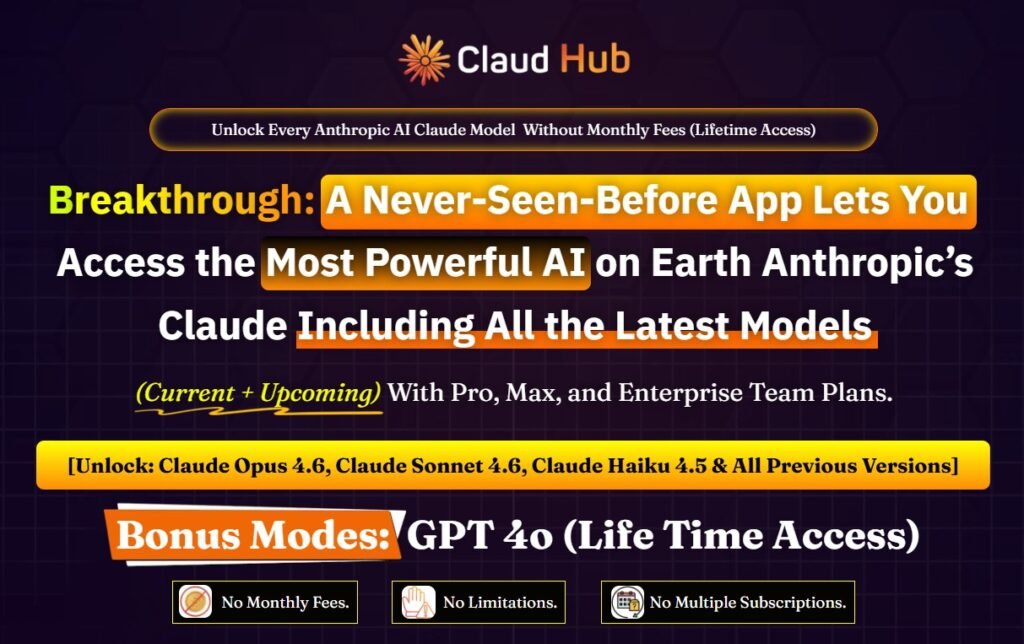
ClaudHub is positioned as a single dashboard that lets you work with Anthropic’s Claude AI models—including multiple model families—without juggling different subscriptions.
The product’s central pitch is simple: ClaudHub Review
- Pay once (a lifetime deal)
- Get instant access to multiple Claude models
- Switch models inside a multi-model chat workspace
- Use built-in prompt templates and output optimization tools
- Avoid paying recurring monthly fees typically associated with premium AI plans
In other words, ClaudHub is marketed as an all-in-one “Claude hub” designed for:
- marketers and copywriters
- creators and YouTubers
- agencies and freelancers
- business owners who need content, ads, emails, scripts, or research
- productivity-focused users who want Claude-like writing quality
If you’ve ever felt like you’re paying for too many AI tools at once (ChatGPT, Claude, Gemini, copywriting assistants, email tools, etc.), ClaudHub is aimed at consolidating that workflow.
Watch The Sales Video: ClaudHub Review
Why Everyone Is Switching to Anthropic Claude (Quick Context): ClaudHub Review
Before you can judge ClaudHub, it helps to understand why Claude has become the “go-to” model for many serious users, especially writers and marketers.
Based on the market perception and the claims in your brief, Claude is widely appreciated for:
1) Strong reasoning and long-form thinking
Claude is often chosen for tasks like: ClaudHub Review
- deep analysis
- strategic planning
- summarizing and restructuring long documents
- creating coherent long-form content
2) Human-sounding writing (a big deal for marketing)
Many people feel Claude outputs:
- a more natural tone
- better transitions and flow
- more “editor-ready” copy
- fewer robotic phrases
That matters if you’re writing sales pages, email sequences, YouTube scripts, or client content where tone directly impacts performance.
3) Large context handling
Claude is known for handling large inputs—useful for:
- dropping in long briefs
- pasting multiple competitor pages
- analyzing a full sales funnel
- turning a long transcript into structured content
4) Reliability and “safer” behavior (relative)
Claude is often positioned as more careful with:
- hallucinations
- overly confident incorrect claims
- unsafe outputs
No model is perfect—but if your work requires accuracy and consistency, this is part of the appeal.
5) Rapid model releases
As new Claude versions roll out, users often feel pressure to keep upgrading.
And that leads directly to the pain point ClaudHub tries to solve:
“Why keep paying monthly—and paying more as models improve—if there’s a way to unlock models in one place with a one-time fee?”
About The Creator: ClaudHub Review

I would always want to know who is behind the curtain particularly in the case of AI products. ClaudHub is the creation of Amit Gaikwad and Anirudh Baavra, the creators of CineFlow AI and a range of other useful tools that real-world creators, in fact, adore.
Amit is also experienced in the affiliate and product launch side with the years of hands-on experience. He is the guy who ensures that each feature addresses a real-world pain point rather than trying to pursue glitzy tech due to a desire to have it. Anirudh is the technical genius who makes that idea a software that simply works the way it should- no bugs, no baffling interface, just a seamless performance.
The simplicity that they dwell on is what I like best about them. Their earlier products, such as Give Sites PRO, OpenClaw Blaster, Hybrid AI, CineFlow AI, QuantumVerse AI, and various marketing tools, have all been designed to be usable by anyone, whether they are a daily creator, a busy marketer, or an amateur that does not need a PhD in prompts. They do not presume that you are a professional. They create tools that are friendly and provide quickness.
The same spirit-ism is reflected in ClaudHub. It is obvious that they made this to suit those who do not want Claude power but the hassle and the cost. No wonder their track record is self-explanatory- they continue to release stuff that fixes rather than causes problems.

ClaudHub’s Core Promise: ClaudHub Review
Claude Models Without Monthly Fees
ClaudHub is marketed around three “big” promises:
- Full Claude model access (Opus, Sonnet, Haiku, etc.)
- Lifetime access (no monthly subscription)
- Future-proofing (new models added automatically)
That combination is exactly what grabs attention—because it sounds like the opposite of how most AI pricing works.
The problem it targets
Most power users eventually hit at least one of these frustrations:
- You’re on a free plan and you feel limited
- You pay for a pro plan and still face restrictions
- You want top-tier output and have to upgrade again
- You use multiple AI tools and the costs stack up
- You want one workspace to compare outputs across models
So ClaudHub’s positioning is: one login, one dashboard, one payment.
Watch The Demo Video: ClaudHub Review
Key Features Explained: ClaudHub Review
Below is what ClaudHub claims to include—rewritten as a practical review so it’s easier to understand what each feature actually does for you.
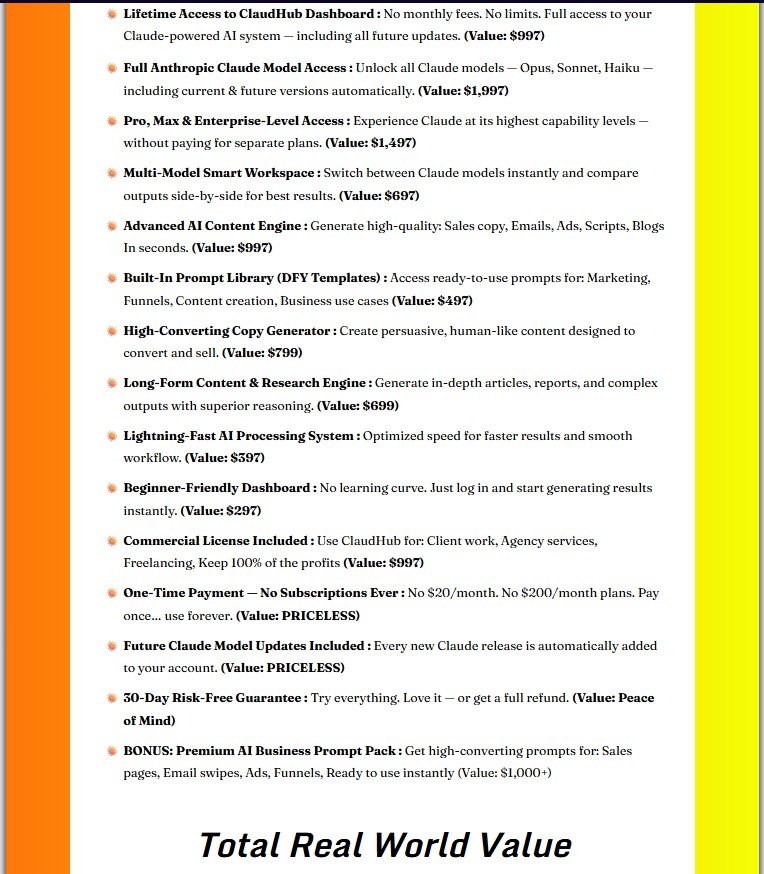
1) Full Claude Model Access (current + future)
The vendor claims you can access all Anthropic Claude models from within ClaudHub, including future releases.
Why it matters:
Different Claude models tend to excel at different tasks:
- premium “best reasoning” model for strategy, sales pages, complex work
- balanced model for everyday content
- lightweight model for quick drafts and short tasks
Having multiple models in one place can improve both speed and quality.
2) Lifetime access (pay once, use forever)
ClaudHub is promoted as a one-time payment instead of a subscription.
Why it matters:
If you use AI daily, monthly subscriptions can become a permanent expense line.
3) Future-proof system (automatic model updates)
The claim: when new Claude models come out, they’re added to your account automatically.
Why it matters:
If true, it reduces “upgrade anxiety”—the feeling that you’ll fall behind unless you keep paying more.
4) Multi-model chat workspace (switch and compare)
ClaudHub claims you can:
- switch models instantly
- compare outputs side-by-side
- pick the best response quickly
Why it matters:
This is a real workflow advantage. For marketing, you might do:
- Model A: brainstorm angles
- Model B: write conversion-focused copy
- Model C: simplify for a broader audience
A workspace that supports quick comparison can save time and reduce re-prompting.
5) Built-in prompt engine (templates for marketing and content)
ClaudHub includes a library of “done-for-you” prompts for:
- sales copy
- emails
- scripts
- ads
- funnels
Why it matters:
If you’re not a prompt engineer, templates can get you to usable output faster—especially for repeat tasks like:
- weekly newsletters
- product descriptions
- YouTube scripts
- ad variations
6) Smart output optimization (refine and improve responses)
ClaudHub is positioned as helping you refine outputs for:
- clarity
- structure
- persuasiveness
- fewer prompt iterations
Why it matters:
If you’ve ever felt stuck rewriting AI drafts, optimization tools can reduce editing time.
7) All-in-one dashboard (no tool switching)
Everything is contained inside one interface: models, prompts, generation, and workflow.
Why it matters:
Tool switching kills momentum. A single workspace often leads to:
- faster content cycles
- fewer distractions
- cleaner project management
8) Pro, Max, and Enterprise-level access (as positioned)
The copy suggests ClaudHub provides an experience similar to higher-tier access levels.
Why it matters:
Power users want the best outputs, higher limits, and advanced capabilities—without paying multiple expensive tiers.
Reality check: “Enterprise-level access” is a strong claim. Confirm what that means in practice (limits, speed, concurrency, context, availability) on the official page.
9) Commercial license included
You can use ClaudHub for:
- client work
- agency services
- freelancing
- monetized content
Why it matters:
A commercial license can remove ambiguity if you plan to sell outputs as part of a service.
10) Secure, private usage + fast performance + beginner-friendly UI
The vendor claims ClaudHub is:
- secure and stable
- optimized for speed
- easy for beginners
Why it matters:
If you’re using AI for business, reliability and simplicity matter as much as model quality.
ClaudHub Review: What Models Does ClaudHub Claim to Unlock?
Based on your provided info, ClaudHub promotes access to:
- Claude Opus 4.6 (and future Opus versions)
- Claude Sonnet 4.6 (and the Sonnet series)
- Claude Haiku 4.5 (and the Haiku series)
- All previous versions
- Automatic access to upcoming releases
This is essentially the complete Claude lineup across capability tiers.
Practical implication:
If you can truly switch between Opus/Sonnet/Haiku at will, you can choose the right balance of:
- output quality
- speed
- cost efficiency (if the system internally manages usage)
How ClaudHub Works (Step-by-Step): ClaudHub Review
ClaudHub is presented as a simple 3-step process:
Step 1: Log in to ClaudHub
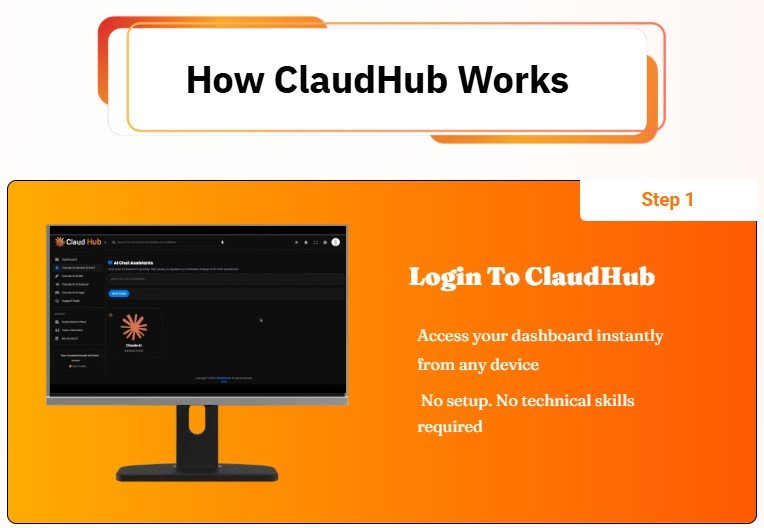
You access a dashboard from any device.
Step 2: Choose your Claude model
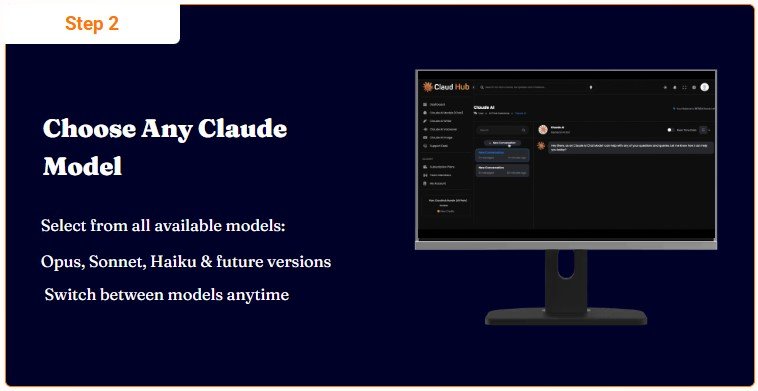
Pick from Opus/Sonnet/Haiku (and any included versions).
Switch models any time.
Step 3: Generate content in seconds

Use templates or type your own prompt to create:
- content
- ads
- emails
- scripts
- ideas
- research summaries
- client deliverables
If the “multi-model workspace” is implemented well, you can generate multiple variations quickly and compare.
Real-World Use Cases: ClaudHub Review
What You Can Create With ClaudHub
This is where a tool like ClaudHub either becomes a daily driver—or just another purchase you forget.
Below are practical, high-demand use cases where Claude models typically shine (especially for writing-heavy tasks).
1) Sales pages and landing pages
Generate:
- headline + subhead stacks
- pain-point bullets
- offer structure
- FAQs
- risk reversals and guarantees
- feature-to-benefit mapping
- testimonial prompts (ethical: for collecting real testimonials, not fabricating them)
Pro tip: Ask for three different sales page structures:
- PAS (Problem-Agitate-Solve)
- AIDA (Attention-Interest-Desire-Action)
- Story-based long-form
Then mix the best sections.
2) Email sequences (promos + newsletters)
Create:
- welcome sequences
- product launch sequences
- abandoned cart emails
- reactivation campaigns
- weekly newsletters with consistent tone
Workflow idea: Use Haiku for quick subject line batches, Sonnet for full drafts, Opus for brand voice refinement.
3) Short-form ads (Meta/Google/TikTok)
Generate:
- 20 hooks in different styles
- 10 primary texts
- 10 CTA variations
- angle testing sets (emotional, logical, social proof, curiosity)
Best practice: Always add constraints: character limit, prohibited words, tone, target persona.
4) YouTube scripts, Reels, and Shorts
Create:
- hook-first intros
- tight story arcs
- retention loops (“In a second I’ll show you…”)
- clear calls-to-action
- title + thumbnail text ideas
Claude-style writing is often strong for conversational scripts that don’t feel robotic.
5) Blog posts and SEO content
Generate:
- outlines based on search intent
- section-by-section drafts
- FAQs and schema-ready Q&A
- meta titles/descriptions
- internal linking suggestions
- topical clusters (supporting articles)
Important: For Google-friendly SEO, your content must be:
- genuinely helpful
- not just rephrased fluff
- structured for readability
- supported by real experience/examples where possible
6) Client proposals and agency deliverables
Produce:
- proposals
- scope of work
- onboarding questionnaires
- reporting narratives (“what happened, why, what next”)
- client-friendly strategy docs
7) Product descriptions (eCommerce)
Create:
- benefit-led descriptions
- variant descriptions
- comparison tables
- Amazon-style bullets
- brand-voice consistent copy
8) Course creation, ebooks, and digital products
Build:
- course outlines
- lesson scripts
- worksheets
- quizzes
- module summaries
- ebook chapter drafts
Tip: Feed in your unique method, case studies, or frameworks to avoid generic output.
9) Research and synthesis
Use Claude models to:
- summarize long PDFs
- extract key takeaways
- compare approaches
- generate decision matrices
- turn notes into structured documents
10) Coding and technical documentation (depending on model capability)
Potential tasks:
- writing docs and README files
- generating code explanations
- creating user guides
- drafting API documentation
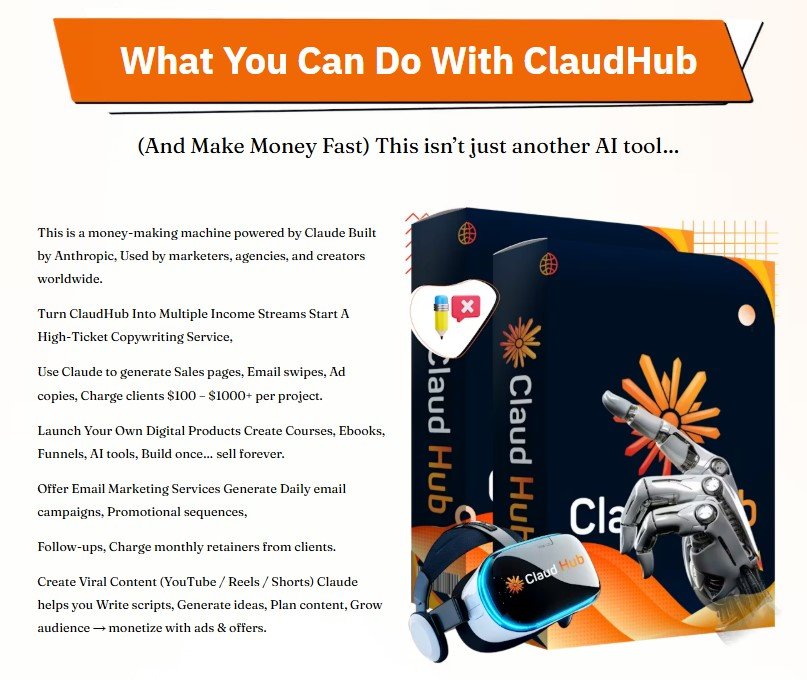
ClaudHub for Making Money: ClaudHub Review
Practical Business Ideas
The product copy strongly emphasizes monetization. Here are realistic ways people typically turn AI writing capability into revenue—without hype.
1) High-ticket copywriting service
Offer services like:
- landing page copy
- email sequences
- ad creative packs
- funnel audits + rewrites
How ClaudHub helps:
Speed and iteration. You can generate multiple angles quickly and present clients with options.
Pricing reality:
Even modest clients may pay $300–$2,000+ depending on deliverable size and niche.
2) Retainer-based email marketing
Pitch:
- 3 newsletters/week
- 1 promo/week
- list segmentation ideas
- subject line testing
Why it works:
Recurring revenue for you, even if ClaudHub is a one-time tool (if the lifetime claim holds).
3) Content repurposing service (high demand)
Turn:
- long podcasts → 10 shorts
- webinars → blog posts + email series
- blogs → LinkedIn posts + threads
Why it sells:
Businesses create content but lack time to repurpose it consistently.
4) YouTube scripting package
Offer:
- 4 scripts/month
- hook packs
- retention edits
- title + thumbnail text
Claude-style writing can be strong for narration and storytelling.
5) Local business “done-for-you” marketing
Sell:
- Google Business Profile posts
- local landing pages
- seasonal promotion emails
- social captions
Local businesses often value speed and simplicity more than “perfect AI.”
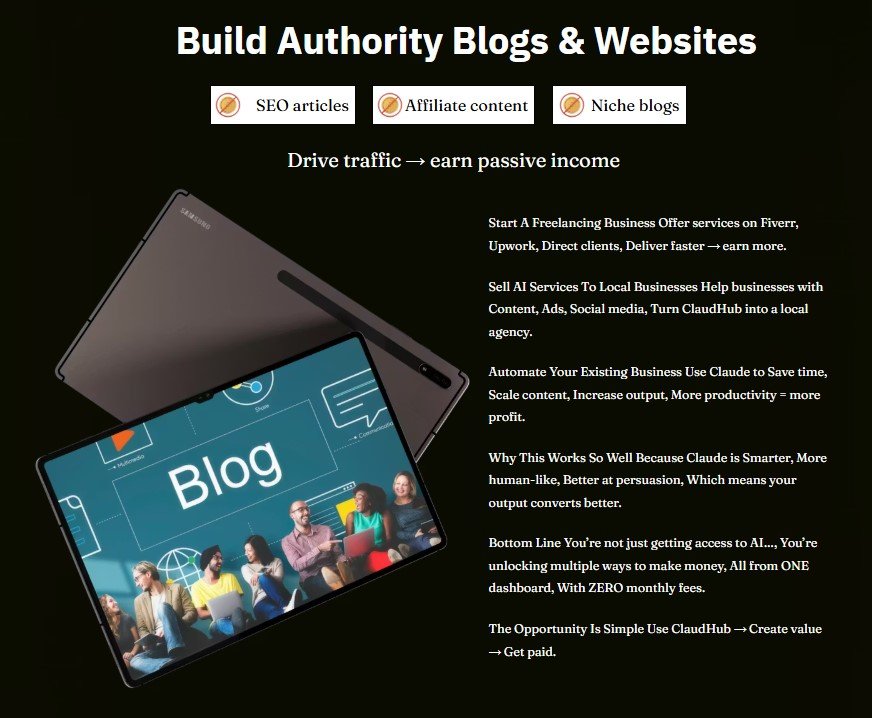
6) Build niche websites for affiliate income
Use ClaudHub to scale:
- product comparisons
- how-to guides
- informational content clusters
Important: To rank, you’ll need real differentiation:
- unique testing
- original photos/screenshots
- expert insight
- genuinely useful structure
ClaudHub vs Paying for Claude Pro/Max/Team (Cost Breakdown): ClaudHub Review
Your brief mentions typical monthly pricing ranges such as:
- Pro: ~$17–$20/month
- Max: ~$100–$150/month
- Enterprise: ~$200–$300/month
(These ranges can vary by region/time—always confirm current official pricing.)
The ClaudHub pitch
- “Real price $597/month” (as framed in the promo)
- “Today only one-time $14.95”
If a one-time payment truly replaces ongoing subscriptions, the ROI math is obviously compelling.
But here’s the smart buyer approach
Before you treat it like a guaranteed cost-saver, confirm:
- Are there daily/monthly usage caps?
- Is “Pro/Max/Enterprise-level access” a feature label or a specific measurable limit?
- Does “future models included” mean all models or some models?
- Is performance consistent at peak times?
- Is there any fair-use policy?
If ClaudHub works smoothly and consistently for your workload, it could reduce costs. If it’s limited, it may still be useful—but the “replace everything” narrative might not fit every user.

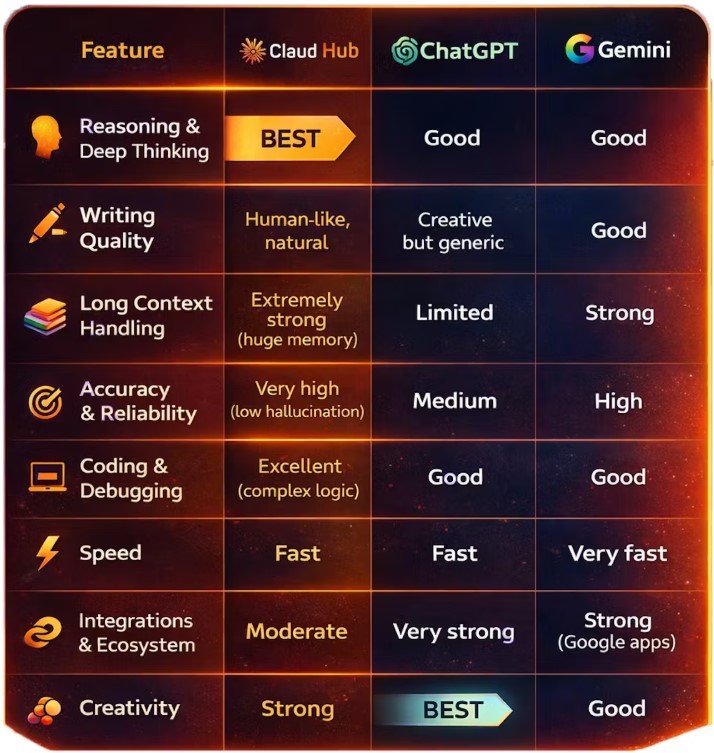
ClaudHub vs ChatGPT vs Gemini (Honest Comparison): ClaudHub Review
A fair comparison isn’t just “which is smarter.” It’s: which tool fits the job and workflow.
Where Claude (often) wins for many users
- more natural long-form writing
- strong reasoning for strategy and synthesis
- excellent tone for marketing content
- strong context handling (depending on model and plan)
Where ChatGPT can win
- broader ecosystem (tools, integrations, third-party apps)
- multimodal features (depending on tier): images, voice, browsing, etc.
- lots of community workflows and prompts
- developer tooling in some environments
Where Gemini can win
- deep Google ecosystem integration
- strong multimodal capabilities in certain setups
- good for users living inside Google Workspace
Where ClaudHub fits
ClaudHub is not trying to “beat” ChatGPT or Gemini in every feature. It’s aiming to be:
- a Claude-first workspace
- with multi-model switching
- plus templates and “output optimization”
- with lifetime access positioning
If your work is heavily writing/copy/strategy focused, a Claude-centered tool can be compelling—assuming access and limits match your needs.

Pros and Cons: ClaudHub Review
Pros (based on the provided feature set)
- One-time payment positioning (potentially huge savings)
- All-in-one Claude workspace instead of juggling subscriptions
- Multi-model switching to compare outputs fast
- Prompt library for marketers, creators, and agencies
- Commercial license included (helpful for client work)
- Beginner-friendly workflow (log in → choose model → generate)
- Future updates included claim (reduces upgrade friction)
Cons / Potential drawbacks (what to verify)
- Third-party access risk: If it relies on external model access, availability can change.
- Limits may exist: Even if “no limitations” is stated in promo copy, most systems enforce fair-use policies. Confirm specifics.
- Privacy and compliance: Understand how prompts/data are stored and processed.
- “Enterprise-level” wording: Clarify what you’re actually getting (limits, speed, concurrency, context window).
- Longevity of lifetime deals: “Lifetime” typically means the lifetime of the product, not your lifetime—read terms carefully.

Who ClaudHub Is Best For (And Who Should Skip): ClaudHub Review
ClaudHub is best for: ClaudHub Review
1) Marketers and copywriters
If you write ads, landing pages, emails, scripts, or offers daily, the ability to generate and compare outputs quickly is valuable.
2) Freelancers and agencies
If your income depends on delivering written assets fast, a Claude-centered dashboard + commercial license can be attractive.
3) Content creators (YouTube, Shorts, blogs)
If you need scripts, outlines, hooks, and repurposed content at scale.
4) Entrepreneurs and small business owners
If you want one tool for content + messaging + planning without paying monthly subscriptions.
You should skip (or be cautious) if:
1) You need guaranteed official-first-party access
If your organization requires strictly official vendor tools and compliance, a third-party layer may not be acceptable.
2) You rely heavily on image/video generation
ClaudHub (as described) is Claude-text focused, not a full multimodal studio.
3) You want deep integrations
If your workflow depends on plugins, automation, or APIs, you’ll want to confirm what ClaudHub supports.
Security, Privacy, and Reliability Considerations: ClaudHub Review
The promo states “secure & private usage.” Treat that as a starting point, not the final word.
Here’s what you should check before using any AI tool for sensitive work:
1) Data handling
- Are your prompts stored?
- Are chats logged?
- Can you delete data?
- Is data used to train anything?
2) Business confidentiality
If you’re working with client data, avoid pasting:
- passwords
- payment details
- private customer lists
- confidential strategy documents
Unless the privacy policy explicitly supports that level of usage.
3) Reliability and uptime
Ask:
- Is there a status page?
- How does performance look during peak hours?
- Are there rate limits that slow you down?
4) Compliance and terms
Because ClaudHub is positioned around access to Anthropic models, confirm that usage aligns with applicable terms. (This is not legal advice—just smart due diligence.)

Pricing, Lifetime Deal, and Refund: ClaudHub Review
From your details, ClaudHub is promoted with:
- One-time price: $14.95 (limited-time)
- Anchored against: $597/month (promotional “real price”)
- 30-day money-back guarantee
How to evaluate the deal intelligently
A low one-time price can be excellent if:
- you’ll actually use it weekly
- the included model access matches your workload
- the platform is stable
- the terms clearly state what you receive
Refund policy
The promo text states a 30-day risk-free guarantee.
Before purchase, confirm:
- whether refunds are “no questions asked”
- whether you must contact support within 30 days
- whether there are any exclusions
💰 ClaudHub Pricing & OTOs Breakdown
| Step | Product Name | Price | Key Features | Best For |
|---|---|---|---|---|
| 🎯 Front-End | ClaudHub | $14.95 (One-Time) | Full AI platform access, no monthly fees, no hidden costs | Beginners & budget users |
| 🎟 Coupon | CLAUD5 | $5 OFF | Works on full funnel | Extra savings |
| 🎟 Coupon | CLAUDMAX | 35% OFF | Works on full funnel | Maximum discount |
🚀 OTO (Upsell) Funnel Breakdown
| OTO | Product Name | Price | Features | Ideal For |
|---|---|---|---|---|
| OTO 1 | Unlimited Edition | $59 – $149 | Unlimited content, models, generations, long-form writing, commercial rights | Heavy users & agencies |
| OTO 2 | DFY Edition | $97 | Ready-made templates, AI Article Wizard, Smart Editor, Rewriter Engine | Beginners & fast content creators |
| OTO 3 | Cloud Hub Creative Studio | $67 | AI images, voiceovers, PDF analysis, multi-format content | Video creators & marketers |
| OTO 4 | Cloud Hub Agent | $47 | Autonomous AI, task automation, funnel building, 24/7 execution | Automation lovers |
| OTO 5 | Financial Freedom System | $47 | Income blueprints, client systems, DFY offers | Freelancers & side hustlers |
| OTO 6 | Enterprise Edition | $47 | Premium intelligence, max speed, full unlock, future updates | Power users |
| OTO 7 | Auto Flow Engine | $47 | Background automation, scheduling, batch processing | Passive workflow seekers |
| OTO 8 | License Rights | $47 | DFY funnels, support system, earn $2K–$10K/month | Affiliate marketers |
| OTO 9 | Agency License | $47 | Unlimited clients, recurring income, full profit retention | Agency owners |
| OTO 10 | Whitelabel License | $297 | Rebrand software, custom domain, full ownership | Entrepreneurs & SaaS builders |
✅ Key Takeaways
- Low entry cost: Start with just $14.95 one-time
- No recurring fees: Everything is optional
- Scalable system: Upgrade only if you need more power
- Best value upgrades:
- OTO 1 (Unlimited) for scaling
- OTO 2 (DFY) for beginners
- OTO 9 (Agency) for client income
Tips to Get Better Outputs (Prompting Playbook): ClaudHub Review
If you buy ClaudHub (or any Claude-powered tool), the difference between “generic AI content” and “publish-ready work” is usually your inputs.
Here are practical prompting patterns that improve results fast.
1) Use a role + goal + audience
Template:
- You are a [role].
- Create [deliverable].
- Audience: [who].
- Goal: [what outcome].
- Tone: [tone].
- Constraints: [length, format, banned words].
2) Provide examples of your brand voice
Paste:
- 1–2 emails you wrote
- a landing page paragraph
- a few social posts
Then say: “Match this voice exactly.”
3) Ask for multiple angles
Instead of one draft, request:
- 5 headline styles
- 3 different story openings
- 10 hooks grouped by emotion (fear, curiosity, aspiration)
4) Use the “critic then rewrite” loop
Prompt:
- Draft the copy
- Critique it harshly as a conversion expert
- Rewrite with improvements
- Give a final version + a shorter version
5) Force structure
For blogs, ask for:
- H2/H3 outline
- key takeaways per section
- FAQ section
- conclusion with action steps
6) Add “truth filters”
Tell the model:
- “Don’t invent stats.”
- “If unsure, say so.”
- “Use cautious language for claims.”
This improves trustworthiness and reduces risk—especially for YMYL topics.


Final Verdict: ClaudHub Review
ClaudHub is designed for one specific type of buyer: someone who wants Claude-powered output (especially for writing, marketing, and long-form content) but is tired of monthly subscriptions, tool-switching, and juggling different access tiers.
If ClaudHub delivers as advertised—especially the ability to switch between Claude models, use a built-in prompt engine, and retain ongoing access without recurring fees—then the value proposition is obvious for:
- marketers
- content creators
- freelancers
- agencies
- entrepreneurs who produce content weekly
That said, the strongest claims (“no limitations,” “enterprise-level access,” “all future models automatically”) are exactly the ones you should verify carefully before purchase—because they determine whether ClaudHub replaces subscriptions or simply becomes a helpful add-on.
My practical recommendation:
If you’re interested, treat ClaudHub like a 30-day trial (via the stated refund policy). Use it heavily for real work—emails, landing pages, scripts, client deliverables—and decide based on speed, output quality, and consistency.
Frequently Asked Questions: ClaudHub Review
Q: How long will the one-time price be available?
A: This special launch price is only available during this limited window.
Once the launch ends, the price increases — and recurring plans may be introduced.
If you’re seeing this page right now, you’re early… but that can change fast. Lock in lifetime access while you can.
Q: Do I need any technical skills or AI experience?
A: Not at all! ClaudHub is designed to be beginner-friendly.
You don’t need coding skills, prompt expertise, or prior AI experience.
Just type what you want — and the AI handles everything for you.
Q: Do I need to install any software?
A: No downloads required.
ClaudHub is 100% cloud-based.
Simply log in from any browser and start generating content instantly.
Q: Is this really a one-time payment? Are there any hidden fees?
A: Yes — today’s access is a one-time payment with no monthly fees.
Optional upgrades may be available, but the core ClaudHub system works perfectly on its own.
Q: What exactly do I get access to?
A: You get full access to Anthropic’s Claude models:
Opus, Sonnet, Haiku
Current + upcoming versions
All from one dashboard, with Pro, Max & Enterprise-level access.
Q: Can I use this to make money?
A: Absolutely. ClaudHub includes a commercial license.
You can use it for:
Client work, Freelancing, Agency services
And keep 100% of your profits.
Q: Will this work on Mac, PC, or mobile?
A: Yes! ClaudHub works on any device with an internet connection —
Windows, macOS, iOS, Android, tablet, or browser.
Just log in and start using it instantly.
Q: What makes this different from other AI tools?
A: Most tools give you limited access to one model.
ClaudHub gives you:
ALL Claude models
Future updates included
Higher-level access (Pro, Max, Enterprise)
It’s not just access — it’s full control of the Claude ecosystem.
FAQ: ClaudHub Review
What is ClaudHub?
ClaudHub is marketed as an AI dashboard that provides access to multiple Anthropic Claude models in one place, with extra features like a prompt library, multi-model switching, and output optimization.
Does ClaudHub really offer lifetime access?
The vendor claims it’s a one-time payment with lifetime access. Read the terms on the official site to understand what “lifetime” refers to (typically the lifetime of the product).
Which Claude models does ClaudHub include?
Per your provided info, ClaudHub claims access to Claude Opus, Claude Sonnet, Claude Haiku (including versions like Opus 4.6, Sonnet 4.6, Haiku 4.5), plus previous and upcoming releases.
Are there usage limits?
The promo copy says “no limitations,” but many platforms still apply fair-use, rate limits, or capacity rules. Verify current limits on the official page.
Can I use ClaudHub for client work?
The product claims a commercial license is included, meaning you can use outputs for client projects and keep profits. Confirm licensing terms before reselling.
Is ClaudHub beginner-friendly?
It’s positioned as beginner-friendly: log in, choose a model, generate content. If you’re new to prompts, the built-in templates may help.
Is ClaudHub better than subscribing directly to Claude?
It depends on reliability, actual access levels, and your workload. If ClaudHub delivers stable access and fits your usage patterns, the one-time price could be cost-effective. If you require official-first-party enterprise compliance, a direct subscription may be safer.