Introduction: Vibe Coding
The Future of AI-Assisted Programming
The software development is in a paradigm shift. During the last decades, programmer wrote line by line, applying strict syntax rules and spending numerous hours debugging the code. This was followed by integrated development environments (IDEs), open-source libraries, low-code frameworks and currently AI-based tools such as GitHub Copilot, ChatGPT and Amazon CodeWhisperer.
However there is something bigger on the way: Vibe Coding. Vibe Coding, in contrast to the conventional forms of the coding, is based on the intent-driven development. Rather than focusing on each bracket, semicolon or API call, the developers can just explain the vibe of what they would like to do and AI will create useful, optimized code.
This strategy is not just a productivity trick but it might even change the nature of programming in future. Vibe Coding has the potential to become the next big thing in the software development by making coding conversational, faster, and more intuitive.
This is an in-depth article where we will discuss what is Vibe Coding, how it is used, its advantages, practical applications, prospects, issues, and why businesses, coders and non-coders should be concerned.
What is Vibe Coding?
Vibe Coding is a type of AI-assisted coding in which the developers describe what they want to accomplish in their natural language, and the AI transforms the ideas into code.
Imagine this:
- A startup founder says: “I want a food delivery app with GPS tracking and PayPal checkout.”
- A developer types: “Generate a React dashboard with user login, analytics, and dark mode support.”
- A game designer requests: “Create a 3D environment with a night sky, realistic lighting, and moving vehicles.”
In each case, AI interprets the request, builds the necessary code structure, and provides ready-to-use output in seconds.
This is possible because of three main technologies:
- Large Language Models (LLMs) → Trained on billions of code snippets across frameworks.
- Contextual AI → Understands project goals and integrates new code seamlessly.
- Natural Language Processing (NLP) → Allows conversational, voice, or text-based coding.
Instead of being bogged down by syntax, developers focus on ideas and functionality—letting the AI handle repetitive or technical details.
What Vibe Coding might look like using pseudo-code + AI-assisted code snippets in Python/JavaScript
The idea is to show how developers could give natural language instructions and have AI generate working code.
📝 Example 1 – Natural Language to Python (AI-Assisted)
# Vibe Coding Instruction:
# “Create a function that sorts a list of numbers in ascending order.”
@vibe.auto_code
def sort_numbers(numbers: list) -> list:
return sorted(numbers)
print (sort_numbers([12, 5, 9, 1]))
Here, the @vibe.auto_code decorator represents the AI layer that automatically handles optimization, edge cases, and performance improvements.
📝 Example 2 – Natural Language to JavaScript
// Vibe Coding Instruction:
// “Build a simple API endpoint that returns today’s date.”
vibe.createAPI(“/date”, “GET”, () => {
return { today: new Date().toISOString().split(“T”)[0] };
});
Instead of manually setting up Express.js or Node.js boilerplate, the vibe.createAPI function lets AI generate the backend logic instantly.
📝 Example 3 – Business Logic in Natural Language
# Vibe Coding Instruction:
# “Build a function that calculates monthly loan payments.”
@vibe.auto_code
def loan_payment(principal: float, annual_rate: float, years: int) -> float:
monthly_rate = annual_rate / 12 / 100
payments = years * 12
return (principal * monthly_rate) / (1 – (1 + monthly_rate) ** -payments)
print (loan_payment(10000, 5, 2)) # Example


Why It is the Next Big Thing
1. It Speeds Up Development
Conventional software development is a slow process. An app developed in house might require weeks or months to develop. Under Vibe Coding, the prototypes are made within hours.
This is important in industries where the success of the industry depends on time-to-market. Firms can start up much faster, businesses can be innovative in little time and those working as freelancers are able to work on more assignments.
2. It Lowers the Entry Barrier
Not all people will be able to commit years learning programming. Under Vibe Coding, the non-coders, marketers, educators, entrepreneurs, can engage in creation of softwares. They simply explain what they desire, and the AI brings it to reality.
3. It Reduces Errors
Debugging is often the most time-consuming part of coding. AI-assisted environments detect bugs in real-time, suggest fixes, and optimize performance before deployment.
4. It Personalizes the Experience
AI learns your preferences, coding style, and frameworks. Over time, your Vibe Coding assistant becomes like a personal co-developer.
5. It Cuts Costs
Why hire a team of 10 when 2 people with AI support can build the same project? Vibe Coding helps startups and agencies save thousands in development costs.
Key Features
- Natural Language to Code Conversion → Simply describe what you want.
- AI Debugging → Automatic fixes for syntax, logic, and runtime errors.
- Context Awareness → New code integrates seamlessly with existing code.
- Cross-Platform Support → Build for web, mobile, IoT, and cloud.
- Auto-Documentation → AI generates comments, READMEs, and guides.
- Real-Time Previews → See instant UI/UX changes.
- Collaboration Tools → AI tracks version history and works in teams.
Watch The Video
Key Benefits of Using
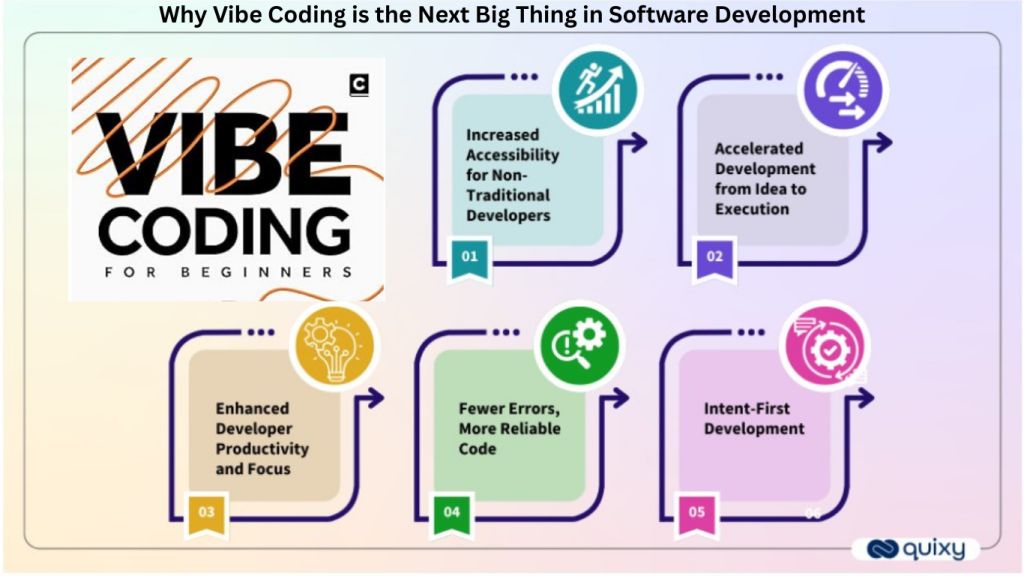
Faster Development Cycles – AI-assisted suggestions reduce time spent on repetitive coding tasks, allowing developers to deliver projects faster.
Accessibility for Beginners – Even non-coders and entrepreneurs can build functional apps without deep technical knowledge.
Cost Savings – Reduces the need for large teams, making it budget-friendly for startups and small businesses.
Error Reduction – AI automatically detects bugs and suggests cleaner, optimized code, improving software quality.
Boosts Productivity – Developers can focus on logic and creativity while AI handles technical overhead.
Cross-Industry Applications – Useful in web development, mobile apps, gaming, AI projects, business automation, and more.
Scalable Solutions – Works for small prototypes as well as enterprise-level applications.
Future-Proof Skills – Learning Vibe Coding helps developers stay ahead as AI becomes a standard part of software engineering.
Seamless Integration – Many Vibe Coding tools connect easily with existing frameworks, APIs, and cloud platforms.
Encourages Innovation – By removing technical barriers, developers can experiment more freely and push creative boundaries.
How to Get Started
- Choose a Vibe Coding Platform
Early tools include GitHub Copilot, Replit’s Ghostwriter, and experimental AI-first IDEs. - Set Up Your Project Vibe
Define your goal: web app, mobile app, data science project, or automation script. - Describe Your Features
Use natural language: “Create a login page with email + Google sign-in.” - Review and Customize
AI generates code, but you refine it to fit your style or requirements. - Deploy and Test
Deploy to cloud platforms or mobile stores faster than ever.
Real-World Use Cases
1. Web Development
Generate full-stack web apps, landing pages, or e-commerce sites instantly.
2. Mobile Apps
Develop iOS/Android apps with built-in APIs for payments, maps, or chatbots.
3. Game Development
AI generates game mechanics, environment physics, and character scripts.
4. Data Science
From cleaning datasets to building machine learning models, AI simplifies workflows.
5. Business Automation
Build scripts for CRM integration, lead generation, or HR automation.
Case Studies
Case Study 1: A Startup’s MVP in Days
A health-tech startup used Vibe Coding to build an MVP app with telemedicine features in just 10 days, saving 70% of projected costs.
Case Study 2: Freelancers Scaling Projects
A freelance developer delivered three projects per month instead of one by letting AI handle routine coding.
Case Study 3: Enterprise Efficiency
A global bank integrated Vibe Coding for internal automation scripts, cutting manual IT costs by 40%.
How Can You Make Money with Vibe Coding?
- Freelancing → Offer faster project delivery.
- Product Development → Build apps or SaaS products with minimal investment.
- Automation Services → Sell AI-generated workflow solutions.
- Education → Create interactive coding courses using Vibe Coding.
- Stock Assets → Sell prebuilt code snippets, templates, or plugins.
Comparison: Vibe Coding vs Other Methods
| Feature | Traditional Coding | No-Code Tools | Vibe Coding |
| Learning Curve | High | Low | Moderate |
| Flexibility | Very High | Low | High |
| Speed | Slow | Fast | Very Fast |
| Error Handling | Manual Debugging | Limited | AI-Assisted |
| Accessibility | Programmers Only | Non-Coders | Both |
Challenges
- Over-Reliance on AI → Beginners may not learn fundamentals.
- Security Risks → AI may generate exploitable vulnerabilities.
- Quality Issues → Complex, unique projects still need expert oversight.
- Ethics & Ownership → Who owns AI-generated code?
Future
By 2025–2030, we may see:
- Voice-driven coding (just talk to your IDE).
- AI-first IDEs replacing traditional environments.
- Collaborative AI teams (AI as your coding partner).
- Democratization of programming → Billions of non-coders building apps.
- Hyper-personalized development → AI coding assistants tuned to your workflow.

Is Vibe Coding the Future of Software Development?
Computer software development is shifting to automation, intelligence, and accessibility, and Vibe Coding is at the core of it. In the past, traditional code has always taken years of learning a programming language, frameworks and debugging. But now, due to emergence of AI-assisted programming, Vibe Coding is making it more efficient, faster and more user-friendly. It combines natural language instructions with code generation that is driven by AI and allows professional developers and non-technical users to build powerful applications in record time. This renders software development more open, economical and scalable.
The fact that Vibe Coding reduces the development time significantly is one of the largest reasons why it can be regarded as the future. The developers do not have to manually write thousands of lines of code, but they can trust AI to create optimized code structures in a few seconds. This minimizes human errors, shortens the time of delivering projects and enhances overall quality. Costs are reduced and the developers are given more time to work on creative problems-solving, rather than doing the same work over and over again.
In addition, Vibe Coding can be compared with the contemporary software tendencies such as low-code software and no-code software which already become popular among startups, businesses, and freelancers around the globe. It finds its use in web development, mobile applications, artificial intelligence, as well as in video games. With further advancements in AI, Vibe Coding is going to get intelligent, adaptive and can process complicated projects previously demanding large development teams.
To conclude, Vibe Coding is not merely a trend–it is a severe innovation that may transform the way we will consider the creation of software. It is AI intelligence plus human creativity that leads to the future when any person can be a creator and software development will be quicker, smarter, and more available than ever.
Why is Vibe Coding Good?
Vibe Coding is a good idea as it is both the strength of artificial intelligence and ease of use of human-friendly commands, which makes software development faster, smarter and more accessible. The traditional coding system is usually very technical and requires a thorough understanding of the code but through Vibe Coding both a coder and non-coder can easily develop an application. It minimizes redundant tasks and errors and provides cleaner and optimised code by relying on AI-driven suggestions and automation. This is not only faster to develop with but also reduces the cost of software development, which is particularly useful to startups and small businesses.
This is another reason why Vibe Coding is good because it is flexible. It may be used in web development, mobile applications, business automation, game design, or even solutions that run on AI. The use of AI saves time because it can perform routine coding as developers concentrate on innovation and solving problems. The novices gain as well since they can create actual projects without decades of experience with programming.
Between this, Vibe Coding supports creativity most of all. It eliminates the technical roadblocks to enable users to develop new ideas and boundaries in the development of software. As AI is increasingly enhanced, Vibe Coding helps developers stay abreast of the trend, which makes this a good skill and a game-changer to create the future of technology.
Will Vibe Coding Replace Programmers?
Vibe coding has caused an engaging controversy in the technology sector: Will vibe coding bring programmers to extinction? Vibe coding is an experimental methodology, as developers can write, debug, and test code more quickly with the assistance of artificial intelligence, which converts natural language prompts into a working program.
Rather than writing down a complicated syntax, programmers are able to tell the computer what they desire in a plain language, and it is translated to something that can be used. Although this would be considered revolutionary, analysts do not think that vibe coding will completely supersede human programmers in the near future. Coding is not merely the writing of lines of code, and is a problem-solving, critical thinking, system design, and understanding system of user needs.
AI-based tools such as vibe coding would help with the daily processes, speed up the work, decrease the number of repetitions, but they do not provide creativity, intuition, and decision-making potential of human developers to complex projects. Vibe coding will not substitute programmers but improve their abilities, and the development process will become more efficient and accessible. Eventually, vibe coding would possibly enable non-technical users to create simple applications, though the expert programmer will continue to be sought after to do advanced software engineering. Finally, vibe coding will transform our approach to coding, but not be a replacement of programmers.
Pros & Cons
✅ Pros
- Faster Development – AI-assisted coding reduces time spent on repetitive tasks and accelerates app creation.
- Accessible to Non-Coders – Beginners, entrepreneurs, and startups can build apps without deep programming skills.
- Cost-Effective – Reduces the need for large development teams, making software creation more affordable.
- AI-Powered Suggestions – Automatically generates cleaner, more optimized code with fewer errors.
- Boosts Creativity – Frees developers from technical overhead, letting them focus on innovation and problem-solving.
- Scalable for Different Projects – Works across web, mobile, games, and business applications.
- Keeps Up with Trends – Built-in AI updates ensure compatibility with the latest frameworks and technologies.
❌ Cons
- Learning Curve – Although easier than traditional coding, beginners may still need time to adapt.
- Over-Reliance on AI – Too much automation may limit a developer’s understanding of underlying programming concepts.
- Customization Limits – Some complex, highly customized applications may still require traditional coding.
- Security Concerns – AI-generated code could have hidden vulnerabilities if not reviewed properly.
- Tool Dependence – Developers might get locked into specific Vibe Coding platforms or ecosystems.
- Not Yet Mainstream – Since it’s still emerging, resources, tutorials, and expert communities are limited compared to traditional programming.
Conclusion
Vibe Coding is not just a tendency, but the future of the software development. It enables being able to code more quickly, with less expense, and intelligently by combining human creativity and AI-directed automation.
Vibe Coding opens up new possibilities whether you are a developer looking to get efficiency and a startup that is creating your MVP, or you are a non-coder with a big idea. Similar to the change in assembly to the high level languages, this is the next step of the evolution of our way of creating technology.
The next big thing is already here—and it’s called Vibe Coding.
Frequently Asked Questions
Q1. What is Vibe Coding in software development?
Vibe Coding is an AI-assisted programming approach that uses machine learning and automation to speed up coding, simplify app creation, and make development accessible to both professionals and beginners.
Q2. How is Vibe Coding different from traditional coding?
Unlike traditional coding, where developers write every line manually, Vibe Coding uses AI-powered tools to generate, optimize, and suggest code, reducing time and effort while improving accuracy.
Q3. Who can benefit from Vibe Coding?
Developers, startups, entrepreneurs, freelancers, educators, and even non-coders can benefit from Vibe Coding by creating apps, websites, games, and business solutions faster and at a lower cost.
Q4. Is Vibe Coding the same as no-code or low-code development?
No. While no-code tools focus on drag-and-drop simplicity, Vibe Coding combines coding with AI-powered assistance, giving developers more control, flexibility, and customization.
Q5. Can beginners learn Vibe Coding easily?
Yes. Vibe Coding platforms are designed to be user-friendly and intuitive, making it easier for beginners to start building projects without advanced technical skills.
Q6. What industries are using Vibe Coding in 2025?
Industries like software development, gaming, e-commerce, fintech, education, healthcare, and real estate are adopting Vibe Coding for faster project delivery and innovation.
Q7. Is Vibe Coding cost-effective for startups?
Yes. Since it reduces the need for large development teams and cuts down on long coding hours, Vibe Coding is highly cost-effective for startups and small businesses.
Q8. What are the limitations of Vibe Coding?
Some limitations include a learning curve for complete beginners, over-reliance on AI tools, possible security vulnerabilities in AI-generated code, and limited customization for complex projects.
Q9. What is the future of Vibe Coding?
The future of Vibe Coding looks promising as AI continues to evolve. It is expected to become a mainstream development practice, making coding faster, more intelligent, and accessible to everyone.
Q10. How do I get started with Vibe Coding?
You can get started by exploring Vibe Coding platforms, taking beginner-friendly tutorials, and experimenting with small projects. Many cloud-based tools make it easy to practice without heavy investments.
Q11. Is vibe coding easy to learn?
It is aimed at simplifying software development, including by beginners, through a combination of software and natural language and visual elements. Vibe coding is simpler and interactive in contrast to when you have to memorize complicated syntax to use in traditional coding. It is easy to learn due to its more intuitive way of learning which combines drag and drop capabilities, AI assistance, and real-time feedback, making it easy to learn by many users. This enables the learners to create apps, websites or digital tools without having profound understanding of programming.
Vibe coding saves time and decreases the learning curve of the students, hobbyists and even professionals. Although complex functionality might still require time, the user-friendly nature of the beginners allows the initial steps to be easy. Its combination of creativity and coding is what people who believe traditional programming to be scaring choose to pursue. All in all, vibe coding is more user-friendly than more traditional ones, and it is a good option that a person can consider when joining the world of software development with reduced pressure.
Q12. What are the 4 types of artificial intelligence?
Artificial Intelligence (AI) is a large industry, yet scholars tend to divide it into four major categories according to functionality and capacity. The simplest form of AI is the Reactive Machines. They lack memory or capability of learning through experiences in the past. They instead respond to certain inputs in real time. Well-known ones are the Deep Blue, the chess playing computer created by IBM. The second one is Limited Memory AI that can utilize the previous data to make improved decisions. This is the technology of self-driven cars, where the system is able to learn on previous movements and adjust to the conditions of the roads.
Theory of Mind AI is the third type that is under development. Such AI will be in a position to know human feelings, thoughts, and desires and the way people interact with machines will be more human and natural. Lastly, the fourth is Self-Aware AI, the most developed one. Such AI would possess consciousness and self-awareness as well as free will in making decisions. Although self-aware AI cannot become reality any time soon, this is the future of artificial intelligence.
The four categories of AI, as Reactive Machines, Limited Memory, Theory of Mind, and Self-Awareness, can serve to understand the way technology evolves and where it can be moving. By identifying these categories, businesses, researchers, and ordinary users will be better placed to understand the limitations and opportunities of AI now and see where AI is headed in the future.
Pingback: AI Review Studio Review: 1-Click, one keyword, unlimited income potential