Introduction
Self-publishing on Amazon has changed dramatically over the past few years. Five years ago, almost anyone could upload a simple lined journal or blank notebook to Amazon Kindle Direct Publishing and earn modest monthly royalties. Today, those basic low-content shelves are crowded with millions of nearly identical listings.
Independent publishers who still earn consistent royalties have shifted toward utility-driven print books. They focus on specific reader problems where demand outpaces supply. One of the fastest-growing segments in North American publishing right now is screen-free bilingual education, especially English-to-Spanish learning materials for children, classrooms, and bilingual households.
Creating dual-language books manually is difficult. Most solo publishers only speak one language fluently. Hiring professional translators costs hundreds of dollars per manuscript. Even worse, formatting two languages side by side inside standard word processors often breaks page margins and triggers frustrating rejection errors during Amazon’s upload review.
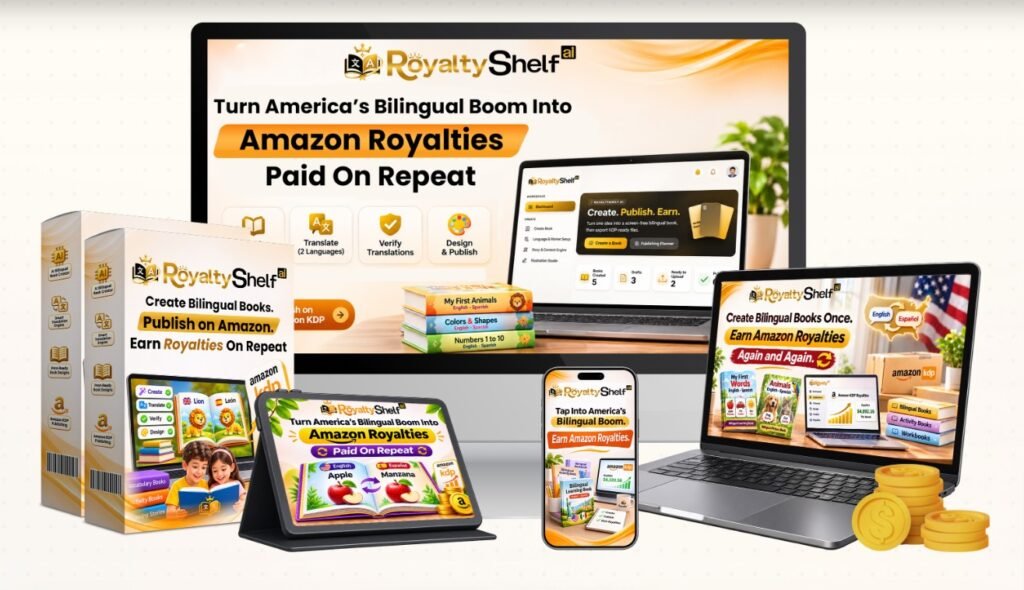
That exact production bottleneck is what RoyaltyShelf AI aims to solve. Developed by Clicks Botz and released on the Launchpad marketplace, this software positions itself not as a generic blog writer, but as a specialized bilingual book creation and KDP formatting engine.
Still, big marketing promises deserve careful scrutiny. Software tools can speed up production, yet no tool automatically guarantees passive income without real work. In this comprehensive review, we will examine how RoyaltyShelf AI operates, verify the underlying bilingual market claims, calculate real Amazon KDP print economics, and expose the honest limitations you need to know before spending a dime.
Overview
The digital publishing market if full of artificial intelligence wrappers that simply spit out unedited walls of text. Most of those tools leave you stranded when it comes time to turn raw paragraphs into a physical paperback book that meets strict printing press tolerances.
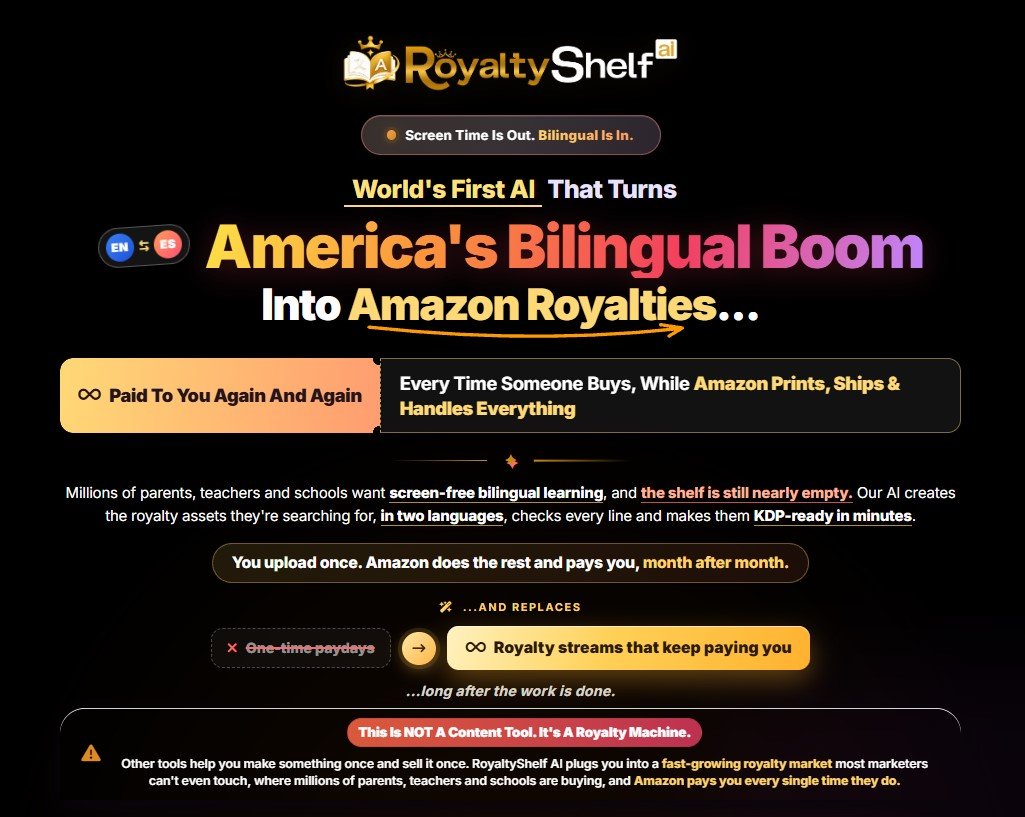
RoyaltyShelf AI takes a much narrower and more practical approach. Instead of trying to write everything from sales emails to social media captions, the platform focuses exclusively on bilingual educational assets built for Amazon’s print-on-demand ecosystem. Specifically, it targets the surging English and Spanish learning market across the United States and beyond.
The premise behind the platform relies on Amazon’s fulfillment infrastructure. When a publisher uploads a properly formatted interior PDF and cover file to Kindle Direct Publishing, Amazon lists the paperback globally. Whenever a parent, teacher, or school administrator orders a copy, Amazon prints the book on demand, ships it to the customer, handles any customer service inquiries, and deposits a share of the retail price into your account.
By combining dual-language generation, line-by-line linguistic verification, and automated print layout sizing inside one dashboard, RoyaltyShelf AI attempts to bridge the gap between idea and published paperback. It replaces single-sale freelance hustle with catalog assets that remain live on Amazon’s digital shelves year after year.
Whether that workflow fits your goals depends heavily on your expectations. Let us unpack every piece of this software from the ground up so you can make an informed, clear-eyed decision.

What Is It?
RoyaltyShelf AI is a cloud-based publishing application engineered to create, verify, and format bilingual books for Amazon Kindle Direct Publishing. Its primary focus centers on the English-Spanish educational niche, though the underlying dual-language framework supports structured parallel learning formats sought by parents and educators.
At a technical level, the software functions as an end-to-end production pipeline for educational print-on-demand books. Traditional AI chat tools generate loose text in a browser window. They have no awareness of physical trim sizes, gutter margins, bleed boundaries, or bilingual line synchronization. If you paste English and Spanish paragraphs into a standard document, the Spanish text typically runs twenty percent longer than the English text, throwing every subsequent page out of alignment.
RoyaltyShelf AI addresses this specific structural challenge. The system pairs a specialized dual-language content generator with an automated verification layer and a KDP-compliant layout formatter. Users select an educational book concept, define the target age group or learning level, and let the software construct structured bilingual lessons, vocabulary builders, reading passages, or screen-free activity pages.
Once the manuscript text is drafted, an internal checking protocol reviews each line across both languages. This step checks for vocabulary consistency, age-appropriate phrasing, and parallel alignment so the English prompt matches its Spanish counterpart accurately on the printed page.
Finally, the software compiles the verified content into print-ready files tailored to standard Amazon KDP dimensions. You do not need to install heavy desktop publishing programs like Adobe InDesign, nor do you need to calculate spine margins manually. Everything runs inside a standard web browser on Windows, Mac, or tablet devices.
About The Creator

RoyaltyShelf AI comes from the development desk of Clicks Botz, a software vendor active on the Launchpad digital marketplace. In the internet marketing and self-publishing tool space, Clicks Botz is known for building task-specific automation utilities aimed at solo entrepreneurs, side-hustlers, and beginner digital publishers.
Looking objectively at their product history, Clicks Botz tends to focus on simplifying complex multi-step workflows into guided, template-driven dashboards. Rather than building enterprise software meant for corporate publishing houses with steep monthly retainers, they design accessible browser tools priced for everyday beginners entering online business models like print-on-demand and affiliate publishing.
Understanding the Launchpad marketplace context is helpful for any prospective buyer. Products launched in this ecosystem usually feature an affordable one-time entry price during their initial release window, accompanied by optional upgrades that unlock higher usage caps or done-for-you templates.
The strength of a Clicks Botz release typically lies in speed of execution and beginner usability. They strip away intimidating technical settings so newcomers can produce a finished file on day one. On the flip side, buyers should always maintain realistic expectations regarding launch-style software. While the core automation handles heavy lifting well, seasoned publishers will still want to apply their own human judgment, niche research, and editorial polish rather than relying blindly on one-click defaults.
Watch The Sales Video
How Does It Work?
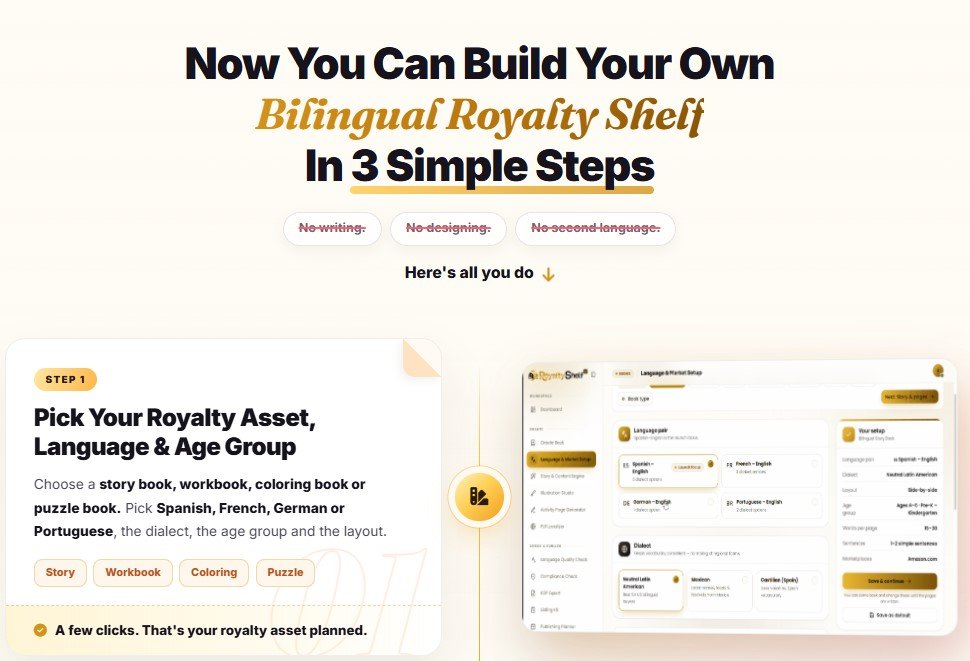
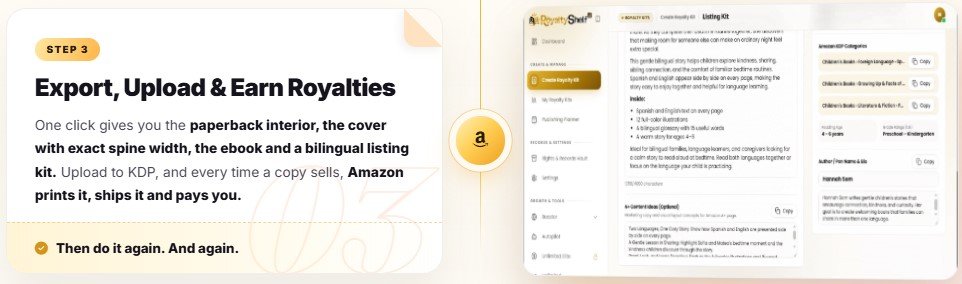
Understanding the daily workflow inside RoyaltyShelf AI helps clarify how much manual effort is removed and where your personal input still matters. The software organizes book production into four sequential stages inside its web interface.
The first stage involves selecting your bilingual niche and book structure. Inside the dashboard, you choose the type of educational asset you want to build. Common formats include bilingual early readers, English-Spanish vocabulary workbooks, dual-language sight word trackers, everyday phrase builders for kids, and screen-free classroom reading companions. You specify the target reader profile, such as preschoolers, elementary students, or Dual Language Immersion learners, so the reading complexity matches buyer expectations.
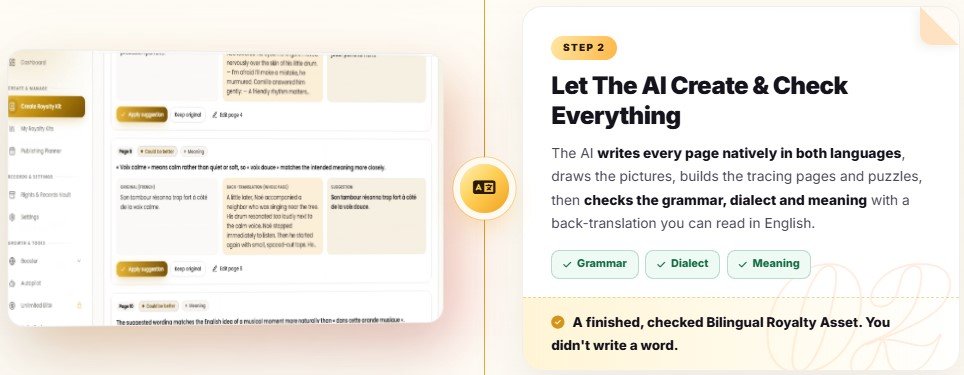
The second stage triggers the dual-language content engine. Based on your topic parameters, the system drafts structured content in both English and Spanish simultaneously. Instead of writing an English book first and running a clumsy bulk translation afterward, the software constructs parallel learning blocks. Each story beat, vocabulary word, comprehension question, or practice exercise is paired directly with its target-language equivalent.
The third stage runs the line-by-line verification process. Translation drift is a notorious problem in automated publishing. A single word in English can carry five different meanings in Spanish depending on context. For instance, the English word “spring” could mean a season, a metal coil, or jumping upward. During this stage, RoyaltyShelf AI cross-examines each paired line to confirm contextual accuracy, natural sentence flow, and grade-appropriate grammar. You can also preview every line inside the editor and make manual tweaks whenever you want to customize a phrase.
The fourth and final stage handles KDP print engineering and export. You pick your desired Amazon paperback trim size, such as a standard six-by-nine-inch reader or a larger eight-and-a-half-by-eleven-inch workbook. The layout engine automatically applies proper interior margins, gutter spacing, page numbering, and symmetric dual-language formatting.
With one click, you export a print-ready PDF manuscript ready for direct upload into your free Amazon KDP dashboard. Once uploaded alongside your book cover and listing metadata, Amazon’s automated print network takes over physical production, Prime shipping, and royalty accounting whenever a shopper clicks buy.
Watch The Demo Video
100-Word Quick Answer
RoyaltyShelf AI is a cloud-based publishing application built by Clicks Botz for Amazon Kindle Direct Publishing. It helps users create print-ready bilingual educational books, primarily in English and Spanish, without fluency in a second language or graphic design skills. The software drafts dual-language content, checks line-by-line alignment, and formats manuscripts to meet Amazon KDP trim and margin rules. Parents, teachers, and homeschoolers actively buy physical screen-free learning books, leaving less competition than blank journals. While RoyaltyShelf AI speeds up book production, your actual royalty income still depends on smart keyword research, attractive covers, and careful human proofreading before publishing online.

Product Overview
Before diving deep into market evidence and unit economics, let us look at a clear, straightforward snapshot of the core specifications behind RoyaltyShelf AI. Having the basic facts in one place makes it much easier to see how this platform fits into a modern self-publishing setup.
In plain terms, this is a browser-based software tool sold through the Launchpad platform. You do not download heavy installation files or pay per-page printing fees upfront. Your Amazon KDP account remains completely free to open and operate, meaning your software access is your primary startup tool expense.
| Specification | Details |
| Product Name | RoyaltyShelf AI |
| Creator / Vendor | Clicks Botz |
| Launch Marketplace | Launchpad |
| Primary Publishing Channel | Amazon Kindle Direct Publishing (Print-on-Demand & Kindle) |
| Core Niche Focus | Screen-Free Bilingual Educational Books (English / Spanish Focus) |
| Software Delivery | 100% Cloud-Based Web Application (Mac, Windows, Chromebook) |
| Skill Level Required | Beginner to Intermediate Self-Publishers |
| Fulfillment Model | Amazon Prints, Ships, and Handles Customer Support |
| Revenue Mechanism | Recurring Amazon KDP Royalties Per Unit Sold |
The core distinction here is specialization. Rather than trying to be an all-purpose graphic design suite where you drag text boxes around a blank canvas for six hours, the platform uses structured educational layouts designed specifically to pass Amazon’s automated print preflight checks without margin errors.
Who It’s For
Not every software tool suits every online entrepreneur. RoyaltyShelf AI serves a distinct group of users who value structured educational publishing over speculative internet fads.
First, this platform is built for aspiring and current Amazon KDP publishers who feel frustrated by low-content saturation. If you have ever uploaded twenty lined journals or simple coloring books only to watch them sit at zero sales underneath three million competing listings, moving up into bilingual educational books offers a logical upgrade path. Educational books solve an urgent buyer need, command higher retail prices, and face far fewer copycat competitors.
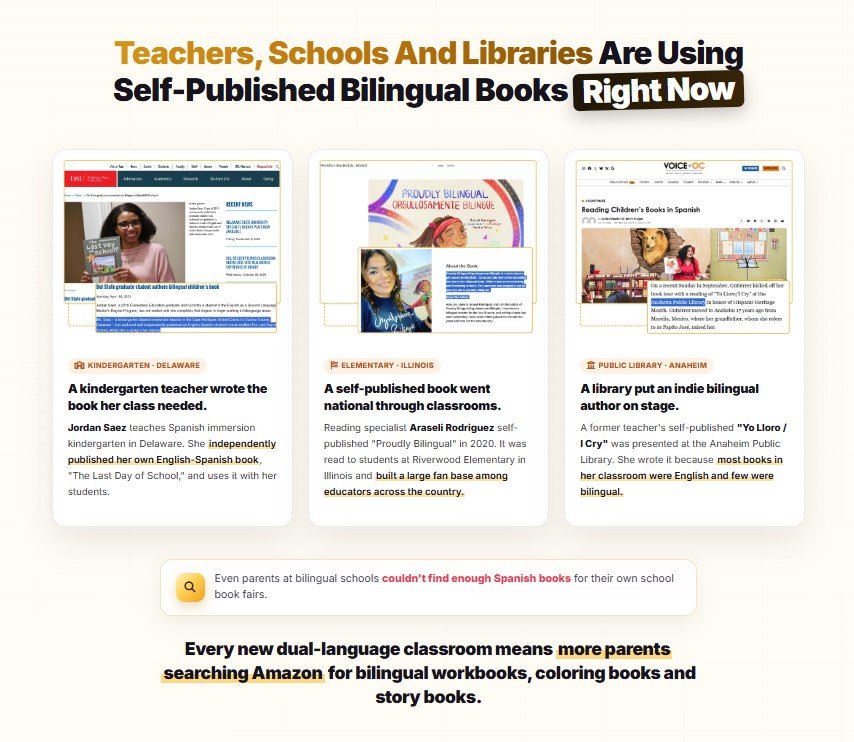
Second, educators, ESL tutors, speech therapists, and homeschooling parents will find tremendous practical value here. Teachers already understand how children absorb vocabulary and sentence structure. However, most teachers lack the time or technical layout skills to package their curriculum ideas into commercial paperbacks on Amazon. This tool lets educators turn classroom concepts into polished bilingual books over a weekend.
Third, busy side-hustlers and solo digital creators who want an asset-based income model fit this workflow well. Freelancing trades hours for one-time payments. Client work stops paying the moment you stop typing. Publishing physical books on Amazon builds a cumulative catalog where titles published in January can still earn royalties during the back-to-school rush in August and holiday shopping season in December.
Conversely, who should skip this product? Anyone looking for a zero-effort lottery ticket should walk away now. If you refuse to spend twenty minutes researching what parents actually type into Amazon’s search bar, or if you plan to upload fifty unreviewed books blindly hoping to strike gold overnight, no publishing tool on earth will save poor execution.
What I Verified
Marketing pages often paint a rosy picture of untapped markets. To give you an honest, evidence-based evaluation of RoyaltyShelf AI, I examined the real-world data behind three central pillars of its pitch: the American bilingual boom, the screen-free parenting shift, and Amazon KDP’s actual publishing rules.
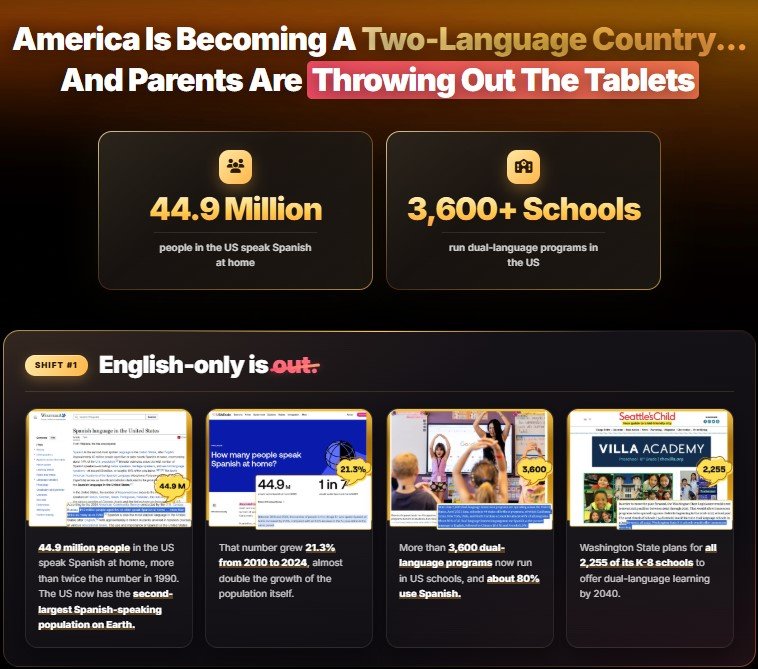
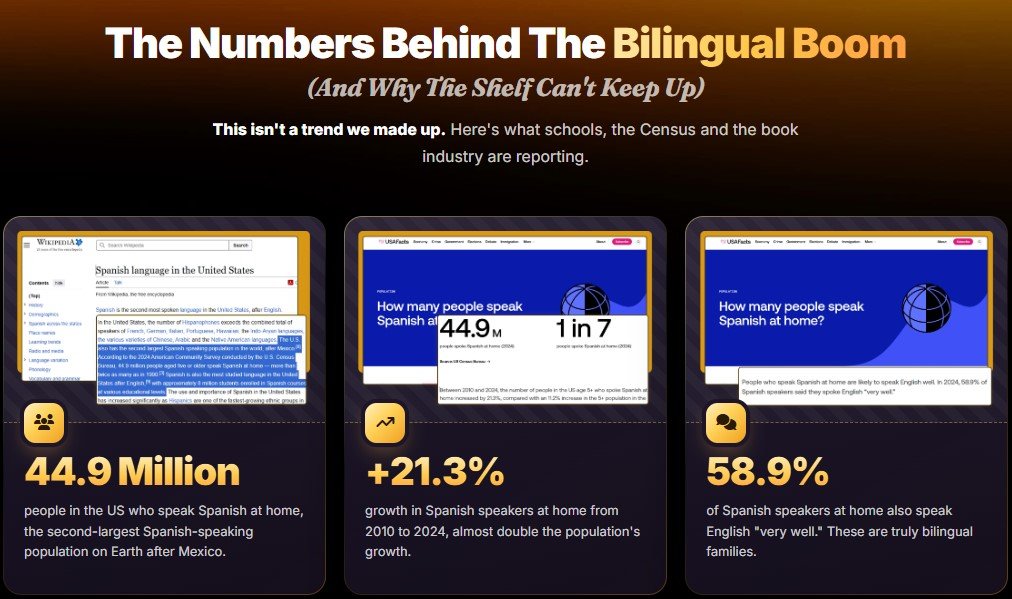
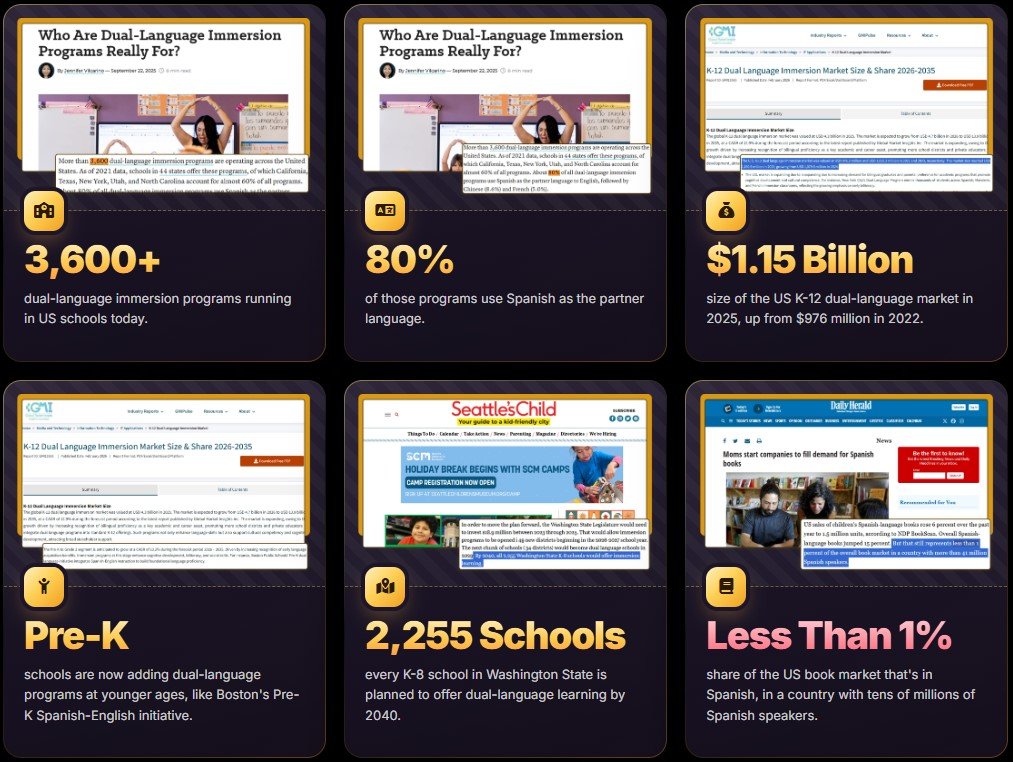
First, the bilingual demand across the United States is completely real and backed by hard demographic data. According to U.S. Census Bureau figures, over forty-two million residents speak Spanish at home, making the United States one of the largest Spanish-speaking nations in the world. Even more important for book publishers is the explosion of Dual Language Immersion programs in American public schools. Over the past decade, thousands of elementary schools across Texas, California, Florida, New York, Illinois, and Utah have launched dual-language tracks where English-speaking and Spanish-speaking children learn both languages together.
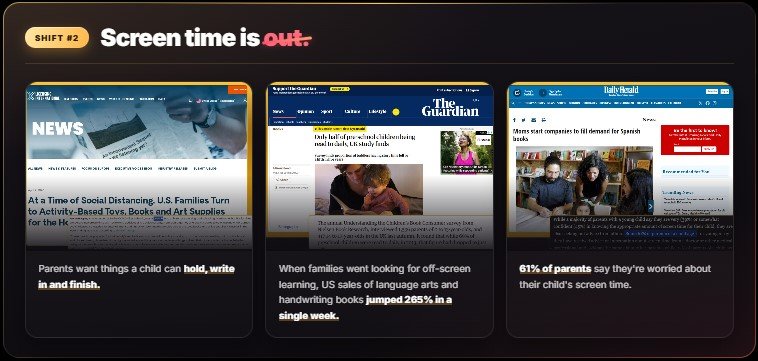
Second, the demand for physical, screen-free learning tools is equally verifiable. Following years of remote tablet schooling, pediatric associations and public school districts have raised serious concerns over digital eye strain and shortened attention spans in young learners. Parents actively search Amazon for physical workbooks, bilingual bedtime readers, and tactile vocabulary trackers that pull kids away from iPads and smartphones. When you inspect Amazon Best Seller Ranks in categories like Children’s Spanish Language Books and Bilingual Education, well-made paperbacks routinely post strong, steady daily sales without facing millions of entrenched competitors.
Third, let us verify how Amazon KDP handles AI-created books and print royalties today. Does Amazon allow books created with tools like RoyaltyShelf AI? Yes, Amazon explicitly permits AI-generated and AI-assisted content on Kindle Direct Publishing, provided you follow two strict policies. First, you must check the truthful disclosure box during the KDP upload setup stating that artificial intelligence assisted in generating your text or images. Second, you must still verify quality and avoid spamming broken content. Amazon enforces a strict cap of three new book uploads per day per publisher account specifically to reward quality over reckless spam.
Furthermore, I verified the technical headache that makes bilingual books scarce on KDP. In typographical engineering, translating English into Spanish creates text expansion of fifteen to twenty-five percent. In a standard word processor, that extra length pushes Spanish paragraphs onto the next page, ruining side-by-side comparisons and breaking interior margin limits. Having a dedicated system that checks line alignment and formats trim boundaries directly solves a genuine mechanical obstacle that stops most solo publishers cold.

Key Features
Rather than listing dozens of minor dashboard buttons, let us examine the core functional features inside RoyaltyShelf AI that actually impact book quality and publishing speed.
Dual-Language Content Creation Engine
The centerpiece of the platform is its synchronized bilingual drafting engine. Instead of writing generic essays, the AI structures content around proven educational frameworks such as parallel short stories, themed vocabulary builders, conversational dialogues, and reading comprehension exercises. It generates both the primary language and second language in tandem, keeping tone and difficulty aligned for young learners or adult beginners.
Line-By-Line Linguistic Verification
Machine translation often stumbles over idioms, regional phrasing, and false cognates. A false cognate is a word that looks similar in two languages but carries completely different meanings. RoyaltyShelf AI runs a secondary verification pass across every paired line. It evaluates grammatical agreement, gender-noun matching in Spanish, and contextual fidelity so your readers receive trustworthy educational material rather than awkward literal translations.
Automated KDP Trim Size And Margin Formatting
Amazon KDP’s automated print preflight system is notoriously unforgiving. If a single page number or text box drifts a fraction of an inch into the outer trim zone or inner spine gutter, KDP rejects your entire PDF manuscript. This platform calculates exact margin tolerances automatically based on page count and standard KDP trim sizes, exporting clean, flattened PDF interiors ready for immediate upload.
Parallel Layout Templates For Screen-Free Learning
How two languages appear on a physical page determines how easily a child or student learns. Some books work best with side-by-side two-column layouts. Others work better with stacked alternating lines or facing-page formats where English sits on the left page and Spanish sits on the right page. The software provides purpose-built educational layout structures that handle Spanish text expansion gracefully without ugly page overflows.
In-App Manuscript Editor For Human Customization
No automated tool should lock you out of your own book. Inside the browser workspace, publishers have full access to edit, rewrite, swap vocabulary words, add custom teacher notes, or personalize introductions before generating the final print file. This flexibility makes it easy to inject unique human personality into every title you publish.
Built-In KDP Metadata And Positioning Guidance
Writing a great bilingual workbook only solves half the puzzle. Customers still need to find your book when they type search phrases into Amazon. The software assists users in crafting relevant book titles, subtitles, descriptions, and backend search concepts tailored to parents and teachers shopping for dual-language resources.
Key Benefits
Features tell you what code does on a screen, while benefits reveal what changes in your publishing workflow and bank account. Using RoyaltyShelf AI delivers four practical advantages over traditional manual self-publishing.
The first major benefit is escaping low-margin, hyper-competitive KDP niches. Selling a blank lined notebook usually nets a tiny one-dollar royalty while forcing you to compete against giant stationery brands. Bilingual educational books deliver real instructional value. Parents and schools willingly pay ten to fifteen dollars for structured dual-language learning books, doubling or tripling your net royalty per sale while placing your title on a much quieter digital shelf.
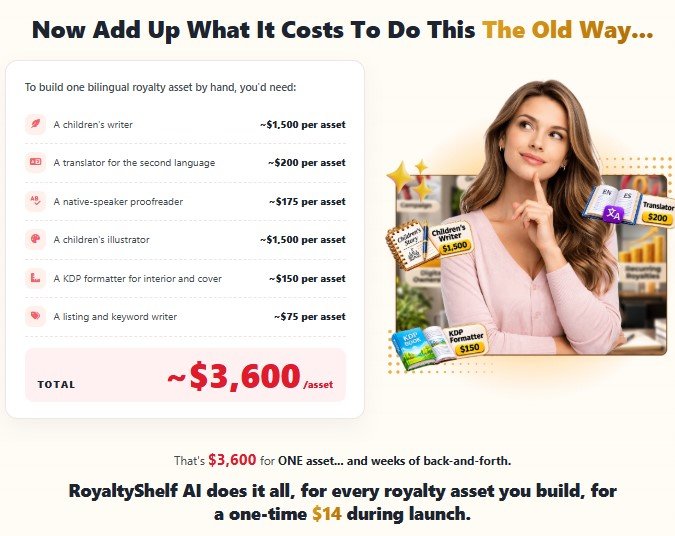
The second benefit is eliminating steep translation and typesetting expenses. Hiring a qualified bilingual translator on freelance marketplaces typically costs between four and ten cents per word, plus another hundred dollars or more for a book formatter to align dual-language columns in Adobe InDesign. Launching ten books manually could easily cost two thousand dollars upfront before earning a penny. Automating the initial drafting, line checking, and print layout reduces your per-book production cost to virtually zero.
The third benefit is speed to market for seasonal buying waves. Educational book sales spike predictably during summer bridge learning in June, back-to-school shopping in August, and holiday gifting in November and December. Because RoyaltyShelf AI condenses weeks of formatting struggle into a focused afternoon workflow, solo publishers can build cohesive book series around high-demand topics right when buyers are actively filling their carts.
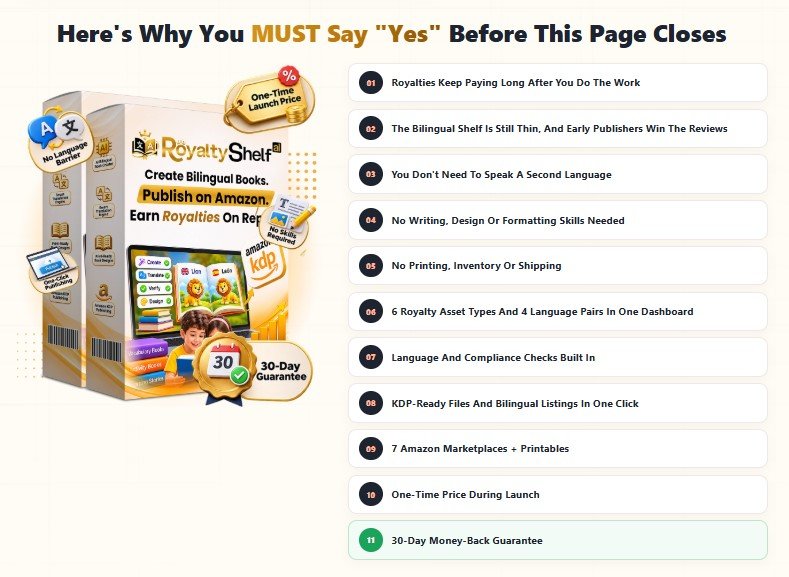
The fourth benefit is leveraging Amazon’s hands-free fulfillment engine. Unlike e-commerce stores where you buy inventory from overseas factories, rent garage space, print shipping labels, and deal with angry refund emails over lost packages, KDP print-on-demand handles all logistics. You upload digital files once, and Amazon manages manufacturing, global Prime delivery, and customer support indefinitely.
Practical Analysis
To give you genuine value beyond sales page talking points, let us break down the exact unit economics of publishing a bilingual paperback on Amazon KDP using RoyaltyShelf AI, followed by a smart strategic blueprint to maximize real sales.
Let us run honest numbers using Amazon’s official U.S. paperback royalty formula. Amazon pays a sixty percent royalty rate on the retail list price of your paperback, minus the physical printing cost per copy. Printing costs for standard black-and-white interior paperbacks in the United States consist of a small fixed base cost plus a per-page fee—specifically around $2.30 flat for books up to 108 pages, or $1.00 fixed plus $0.012 per page for books over 108 pages (exact rates vary slightly by ink type and marketplace).
Suppose you use RoyaltyShelf AI to create a 100-page English-Spanish Bilingual First Words & Reading Workbook for ages six to eight in a generous 8.5-by-11-inch classroom format with a crisp black-and-white interior and a full-color glossy cover. Because bilingual educational books carry higher perceived value than blank coloring books, you price the paperback competitively at $12.99.
Sixty percent of $12.99 equals $7.79. Subtracting Amazon’s approximate $2.30 printing deduction leaves you with roughly $5.49 in net profit royalty every single time one parent or teacher buys a copy. You never touch a printer, never buy envelopes, and never pay upfront inventory fees.
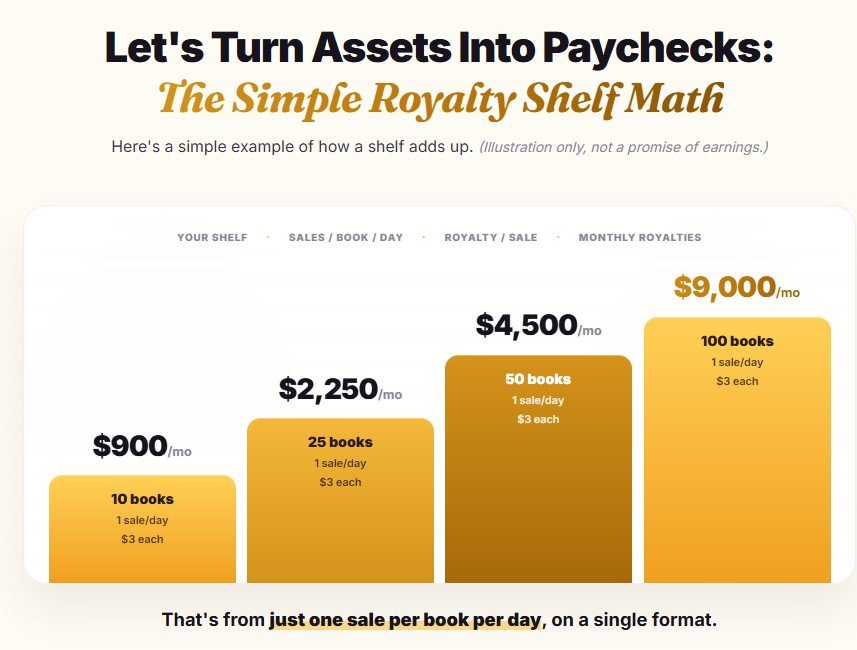
Now consider catalog compounding. A single book selling just two copies per day generates roughly sixty sales per month, equating to around $329 per month from one title. If you spend two months methodically researching sub-niches and publishing fifteen high-quality, carefully edited bilingual books that average even one sale per day each, those small streams combine into meaningful recurring income. Even better, school teachers frequently order five, ten, or twenty copies at once for Dual Language Immersion reading groups, creating sudden multi-unit royalty spikes from a single checkout.
How do you make sure your books actually earn five-star reviews and rank above lazy competitors? Never publish generic titles like “Spanish Book For Kids.” That phrase is far too broad. Instead, use RoyaltyShelf AI to target hyper-specific micro-niches where parents have urgent needs. Examples include Bilingual English-Spanish Bedtime Stories About Dinosaurs For Ages 4-6, Dual Language Sight Word Practice For 1st Grade Immersion Students, or Bilingual Medical Phrases Workbook For Healthcare Beginners.
Furthermore, combine series branding with human care. Create a recognizable series name across five or six levels so a parent who loves Level 1 automatically comes back to buy Levels 2 and 3. Read through every single generated manuscript before exporting. Add a warm introductory page explaining how parents can read the English line aloud first and let their child repeat the Spanish line together. Small, thoughtful human touches transform software-generated drafts into beloved educational books that earn organic word-of-mouth recommendations.

Limitations
No software tool is flawless, and people-first reviews must highlight honest weaknesses alongside strengths. Before investing in RoyaltyShelf AI, you should weigh five real-world limitations carefully.
First, linguistic regionalism requires publisher awareness. The Spanish language spoken in Mexico City differs in everyday vocabulary from the Spanish spoken in Madrid, Buenos Aires, or San Juan. For example, a simple everyday word like “straw” or “bus” changes completely depending on the country. While the software’s line verification ensures clean standard neutral Spanish, you should always specify Latin American Spanish if your primary target audience lives in the United States, and spot-check key nouns using a trusted bilingual dictionary like WordReference.
Second, heavy visual illustration books require external artwork coordination. If your goal is to produce lavishly painted, thirty-two-page full-color picture books where characters wear identical outfits across twenty consecutive scenes, text-and-layout automation alone will not magically draw Pixar-level sequential art. RoyaltyShelf AI shines brightest on text-driven bilingual readers, vocabulary workbooks, dual-language short story collections, comprehension guides, and structured classroom activity books.
Third, you still need standout book covers to win clicks on Amazon. Shoppers judge books by their covers in less than two seconds while scrolling search results on mobile phones. Even if the software includes basic cover helpers, investing thirty minutes in Canva or hiring an affordable cover designer to craft a bold, vibrant, parent-friendly cover will dramatically improve your click-through conversion rate.
Fourth, Amazon KDP does not hand out guaranteed free traffic simply because you clicked publish. While niche bilingual keywords have much lower competition than blank notebooks, your new book starts with zero customer reviews. You will need solid keyword optimization in your seven backend KDP search boxes, and some publishers choose to run modest five-dollar-a-day Amazon Sponsored Product ads during the first month to jumpstart initial sales velocity.
Fifth, Amazon enforces a strict Net-60 payout schedule. Even if you publish a book with RoyaltyShelf AI tonight and make ten sales tomorrow morning, Amazon pays royalties sixty days after the end of the month in which the sale occurred. KDP is a steady, cumulative wealth-building asset model, not quick cash to pay Friday’s electric bill.
Bonuses
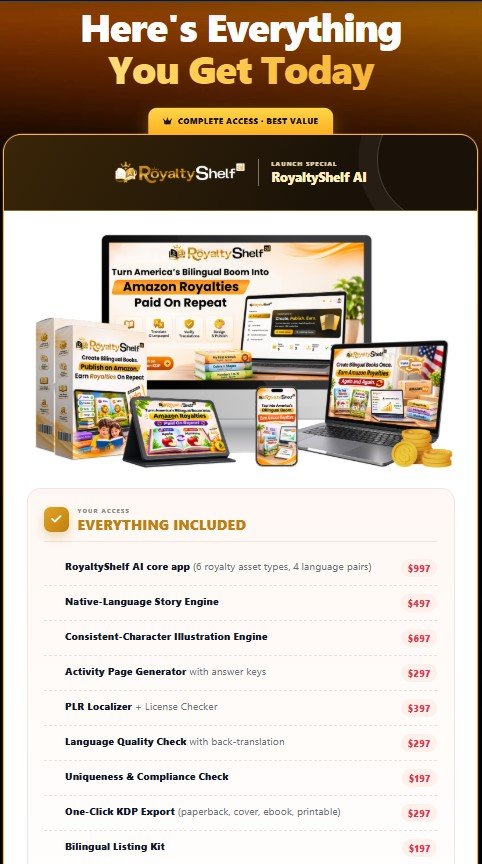
Software releases from Clicks Botz on the Launchpad marketplace typically bundle limited-time launch bonuses alongside front-end access to increase early buyer value and accelerate implementation.
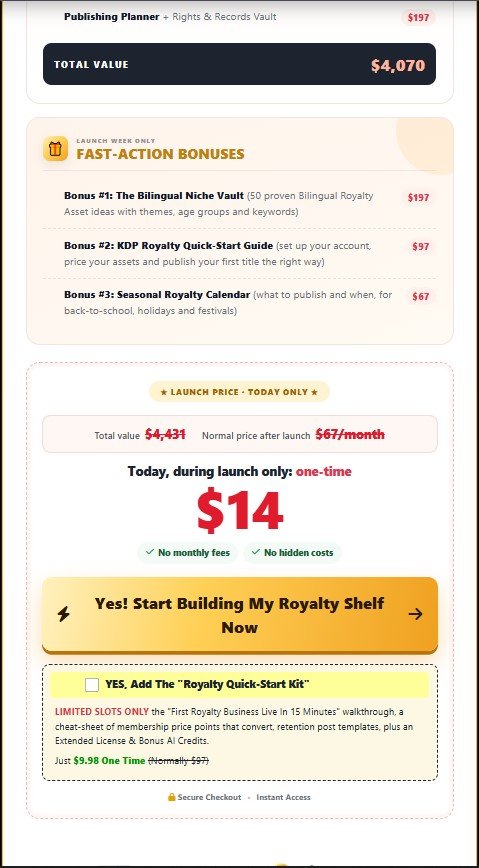
While exact bonus titles can rotate during special promotional windows on the live checkout page, launch packages in this series generally focus on bridging the marketing gap after your PDF manuscript is exported. Common value-adds include curated KDP bilingual niche research checklists, quick-start video walkthroughs demonstrating exact KDP dashboard upload settings, seven-box backend keyword selection guides, and commercial publishing rights so you keep one hundred percent of all royalties earned on Amazon or third-party marketplaces like Barnes & Noble Press and IngramSpark.
A word of practical advice when evaluating bonuses on any software sales page: ignore inflated “retail value” stickers claiming a ten-page PDF checklist is worth nine hundred dollars. Instead, judge bonuses strictly by how much time they save you during your first week. Step-by-step KDP upload tutorials and vetted bilingual sub-niche lists carry genuine utility for beginners because they prevent rookie category mistakes right out of the gate. Always check the bottom of the official sales page prior to checkout to verify the exact active bonus roster included with your license.
Pricing & OTOs

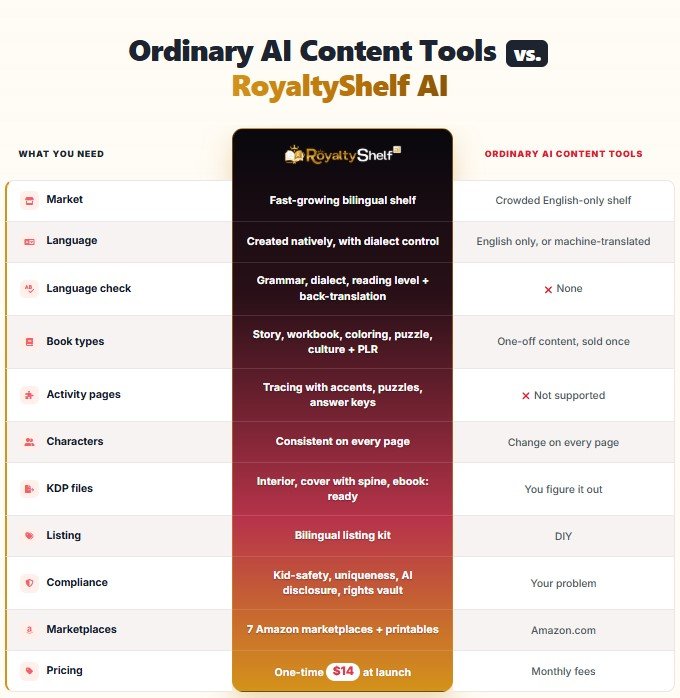
Understanding the full pricing funnel before clicking buy helps you budget wisely and avoid impulse upgrades you do not actually need. Like most Clicks Botz software launches on Launchpad, RoyaltyShelf AI uses a low one-time front-end entry price supported by optional One-Time Offers (OTOs) after initial checkout.
Please note that Launchpad vendors frequently apply dynamic early-bird pricing or small coupon codes on the live sales page, meaning exact dollar figures can shift slightly by a few dollars after launch week. Below is a clear breakdown of the standard product funnel structure and typical price bands so you know what to expect.
| Funnel Stage | Tier Name / Focus | Typical Price Range | What It Adds & Who Needs It |
| Front-End (FE) | RoyaltyShelf AI Core Commercial | $17 – $27 (One-Time) | Core dual-language creation engine, line-by-line checker, KDP print formatting, and commercial publishing rights. Ideal starting point for everyone. |
| OTO 1 | Unlimited / Pro Edition | $37 – $67 | Removes monthly book creation caps, unlocks faster priority rendering, additional layout templates, and broader language pairs beyond core caps. Best for high-volume catalog builders. |
| OTO 2 | Done-For-You (DFY) Bilingual Vault | $67 – $147 | Pre-built, ready-to-customize bilingual book packages, niche research packs, and cover templates for rapid deployment. Helpful if short on time, though editing is still wise. |
| OTO 3 | Automation & Multi-Platform Suite | $37 – $67 | Streamlines series organization, metadata batching, and formatting expansions for wider print networks like IngramSpark or Lulu. Optional convenience upgrade. |
| OTO 4 | Buyer Traffic & Ranking Accelerator | $47 – $97 | Training and tools focused on external book promotion, Pinterest/social book visibility, and driving initial launch clicks to KDP listings. |
| OTO 5 | Agency / Client Publishing License | $97 – $197 | Allows you to produce bilingual KDP books as a paid service for schools, local authors, or Fiverr/Upwork clients. Only needed if running a client service agency. |
Here is my candid recommendation on navigating this funnel: start with the Front-End license first. Test the interface, create your first two bilingual books, and experience the KDP upload process firsthand. If you fall in love with the workflow and run into usage ceilings while scaling up a twenty-book series, OTO 1 (Unlimited/Pro) is usually the single most practical upgrade for serious KDP publishers. Beginners on a tight budget can safely skip the Done-For-You and Agency tiers until they have earned back their initial software investment from real book royalties.
Comparative Analysis Of The Product With Existing Products
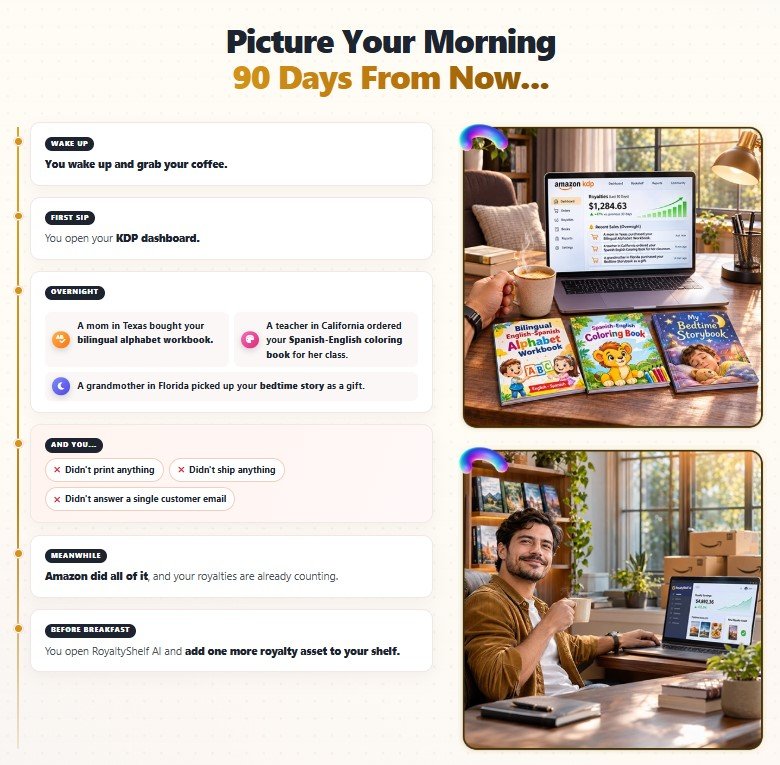
How does RoyaltyShelf AI stack up against cobbling together existing general-purpose tools already sitting on the market? Most self-publishers today try one of three existing routes: raw AI chatbots paired with graphic canvases, legacy low-content puzzle software, or standard eBook generators.
First, let us compare RoyaltyShelf AI against combining ChatGPT with Canva and Kindle Create. On paper, you could prompt ChatGPT to write twenty bilingual stories, copy and paste every paragraph one by one into eighty separate Canva pages, eyeball the margins manually, and export a PDF. In practice, anyone who has actually tried this knows how painful it becomes around page fifteen. ChatGPT frequently loses structural consistency halfway through a workbook, forgets previous vocabulary lists, and leaves Spanish text overflowing Canva text boxes. Canva also lacks dynamic gutter margin scaling for KDP spine thickness. RoyaltyShelf AI consolidates drafting, line-level QA, and KDP print margin math into one unified workflow, saving hours of tedious copy-pasting per book.
Second, let us compare it against traditional KDP software tools like Book Bolt or Tangent Templates. Book Bolt is an exceptional platform for keyword research, word searches, Sudoku puzzles, and blank lined interiors. However, Book Bolt does not write structured dual-language reading lessons, bilingual stories, or line-checked English-Spanish educational texts. In fact, the two tools barely overlap—one builds wordless puzzle grids and researches keywords, while Clicks Botz’s platform builds substantive bilingual instructional interiors.
Third, let us compare it against older marketing eBook makers like Sqribble or Designrr. Those older platforms were engineered to turn blog posts into colorful digital lead magnets with bright background graphics meant to be read on computer monitors. If you try uploading a Sqribble PDF to Amazon KDP Print, it fails immediately due to non-standard page ratios, bleed violations, and ink saturation issues. RoyaltyShelf AI builds clean, ink-efficient interiors calibrated specifically for physical paperback printing presses.
Alternatives
Smart buyers always examine viable alternatives before committing to any software platform. Depending on your budget, language fluency, and technical background, several alternative workflows deserve honest consideration.
Alternative 1: DeepL Pro + Atticus (Best For Fluent Bilingual Authors)
If you already speak both English and Spanish fluently and prefer writing original manuscripts from scratch, pairing DeepL Pro ($8.99/month) with Atticus ($147 one-time) is a strong professional setup. DeepL offers world-class neural translation assistance, while Atticus formats standard novels cleanly for print. However, Atticus struggles with complex two-column parallel workbook tables compared to specialized educational formatters, and the combined upfront cost approaches two hundred dollars.
Alternative 2: Publisher Rocket (Best Complementary Research Tool)
Publisher Rocket ($199 one-time) does not write or format books at all, so it is not a direct replacement for RoyaltyShelf AI. Instead, it analyzes real-time Amazon buyer search volume, competitor monthly earnings, and KDP categories. If you have extra budget later on, pairing Publisher Rocket for niche discovery with RoyaltyShelf AI for bilingual book production creates a formidable two-tool publishing stack.
Alternative 3: Book Bolt (Best For Puzzle & Low-Content Publishers)
Priced around $9.99 to $19.99 per month, Book Bolt remains the gold standard if you prefer publishing crosswords, mazes, cryptograms, and activity trackers rather than language-learning books. If you dislike text proofreading altogether and only want visual puzzle books, Book Bolt is the better fit, though recurring monthly subscriptions add up over twelve months compared to a one-time software license.
Alternative 4: Adobe InDesign + Human Freelance Translators (Best For Traditional Publishers)
Established publishing houses with multi-thousand-dollar budgets hire certified native translators on Reedsy or ProZ and typeset manuscripts inside Adobe InDesign ($22.99/month). This produces heirloom bookstore quality and zero AI disclosure requirements, yet requires steep technical training and $500 to $1,500 in capital per title—placing it out of reach for everyday beginners testing niche ideas.

Pros & Cons
Every publishing platform involves trade-offs between automation convenience and manual artisan control. Looking objectively across the entire feature set and market reality, here is a balanced summary of where RoyaltyShelf AI excels and where it falls short.
The Pros:
The standout strength of RoyaltyShelf AI is its laser focus on a genuinely underserved, high-demand print category—screen-free English and Spanish educational books—rather than saturated blank journals. Its integrated line-by-line bilingual verification solves the biggest anxiety solo publishers face when working in a second language. Furthermore, automated KDP trim and gutter formatting eliminates frustrating PDF rejection loops during upload. Because it runs completely in the cloud and launches at an accessible one-time front-end price, beginners can test educational self-publishing without recurring monthly software overhead or expensive freelance translation bills.
The Cons:
On the downside, automated AI content still requires diligent human review before publication to ensure regional Spanish phrasing feels natural and pedagogical exercises make complete logical sense. The software specializes heavily in structured text and workbook layouts rather than complex, character-consistent full-color picture books. Like many Launchpad releases, the checkout process includes multiple optional upsells that require disciplined evaluation. Finally, users must still handle external KDP keyword research, attractive cover design, and Amazon’s mandatory AI-disclosure compliance on their own.

Who Will Be Benefited From This Product?
Looking at practical real-world scenarios makes it easy to see who extracts the highest return on investment from RoyaltyShelf AI.
Stalled KDP Publishers Ready To Pivot Upward
Thousands of people already own an active Amazon KDP account filled with ten or twenty low-content notebooks earning pennies a month. These users already know how to upload a cover and fill out KDP tax forms. Handing them a streamlined engine to produce substantive 80-to-120-page bilingual workbooks immediately upgrades the quality, retail price point, and organic discoverability of their catalog.
Bilingual & ESL Classroom Educators
Teachers working in Dual Language Immersion programs or ESL classrooms spot curriculum gaps every single week. Maybe their third-grade students struggle with Spanish past-tense verbs, or kindergarten parents ask for simple English-Spanish sight word practice over summer break. Educators can use this tool to turn those exact classroom pain points into published Amazon paperbacks that help students nationwide while supplementing teacher salaries.
Bilingual Households & Homeschooling Creators
Heritage Spanish speakers raising bilingual kids in English-dominant neighborhoods often feel disappointed by generic store-bought textbooks. They possess the cultural intuition and native ear to spot-check Spanish phrasing effortlessly, allowing them to use RoyaltyShelf AI to produce culturally warm, accurate bilingual readers in a fraction of the time it would take to write and format from scratch.
Digital Side-Hustlers Seeking Faceless Asset Income
Not everyone wants to film TikTok dances, show their face on YouTube, or jump on high-pressure Zoom sales calls with agency clients. Publishing educational books under specialized pen names or educational imprint brands on Amazon KDP lets introverted creators build quiet, faceless intellectual property assets from a laptop at their own pace.
Final Verdict
Stepping back from all the hype that usually surrounds software launches, RoyaltyShelf AI earns high marks for picking the right problem to solve. Most publishing tools encourage beginners to flood Amazon with more disposable clutter nobody asked for. Steering creators toward screen-free bilingual educational books aligns software automation with real-world parent, teacher, and school demand.
Is this tool a magical push-button ATM that deposits royalties while you ignore quality altogether? Absolutely not. Anyone telling you that uploading unedited AI files guarantees instant wealth is misleading you. Amazon rewards books that delight real readers, earn positive parent reviews, and target smart, specific search keywords.
However, when viewed accurately as a specialized production accelerator, RoyaltyShelf AI delivers undeniable practical value. It removes the three steepest barriers keeping solo creators out of the lucrative English-Spanish educational market: initial dual-language drafting, line-by-line contextual alignment, and finicky KDP print margin formatting. Replacing hundreds of dollars in translation and typesetting costs with an affordable, browser-based tool dramatically lowers the risk of testing new educational book concepts.
If you are willing to spend time researching specific bilingual sub-niches, reviewing your generated manuscripts with care, crafting appealing covers, and building a clean catalog consistently over time, RoyaltyShelf AI is a smart, cost-effective addition to your self-publishing toolkit.
Frequently Asked Questions
Do I need to speak Spanish fluently to use RoyaltyShelf AI?
No, fluency in a second language is not required to operate the platform. The software drafts content in both languages simultaneously and runs an internal line-by-line verification check to align vocabulary and grammar. However, smart publishers still run quick spot-checks on key titles and vocabulary lists using reliable bilingual dictionaries to ensure regional clarity for their target buyers.
Does Amazon KDP allow books created with RoyaltyShelf AI?
Yes, Amazon Kindle Direct Publishing allows books created with AI assistance, provided you follow their content guidelines and truthfully check the mandatory AI-disclosure box during the KDP book setup process. Amazon cares deeply about buyer satisfaction, so reviewing your manuscript thoroughly and formatting margins cleanly ensures smooth approval and happy customer reviews.
Does it cost money to upload and print books on Amazon KDP?
Opening an Amazon KDP account and uploading paperback or Kindle manuscripts is one hundred percent free. You never buy physical books upfront. Amazon only prints a copy after a customer places a paid order on Amazon, deducts the small single-book printing fee directly from the retail sale price, and sends you the remaining royalty profit.
How many books can I upload to Amazon KDP per day?
Amazon currently enforces a platform-wide limit of three new book submissions per day per KDP account. Honestly, even publishing two or three well-researched, carefully proofread bilingual books per week is plenty fast enough to build a strong, sustainable educational catalog over a single year.
Can RoyaltyShelf AI create both paperbacks and Kindle eBooks?
While the primary marketing focus highlights physical screen-free print books—where parent and classroom demand is strongest and margins are healthiest—KDP-formatted manuscripts can also be adapted for digital tablet reading or sold across secondary print-on-demand distributors like Barnes & Noble Press if you hold standard commercial rights.
Are there recurring monthly fees to keep using the software?
During the active Launchpad release window, the Front-End version of RoyaltyShelf AI is offered for a low one-time payment rather than a mandatory monthly subscription. Always double-check the pricing box on the live sales page before ordering, as vendors occasionally transition launch deals to recurring models once initial launch periods close.
How quickly will I receive royalty payouts from Amazon?
Amazon KDP operates on a standard Net-60 accounting cycle via direct bank deposit (EFT) in most major countries. For example, royalties earned from books sold throughout the month of March are deposited directly into your bank account around the end of May. Once your catalog is rolling consistently, those payouts arrive every single month thereafter.
What kind of computer do I need to run RoyaltyShelf AI?
Because the entire application runs in the cloud, you do not need an expensive gaming computer or specific operating system. Any modern desktop, Windows laptop, MacBook, or Chromebook with a stable internet connection and updated web browser will run the dashboard smoothly.
How do I make sure my bilingual books actually sell once uploaded?
Focus on specific buyer problems rather than vague topics. Instead of publishing a broad general dictionary, create targeted resources like Bilingual Spanish-English Sight Words For Kindergarten or Dual Language Short Stories About Farm Animals. Combine specific search keywords in your subtitle with a clean, professional cover and clear Amazon Look Inside preview pages so parents feel confident buying immediately.