Introduction
Writing and formatting a book for Amazon Kindle Direct Publishing takes serious effort. You spend weeks researching your niche. You draft the chapters or design the interior pages. You polish the cover until it looks professional. Finally, you hit the publish button and wait for the royalties to roll in. For the vast majority of self-published authors, what follows is complete silence. Your book sits buried on page forty of the Amazon search results. Nobody sees it because Amazon primarily promotes books that are already making consistent sales.
This creates a frustrating catch-22 for independent authors. To get organic visibility on Amazon, you need steady sales. To get steady sales, you need visibility. Usually, the standard advice is to run Amazon Pay-Per-Click ads or build a massive following on TikTok and Instagram. However, Amazon ads have become fiercely competitive and expensive. It is very common for new authors to spend five dollars on clicks just to make a two-dollar royalty. Meanwhile, dancing on short-form video platforms feels exhausting and unnatural for writers who just want to publish books.
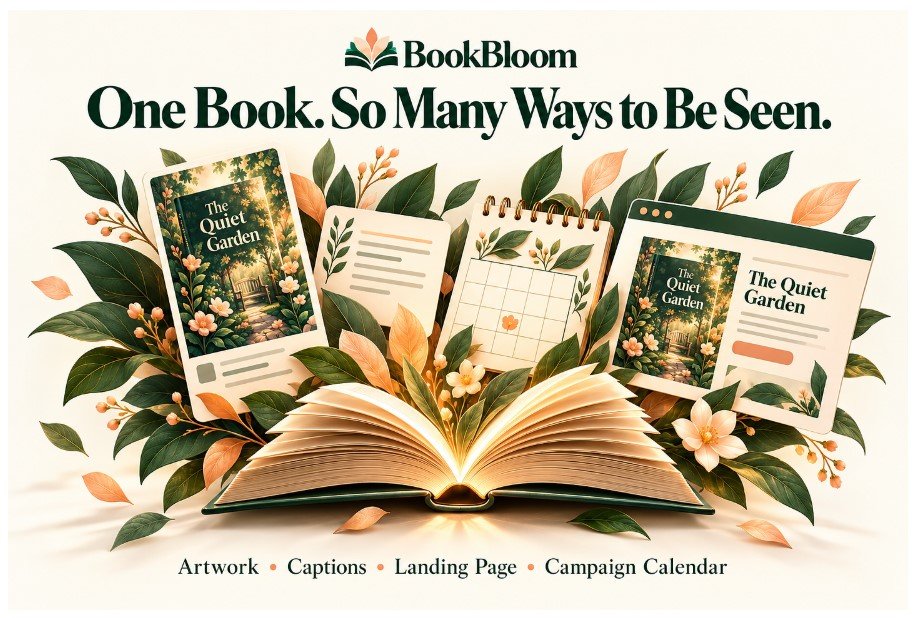
This exact traffic bottleneck is what BookBloom AI aims to solve. Created by digital product vendor Dpapa, this software takes a completely different approach to book marketing. Instead of forcing you to bid on expensive ad keywords or become a daily social media influencer, it uses Pinterest as a visual search engine. You enter your book details once. The system then builds an entire thirty-day promotional campaign around that single book. It generates the marketing angles, designs the visual pins, writes the search-optimized captions, maps out the board structure, and even builds a dedicated landing page to warm up readers before they click over to Amazon.
In this detailed review, we will look closely at how BookBloom AI actually functions under the hood. We will examine its core outputs, analyze the logic behind its bridge-page architecture, evaluate its honest limitations, and help you decide if it fits your self-publishing workflow.
Overview: BookBloom AI
To understand why BookBloom AI exists, you first need to look at how book discovery works outside of Amazon. Most authors treat Pinterest like a regular social media network. They think it works like Instagram or Facebook, where your posts only reach people who already follow your profile. In reality, Pinterest operates as a visual search and discovery engine. Millions of users go there every day with high commercial intent. They type specific problems, hobbies, aesthetic preferences, and reading tropes directly into the search bar.
When a user searches for stress-relief coloring ideas, cozy mystery book recommendations, or toddler bedtime routines, Pinterest serves them visual pins that match those exact keywords. A single well-optimized pin can continue driving traffic for months or even years after you publish it. The problem is that executing a proper Pinterest strategy for a book takes an enormous amount of manual labor. You have to brainstorm thirty different ways to talk about your book so you are not just spamming the same boring cover image. You have to open a graphic design tool and build thirty unique vertical graphics. You have to research keywords, write descriptions, organize boards, and build a website page to catch the traffic.
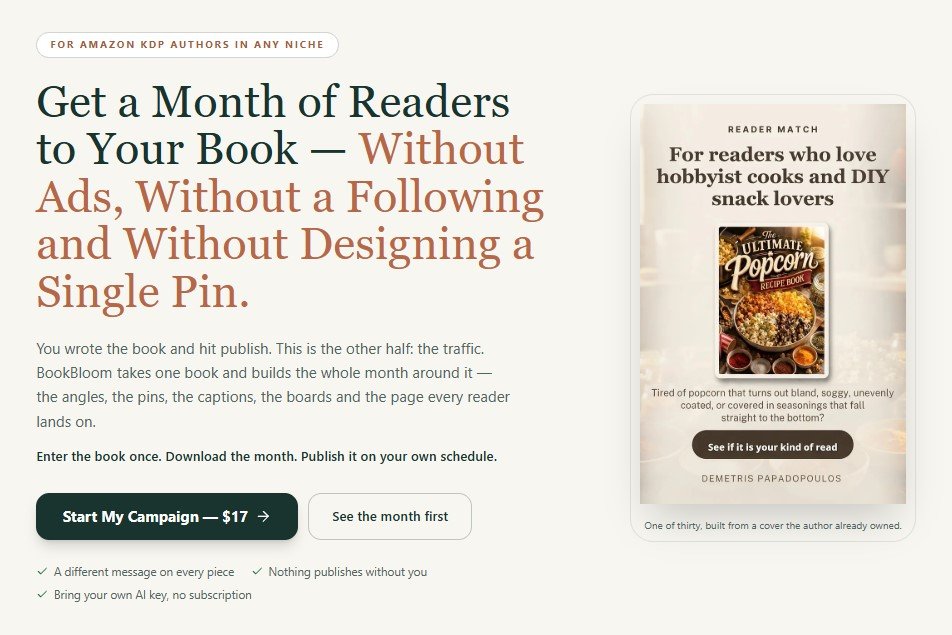
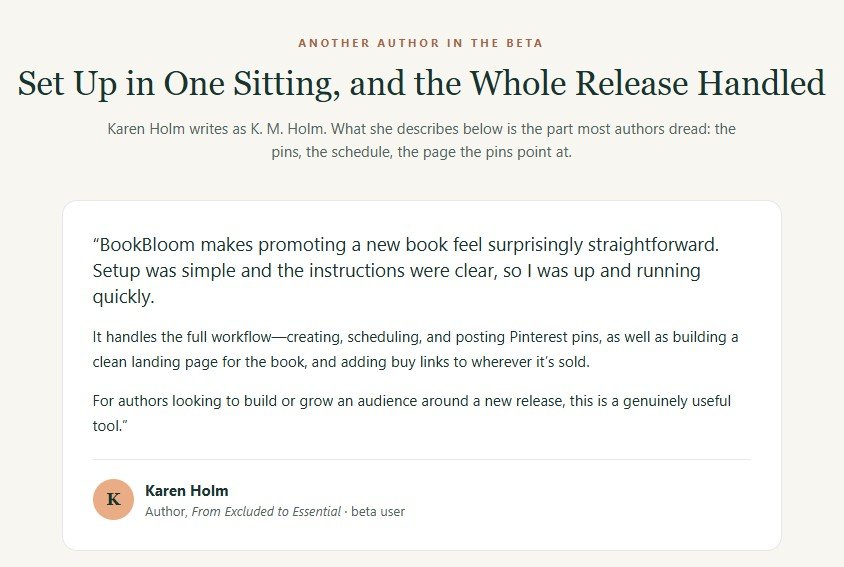
BookBloom AI condenses that entire monthly production cycle into a single automated workflow. It acts as an end-to-end campaign generator specifically engineered for Amazon KDP publishers. You feed the system your book title, description, genre, and target reader profile. Within minutes, the software unpacks your single book into a complete thirty-day content calendar. You do not need to touch a graphic design canvas. You do not need to write copy from scratch. Once the package is generated, you simply download your assets and publish them on your own schedule.

What is it?
BookBloom AI is a specialized, cloud-based marketing automation application designed exclusively for self-published authors and Amazon KDP creators. At its core, it is a single-input, multi-output content and funnel engine. Unlike generic artificial intelligence writing tools that only spit out raw text when you feed them complex prompts, this platform is pre-programmed with book marketing frameworks, visual template engines, metadata optimizers, and HTML page builders.
When you use BookBloom AI, you are not buying an automated bot that logs into your Pinterest account and spams links. Automated spamming violates platform terms of service and gets accounts banned quickly. Instead, this software is an asset-creation engine. It produces a comprehensive, downloadable thirty-day marketing kit tailored to one specific book at a time.
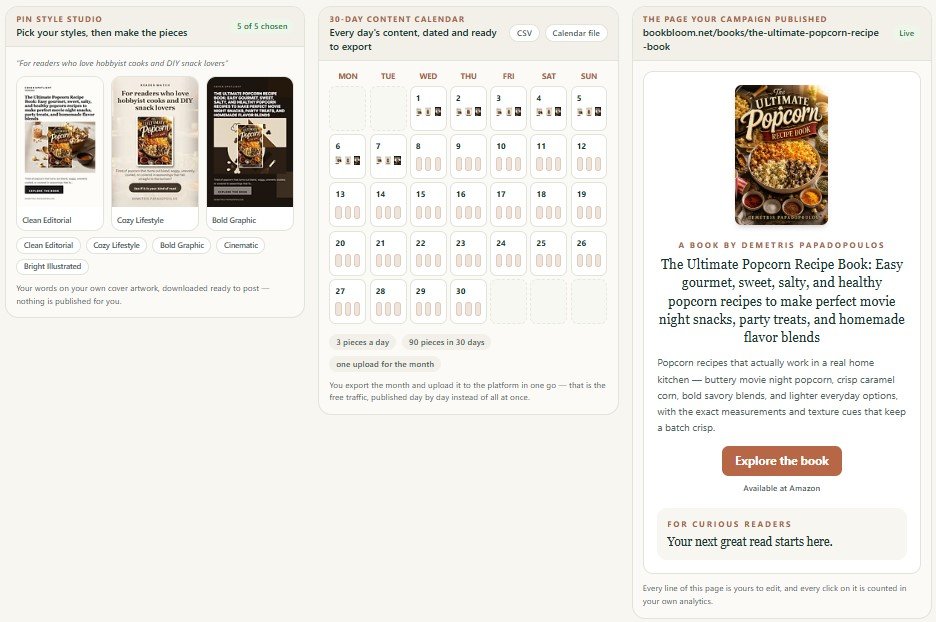
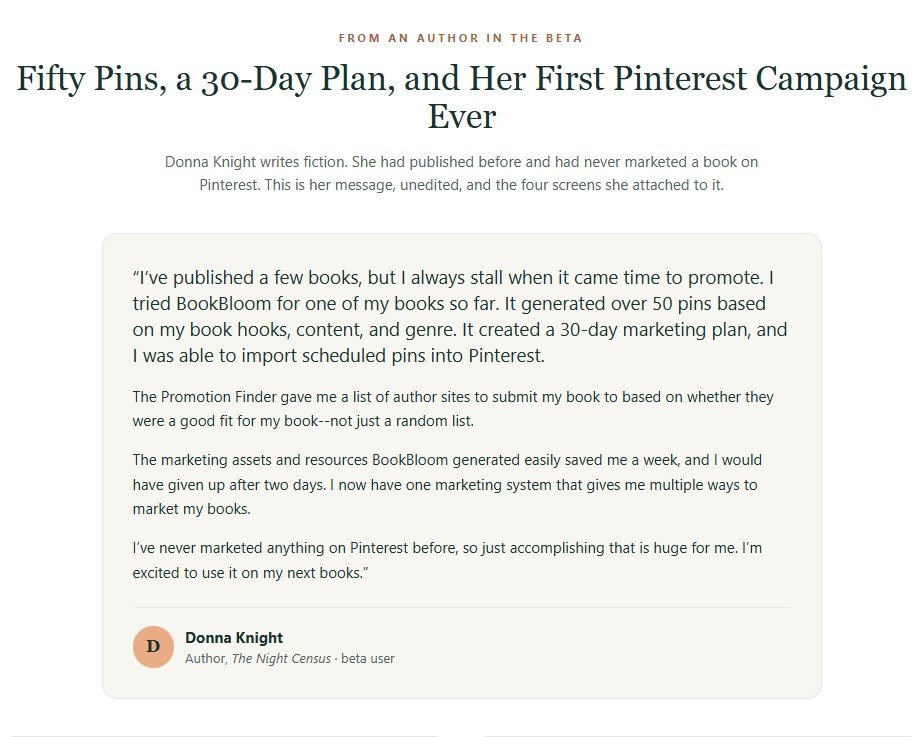
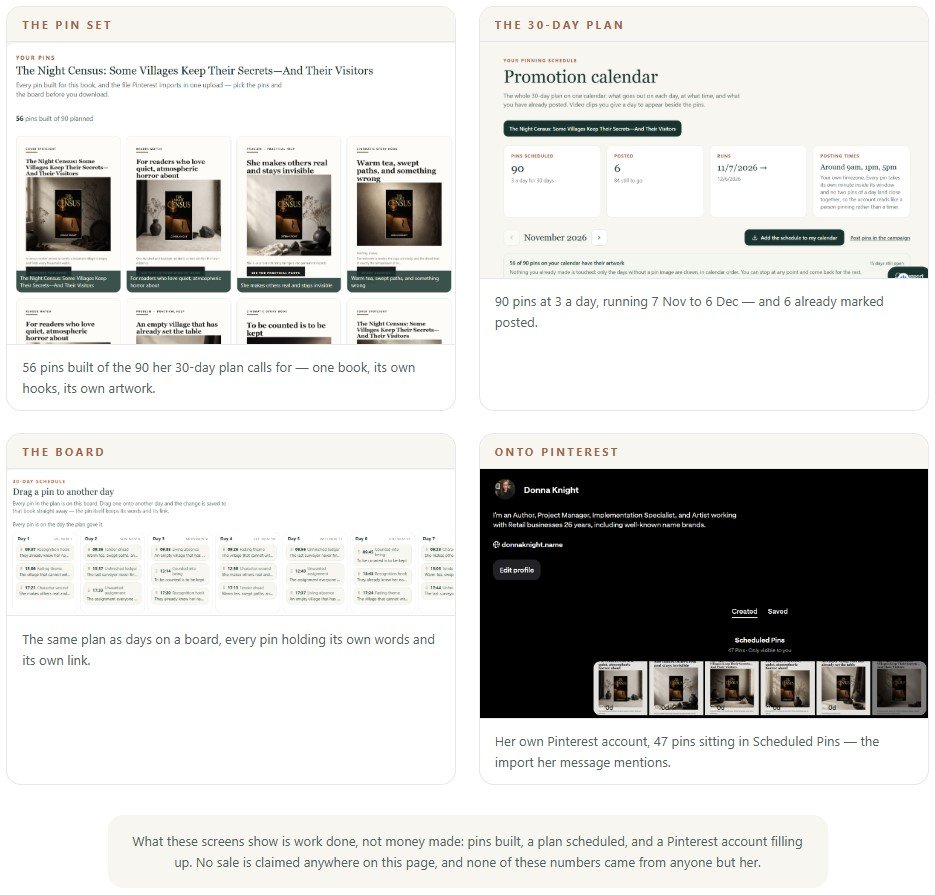
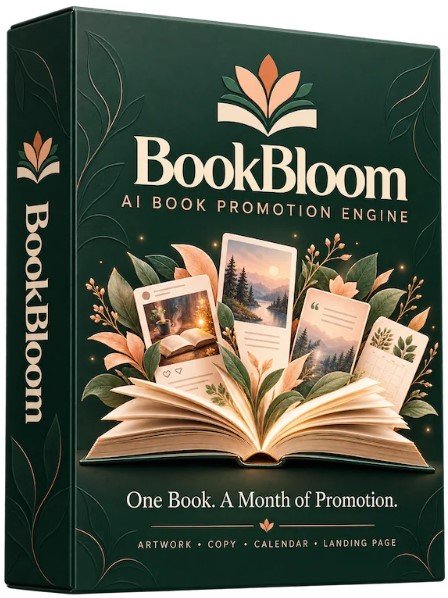
That kit contains five distinct components that work together as a unified traffic system. First, it generates thirty unique marketing angles so you can promote the same book all month without repeating yourself. Second, it automatically renders thirty ready-to-publish Pinterest pin images based on those angles. Third, it writes thirty keyword-rich titles and captions designed to rank in Pinterest search results. Fourth, it outlines the exact board names and descriptions you need to set up your profile properly. Fifth, it builds a dedicated reader landing page where all of your pins will point, ensuring your traffic is pre-sold before they ever reach your Amazon listing.
About The Creator

BookBloom AI was developed and brought to market by Dpapa, an established software vendor and digital marketer operating on the WarriorPlus platform. In the crowded marketplace of digital publishing tools, creator track records matter significantly. Many software launches in the make-money-online space are built by marketers who have never actually published a book or run a real content campaign. They release flashy, vague tools that promise one-click riches and stop working three weeks after launch.
Dpapa has built a much more grounded reputation by focusing specifically on practical bottlenecks faced by independent publishers, content creators, and niche marketers. His previous software releases consistently focus on workflow simplification, content structuring, and niche research for platforms like Amazon KDP and Etsy. Rather than pitching unrealistic loophole systems, his product philosophy centers on taking proven, manual digital marketing processes and automating the repetitive heavy lifting.
With BookBloom AI, you can clearly see that practical influence in the architecture of the tool. The inclusion of a dedicated bridge landing page alongside the Pinterest pin generator shows a strong understanding of how Amazon’s internal conversion algorithm actually treats external traffic. The tool is built to solve a very specific operational headache: helping busy authors market their catalogs consistently without burning out on daily graphic design and copywriting tasks.
Watch The DEMO Video
How does it work?
The operational workflow inside BookBloom AI is intentionally linear. The interface strips away complicated settings and forces you through a structured three-stage pipeline. Here is the exact step-by-step process of how the software transforms a basic book listing into a full month of traffic assets.
Step 1: Enter the Book Details Once
You start by opening a new campaign inside the dashboard. The system asks you to input the foundational data for a single book. You enter your book title, subtitle, Amazon ASIN or direct purchase link, your cover image file, and your existing Amazon book description. You can also specify your primary niche or genre, whether it is a non-fiction self-help guide, a dark romance novel, a children’s picture book, or a low-content gratitude journal. You only have to perform this data entry once per campaign.
Step 2: AI Angle Extraction and Asset Generation
Once you submit the book details, the internal engine of BookBloom AI goes to work. First, it analyzes your book description and genre to identify who your ideal reader is and what emotional or practical triggers make them buy. Instead of just creating thirty ads that say “Buy My Book,” the system extracts thirty distinct content angles. It breaks your book down into specific problem-solving tips, thematic tropes, intriguing questions, emotional hooks, and relatable reader scenarios.
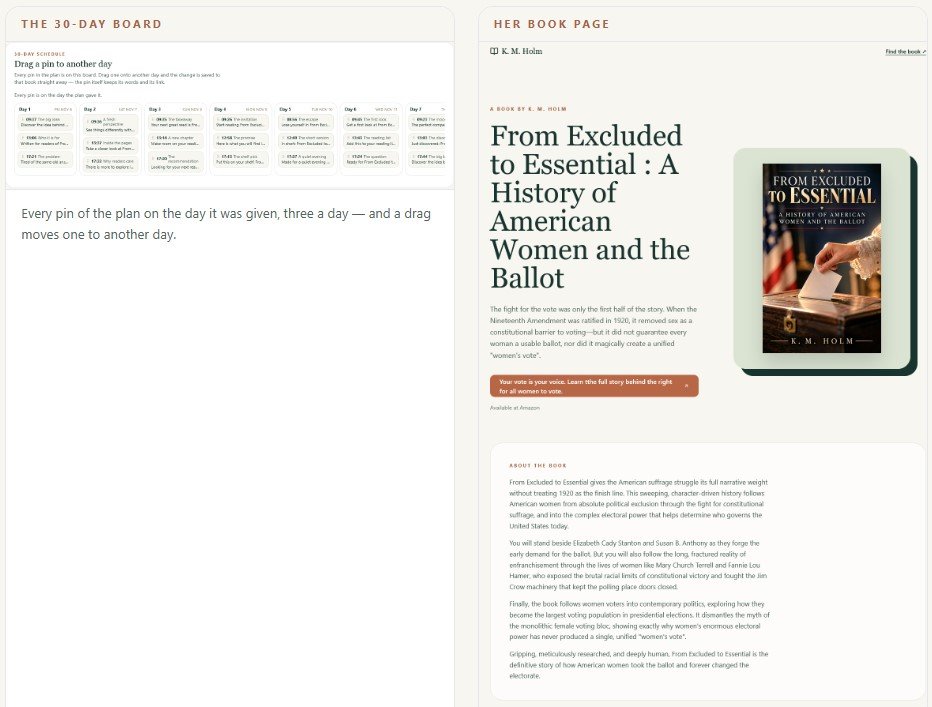
Next, the software passes those thirty angles into its visual layout processor and copywriting module simultaneously. It creates thirty vertical Pinterest pin graphics, incorporating strong typography overlays, high-contrast color schemes, and relevant visual hierarchy without requiring you to drag or drop a single element. At the exact same time, it writes thirty matching pin titles, thirty keyword-optimized descriptions, and a structured list of Pinterest board recommendations. Finally, it compiles your book cover, blurb, and call-to-action buttons into a clean, fast-loading landing page aimed specifically at readers.
Step 3: Download the Month and Publish on Your Schedule
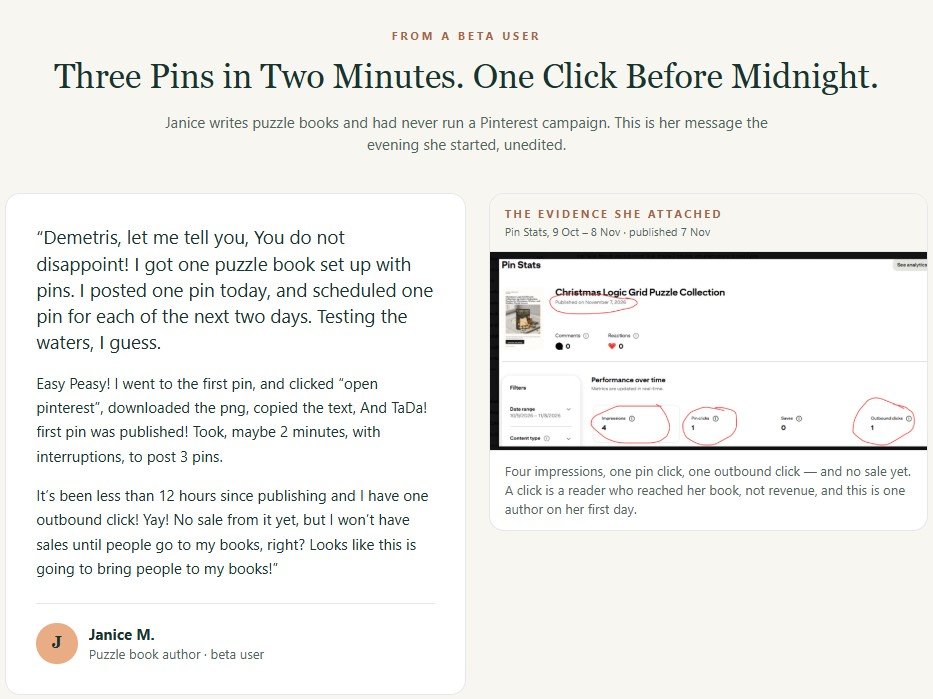
When the processing bar finishes, BookBloom AI packages all of your generated assets into an organized campaign bundle. You can preview the pins, read through the angles, and make quick text edits if you want to tweak a specific phrase. You then download the entire thirty-day folder straight to your computer. From there, you remain in complete control of the publishing cadence. You can upload one pin a day manually while drinking your morning coffee, or you can batch-schedule the entire thirty-day folder in twenty minutes using Pinterest’s free native scheduler.
100-word quick answer
BookBloom AI is a specialized content and traffic automation software built for Amazon KDP authors across all genres. Created by Dpapa, it solves the post-publishing traffic problem without requiring paid Amazon ads, an existing social media audience, or graphic design skills. You simply enter your book information once. The platform automatically generates a complete thirty-day Pinterest marketing campaign. This includes thirty unique promotional angles, thirty finished vertical pin graphics, search-optimized titles and captions, board setup guides, and a custom reader bridge page. You download the monthly asset pack and schedule one pin daily to drive steady organic readership.
Product overview
To give you a crystal-clear picture of the fundamentals before we dive into the deep strategic analysis, here is a straightforward breakdown of the core product specifications.
The product name is BookBloom AI, and it is developed by Dpapa. It operates entirely in the cloud through your standard web browser, meaning you do not need to download bulky software files or worry about whether you use a Windows PC or an Apple Mac. The primary target platform for traffic generation is Pinterest, paired with a standalone reader landing page that redirects warm traffic directly to Amazon Kindle Direct Publishing listings.
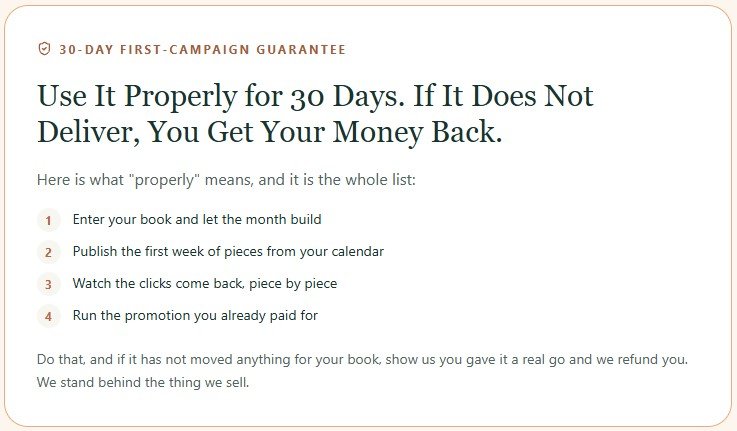
The core output of a single campaign run is thirty complete days of promotional assets derived from one single book input. The skill level required to operate the dashboard is completely beginner-friendly. There is no coding required to launch the landing page, and no graphic design manipulation is needed to produce the pin visuals. The launch takes place on the WarriorPlus marketplace, offering a low one-time front-end price during the initial promotional period alongside a straightforward refund guarantee for buyers who want to test the workflow firsthand.
Who it’s for
Because Amazon KDP encompasses hundreds of vastly different publishing categories, it is important to examine exactly which types of creators will get the most mileage out of BookBloom AI.
First and foremost, this software is built for non-fiction self-publishers. If you write books about personal finance, keto dieting, backyard gardening, parenting strategies, spiritual healing, or small business productivity, Pinterest is an absolute goldmine for your work. Users on Pinterest actively search for solutions to these exact everyday problems. This tool breaks your non-fiction topic down into thirty bite-sized educational hooks that naturally lead searchers straight to your book.
Second, it serves fiction novelists and genre writers. Many fiction authors mistakenly assume Pinterest is only for recipes and home decor. In reality, massive communities of avid readers use the platform to hunt for specific book tropes, aesthetic mood boards, and reading lists. Whether you write cozy mysteries, historical romance, sci-fi thrillers, or fantasy epics, the angle generator inside BookBloom AI helps highlight character dynamics, plot hooks, and genre tropes that attract binge-readers.
Third, it is highly practical for low-content and medium-content KDP publishers. If you publish journals, planners, logbooks, adult coloring books, puzzle books, or kids’ activity books, running paid Amazon ads is very difficult because your profit margin per book is usually only two or three dollars. You cannot afford high ad costs. Organic visual search traffic is the most sustainable way to move volume in low-content publishing, and this tool automates the visual promotion required to showcase those interiors and covers.
Finally, it is ideal for pen-name publishers and catalog managers. Many experienced KDP publishers operate multiple pen names across five or six unrelated niches. Trying to manually maintain social media accounts for four different author identities is a fast track to burnout. Being able to generate a full month of marketing assets for each pen name in a single afternoon changes the economics of managing a large backlist.
What I verified
When evaluating any marketing tool aimed at authors, it is vital to verify whether the underlying marketing strategy actually aligns with how platform algorithms work in the real world. Upon analyzing the architecture of BookBloom AI, two specific technical mechanisms stood out as genuinely smart and well-researched.
Verification 1: The Bridge Page Protects Your Amazon Conversion Rate
Most inexperienced authors create a social media post, put their direct Amazon book link in the caption, and hope for the best. What they do not realize is that sending cold traffic directly to an Amazon product page can actively hurt their book’s organic ranking. Here is why. Amazon’s search algorithm prioritizes conversion rate above almost everything else.
If five hundred curious people on Pinterest click your pin and land directly on your Amazon listing, but only two people buy it because they were not fully prepared to make a purchase, your conversion rate drops below half a percent. Amazon’s algorithm sees five hundred visitors rejecting your book and concludes that your listing is low quality. Consequently, Amazon pushes your book further down in its internal search results.
BookBloom AI solves this invisible trap by automatically generating a dedicated bridge landing page for your book. Your Pinterest pins send readers to this intermediate page first. The landing page warms the reader up, showcases the hook, displays the cover cleanly, and lets them decide if they are genuinely interested. Only the readers who click the buy button on your bridge page are sent over to Amazon. This filters out accidental clicks and window shoppers, ensuring that the traffic hitting your actual Amazon listing converts at a high percentage.
Verification 2: Pinterest Rewards Angle Diversity Over Repetitive Covers
Another critical verification involves how Pinterest’s modern spam filter works. Years ago, marketers could create one graphic of a product and pin it fifty times to different boards. Today, doing that will get your account shadowbanned. Pinterest demands “fresh pins” and diverse semantic context. If you just post thirty slightly different pictures of your 3D book cover with the caption “Out Now on Amazon,” nobody will click, and the algorithm will bury your reach.
By forcing the workflow to start with thirty distinct angles, BookBloom AI aligns directly with how Pinterest’s visual and text classifiers distribute content. One pin talks about a specific problem the book solves. Another pin highlights a relatable quote. A third pin focuses on a gift idea for a specific type of person. Because the text overlay on the image matches the unique angle in the caption and points to a relevant keyword board, Pinterest treats every single upload as valuable, fresh content worthy of search distribution.
Key Features
Let us break down the core functional modules included inside the BookBloom AI software suite so you know exactly what tools you are getting access to inside the dashboard.
1. The 30-Angle Book Extraction Engine
This is the strategic brain of the software. When you feed your book metadata into the platform, this module dissects the core themes, benefits, tropes, and target audience pain points of your title. Instead of repeating the same generic sales pitch, it writes thirty distinct promotional angles. Each angle acts as a unique entry point into your book, allowing you to market the exact same product for thirty consecutive days while keeping your messaging fresh, engaging, and highly relevant to different segments of searchers.
2. Automated Pin Graphic Generator
You do not need a Canva Pro subscription, Photoshop skills, or an eye for typography to use this system. BookBloom AI takes the thirty extracted marketing angles and automatically generates thirty vertical Pinterest pin graphics formatted to optimal platform dimensions. It pairs clean, readable text overlays with structured layouts and integrates your book imagery so the pins stop the scroll and communicate the hook instantly.
3. Pinterest SEO Caption & Keyword Writer
Pinterest relies heavily on text metadata to understand who should see your pins. For every single one of the thirty pins generated, the software writes a click-worthy pin title and a search-engine-optimized description caption. It naturally weaves high-intent search phrases and niche keywords into the sentences so your pins show up when readers type related queries into the Pinterest search bar.
4. Strategic Board Architecture Planner
Dropping great pins onto random, poorly named boards kills your organic reach. Pinterest reads your board titles and board descriptions to establish topical authority for your account. BookBloom AI generates a complete board setup blueprint for your specific book. It tells you the exact names to give your boards, provides the keyword-rich descriptions to paste into the board settings, and maps out which pins belong on which boards.
5. Dedicated Reader Bridge Page Builder
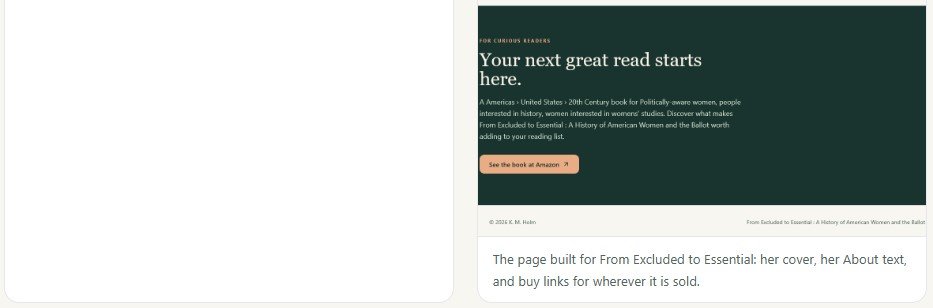
Instead of leaving you to figure out web design or pay monthly fees for funnel builders, the software automatically creates a clean, distraction-free landing page dedicated to your book. This page bridges the gap between the Pinterest pin and the Amazon checkout cart. It features your book cover, persuasive reader-focused copy, key highlights, and a clear call-to-action button linked directly to your Amazon listing.
6. One-Click Monthly Campaign Exporter
Organization is often the hidden downfall of content batching. Once all assets are created, BookBloom AI compiles your thirty pin images, thirty titles, thirty captions, board guides, and landing page files into a structured, downloadable monthly package. Everything is clearly labeled by day so you never lose track of which asset you have already published and which one is scheduled next.
Key Benefits
Features tell you what the code does, but benefits explain how the tool actually changes your day-to-day life as a self-published author. Here are the primary operational benefits of integrating BookBloom AI into your publishing routine.
Eliminates Risky Advertising Spend
The most immediate financial benefit is removing the pressure to run paid ads on thin royalties. When you publish a book priced at $9.99 on KDP, your royalty after printing costs might only be $2.80. Losing money on Amazon PPC ads or Facebook ads while trying to find a profitable keyword can quickly drain your bank account. By building an organic search engine presence on Pinterest, every click you generate costs nothing, meaning you keep 100% of your Amazon royalty payouts.
Bypasses the Zero-Follower Barrier
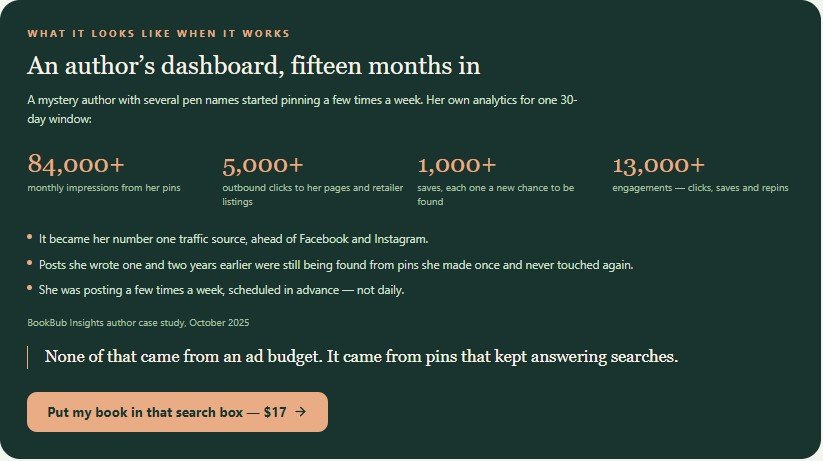
Starting an Instagram, TikTok, or X account from scratch is demoralizing because your early posts are shown to almost nobody until you build a loyal follower base. Because BookBloom AI structures your content for Pinterest search discovery rather than social feed engagement, you do not need followers to get traffic. A brand-new account with zero followers can still rank a well-optimized pin in search results and send readers to a landing page.
Cures Graphic Design Paralysis
Many authors procrastinate on marketing because they hate spending hours inside graphic design tools agonizing over fonts, colors, and layout spacing. By automating the visual creation of all thirty pins at once, the software eliminates creative fatigue. You get consistent, clean marketing visuals without spending your weekends staring at blank templates.
Turns Backlist Books Into Active Assets
Most authors have older books sitting in their KDP dashboard that haven’t made a sale in months simply because the author moved on to writing the next project. Because a single run inside BookBloom AI takes only a few minutes, you can quickly revive neglected backlist titles by generating a fresh thirty-day traffic campaign for each older book in your catalog.
Practical analysis
To give you genuine value in this review, let us step back from the sales page promises and conduct a practical operational analysis of how you should actually deploy BookBloom AI to get real results. Software is only as good as the strategy used to run it.
The Math of KDP Royalties vs. Time Invested
Let us look at the time economics of manual Pinterest marketing versus using this system. If you sit down to create a thirty-day campaign manually, brainstorming thirty distinct hooks takes about two hours. Designing thirty unique vertical graphics in Canva takes roughly ten minutes per pin, which equals five hours. Researching keywords and writing thirty unique titles and descriptions takes another three hours. Building a simple landing page takes at least an hour. That is eleven hours of unpaid administrative work for just one book.
If you have a catalog of ten books, doing that manually is virtually impossible alongside writing new material. BookBloom AI compresses that eleven-hour production window down to roughly fifteen minutes of input and review time. Even if you spend an extra twenty minutes tweaking a few headlines to match your personal voice, you are saving over ten hours of labor per book.
How to Deploy the 30-Day Pack Safely and Effectively
Once you download your monthly zip file from BookBloom AI, do not make the rookie mistake of uploading all thirty pins to Pinterest in ten minutes on the same afternoon. Pinterest rewards consistency, not sudden bursts of bulk uploading followed by twenty-nine days of silence.
Instead, use the native scheduling tool built right into every free Pinterest Business account. Sit down once a week on Sunday evening. Take seven pins from your downloaded folder, upload them to Pinterest, copy and paste the provided titles and captions from your document, attach your bridge page link, and schedule one pin to go live each day for the upcoming week. This takes less than fifteen minutes a week, keeps your account completely safe from third-party automation flags, and feeds the algorithm the steady daily activity it loves.
Adapting Across Different KDP Niches
During your practical usage, you will notice that different book genres respond best to slight adjustments in how you frame the input data. If you are promoting a low-content book like a budget planner or anxiety journal, make sure your initial book description input highlights the specific daily transformation the user gets, rather than just listing page dimensions and paper weight. That gives the AI stronger material to build emotional angles. If you are promoting genre fiction, feed your key character tropes, setting details, and comparable mood cues into the input box so the generated pins read like exciting reader hooks rather than dry plot summaries.
Limitations
No software tool is magic, and an honest review must point out where BookBloom AI has boundaries and limitations so you go in with realistic expectations.
First, Pinterest is a slow-burn search engine, not an instant traffic switch. If you expect to generate a campaign today, post your first pin tonight, and wake up tomorrow morning to fifty book sales on Amazon, you will be disappointed. Pinterest takes time to index new pins, read the keywords, test the visuals with small batches of users, and rank your content in search results. Typically, pins gain momentum over three to six weeks and build compounding traffic over several months. You need patience and consistency for this strategy to pay off.
Second, publishing is not auto-posted directly from the software. BookBloom AI generates and packages the entire campaign for you to download, meaning you still have to manually upload or schedule the pins onto your Pinterest account. While some marketers might see this as an extra chore, it is actually a blessing in disguise for account safety, as unauthorized auto-posting apps frequently trigger Pinterest security blocks.
Third, AI copy occasionally benefits from a quick human review. While the angle extraction engine and caption writer are specifically tuned for books, artificial intelligence can sometimes phrase a hook in a slightly repetitive or overly dramatic way, especially for nuanced literary fiction. You should plan to spend ten minutes skimming through the generated text outputs to ensure every claim accurately reflects what is inside your book.
Bonuses
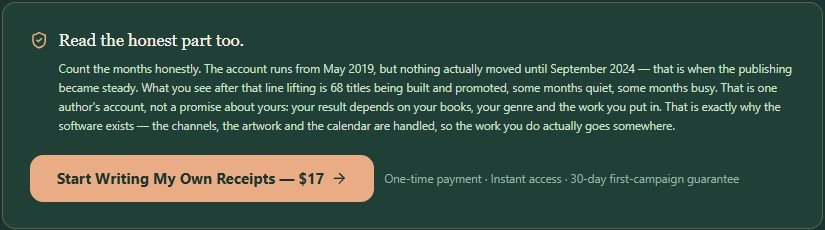
During the initial launch phase on WarriorPlus, the vendor includes complimentary bonus resources inside the member area designed to help authors maximize their setup without hitting roadblocks.
While promotional bonuses can rotate depending on the stage of the launch, they are specifically structured to support the core workflow of BookBloom AI. Typically, these include quick-start implementation guides on setting up and optimizing a high-converting Pinterest Business profile from scratch, best-practice checklists for warming up a brand-new account so your initial pins get indexed faster, and strategic training on how to link multiple books together once a reader lands on your bridge page. These additions are practical because they fill in the strategic gaps for authors who have never opened a Pinterest business dashboard before.
Pricing & OTOs
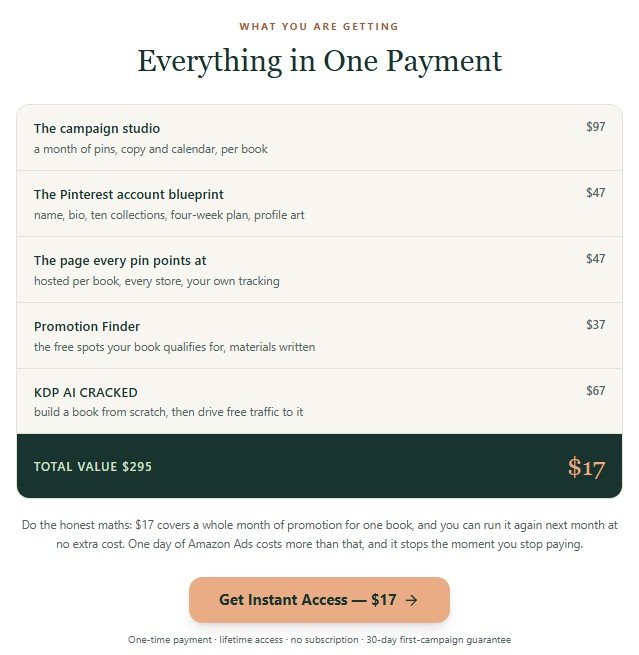
The pricing structure for BookBloom AI follows a modular funnel model. The core front-end software is kept very affordable so solo authors can get in and start building campaigns right away, while optional upgrades—known as One-Time Offers (OTOs)—unlock expanded capacity, extra formats, or commercial permissions for heavy power users.
Below is a clear breakdown of the pricing and funnel structure:
| Funnel Stage | Product Name | Estimated Price | Core Value & Key Additions |
| Front-End (FE) | BookBloom AI Core Software | ~$17 – $27 (One-Time) | Complete 30-day book campaign generator: 30 angles, 30 pins, SEO captions, board setup blueprints, and the reader landing page builder. |
| OTO 1 | BookBloom AI Pro / Unlimited | ~$37 – $47 | Removes monthly campaign generation limits, unlocks additional visual pin templates, advanced angle styles, and faster batch processing for large KDP catalogs. |
| OTO 2 | BookBloom AI Multi-Platform / Traffic Expansion | ~$47 – $67 | Expands the 30-day book angles into additional visual formats suitable for Instagram Bookstagram posts, Facebook reader groups, and vertical short-form story graphics. |
| OTO 3 | BookBloom AI Done-For-You Niche Packs / Templates | ~$67 – $97 | Pre-built, high-converting campaign structures, proven KDP niche research data, and enhanced landing page layouts for multiple simultaneous book showcases. |
| OTO 4 | BookBloom AI Agency / Commercial License | ~$97 – $127 | Grants full commercial rights to generate and sell 30-day Pinterest book marketing packages and landing pages to other self-published authors as a freelance service. |
Which Upgrades Actually Matter?
You do not need to buy the entire funnel for the software to work. The Front-End version of BookBloom AI gives you everything promised on the main sales page to take a book and build a complete thirty-day traffic campaign. However, if you are a prolific publisher with ten, twenty, or fifty books sitting in your KDP dashboard, OTO 1 (Pro/Unlimited) is a very sensible upgrade because it removes usage caps and provides broader template variety so your pins across multiple accounts never look identical. If you only have one or two books published right now, stick with the Front-End first and test the workflow before considering any upgrades.
Comparative analysis of the product with the existing products
To truly judge the value of BookBloom AI, we need to compare it directly against how authors currently piece together their marketing using existing standalone tools.
Right now, if a self-published author wants to build the exact same thirty-day Pinterest and landing page system without BookBloom AI, they have to assemble a fragmented tech stack. First, they use ChatGPT or Claude to brainstorm thirty marketing angles and write thirty Pinterest captions. That requires writing complex prompts, feeding the AI Pinterest SEO character limits, and copying and pasting text back and forth into a spreadsheet.
Second, they have to open Canva Pro ($15/month) or BookBrush ($10-$20/month) to manually design thirty separate pin graphics, uploading their book cover, adjusting font sizes, and exporting thirty individual files. Third, they have to buy a landing page builder like Carrd, Leadpages, or Linktree Pro ($5-$37/month) to build a clean bridge page so they aren’t direct-linking cold traffic to Amazon.
The primary advantage of BookBloom AI over this traditional piecemeal approach is workflow unification and cost consolidation. Instead of logging into three separate platforms, paying multiple recurring monthly subscriptions, and manually transferring text from an AI chat window into a graphic design canvas, this software handles the ideation, visual rendering, SEO copywriting, and landing page creation inside one single pipeline. While dedicated design tools like Canva offer deeper pixel-by-pixel manual customization for professional graphic designers, BookBloom AI wins decisively on speed, simplicity, and book-specific marketing logic.
Alternatives
If you are weighing your options before buying, it helps to look at the closest viable alternatives on the market and see how they stack up for KDP authors.
1. Tailwind Create + Tailwind Scheduler
Tailwind is one of the oldest official Pinterest marketing partners. Its “Tailwind Create” feature lets you upload photos and generate multiple pin variations automatically, and it includes a direct auto-scheduler. However, Tailwind is built primarily for lifestyle bloggers and e-commerce stores rather than book authors. It does not automatically extract thirty distinct reader angles from a book blurb, it does not build a dedicated KDP bridge landing page, and it requires a recurring monthly subscription starting around $15 to $25 per month forever.
2. Canva Pro + ChatGPT (The Manual Bulk-Create Method)
You can prompt ChatGPT to generate thirty short book hooks in a CSV table, import that CSV file into Canva Pro using the “Bulk Create” feature, and map the text onto a single pin template. This is a popular workaround among tech-savvy marketers. The downside is that every single pin ends up looking completely identical except for the text swap, which Pinterest’s visual algorithm quickly recognizes as repetitive template spamming. Furthermore, it leaves you without board strategies, individual SEO descriptions, or a reader landing page.
3. BookBrush
BookBrush is a graphic design platform created specifically for authors. It features fantastic 3D book cover creators, box-set mockups, and social media ad templates. However, BookBrush is fundamentally a manual graphic design studio. You still have to come up with your own marketing angles, design each graphic one by one, write your own Pinterest SEO copy, and host your own website landing pages externally.
Compared to these three alternatives, BookBloom AI occupies a unique middle ground: it combines the author-specific focus of BookBrush with the rapid batch generation of AI, while bundling the landing page component for a single one-time cost.
Pros & Cons
Every software investment comes with clear strengths and practical trade-offs. Here is a concise summary of where BookBloom AI shines and where it falls short.
Pros: BookBloom AI
The biggest strength of the software is that it turns a single book input into an entire thirty-day promotional ecosystem in minutes. It completely removes the need for graphic design skills or expensive paid ad budgets. The built-in thirty-angle extraction ensures your marketing stays varied and engaging rather than repetitive and spammy. Including an automated reader bridge page directly protects and improves your Amazon KDP listing conversion rate. Furthermore, it works across every single KDP niche, from low-content journals to full-length novels, and is available for a low one-time launch price without mandatory monthly subscription fees.
Cons: BookBloom AI
On the flip side, you still have to manually upload or schedule the downloaded pins onto Pinterest yourself, as there is no direct auto-posting integration. Organic Pinterest traffic takes weeks to gain traction in search results, so it is not a magic button for overnight book sales. Additionally, users who want complete, granular control over custom fonts and intricate visual layers may find the automated pin generator slightly less flexible than designing from scratch in Photoshop or Canva.
Who will be benefited from this product?
Let us narrow down the exact profile of the buyer who will walk away thrilled with their purchase versus the person who should skip it.
You will benefit tremendously from BookBloom AI if you already have at least one book published on Amazon KDP—or are preparing to launch one soon—and you feel completely overwhelmed by the marketing side of self-publishing. If you are tired of watching your books sit without traffic, refuse to gamble your hard-earned royalties on complicated Amazon PPC campaigns, and hate spending hours trying to design social media graphics, this tool removes your biggest daily roadblocks. It is especially valuable for prolific publishers managing multiple books who need a repeatable, scalable way to deploy organic traffic assets every month.
Conversely, you will not benefit from this product if you haven’t actually published a book yet and have no intention of completing one. It is also not suited for impatient marketers looking for a loophole system that generates instant buyer traffic within twenty-four hours without requiring twenty minutes a week to schedule pins.
Final Verdict
When you strip away all the noise surrounding digital marketing tools, self-publishing success comes down to two things: putting out solid books and getting qualified eyes onto those books consistently. Most authors master the first part and fail entirely at the second because book promotion feels like a full-time graphic design and copywriting job.
BookBloom AI succeeds because it does not try to be a bloated, all-in-one miracle app for every internet marketer on earth. Instead, Dpapa narrowed the focus exclusively to Amazon KDP authors and built a coherent, end-to-end traffic workflow around Pinterest and reader bridge pages. The logic behind unpacking one book into thirty unique angles is sound. The inclusion of a dedicated landing page to warm up readers before they hit Amazon shows genuine insight into how e-commerce conversion algorithms operate.
While you will still need the discipline to spend fifteen minutes a week scheduling your downloaded pin assets and the patience to let Pinterest’s search engine index your content over time, the software eliminates roughly ninety percent of the manual grunt work involved in organic book promotion. At its low one-time launch price, BookBloom AI is a practical, smart, and highly cost-effective addition to any self-published author’s marketing toolkit.
Frequently Asked Questions: BookBloom AI
Does BookBloom AI work for low-content and medium-content KDP books like journals or coloring books?
Yes, it works exceptionally well for low-content and medium-content books. In fact, Pinterest is one of the best visual discovery platforms on the internet for planners, trackers, journals, coloring books, and activity books because users actively search for visual gifts, organizational tools, and stress-relief activities. Furthermore, because low-content books have smaller royalty margins per unit, generating free organic search traffic is far more profitable than running paid Amazon ads.
Do I need an existing following on Pinterest for this system to get readers?
No, you can start with a brand-new Pinterest Business account with zero followers. Unlike Instagram or Facebook, where posts primarily go to people who already follow your page, Pinterest operates as a visual search engine. Because BookBloom AI writes keyword-optimized titles, captions, and board structures, your pins are designed to show up when everyday users type matching phrases into the search bar, regardless of your follower count.
Why does the software build a landing page instead of linking pins straight to Amazon?
Linking pins directly to Amazon is often discouraged and counterproductive for two reasons. First, Pinterest frequently limits the organic reach of raw Amazon affiliate or product links. Second, sending cold browsers straight to your Amazon listing results in lots of window-shopping clicks without purchases, which tanks your Amazon conversion rate and hurts your organic Best Seller Rank. The built-in landing page acts as a bridge that warms up the reader first, ensuring only genuinely interested buyers click through to Amazon.
Do I have to pay extra for website hosting or a domain name for the reader landing page?
No, the system is designed to work out of the box without forcing you to buy separate web hosting plans, install WordPress, or configure complicated domain DNS settings. The page generation is handled directly through the platform’s workflow so you can deploy your campaign links immediately.
Will using BookBloom AI put my Pinterest or Amazon KDP account at risk of getting banned?
No, both accounts remain completely safe. Amazon loves external traffic coming from clean landing pages because it brings new shoppers onto their site. On the Pinterest side, because BookBloom AI does not use unauthorized third-party bots to spam-post into your account—and instead generates unique, fresh visual assets and distinct angles that you download and schedule cleanly—your account adheres strictly to platform best practices.
How long does it take to generate a full 30-day campaign for one book?
Entering your initial book details takes about two to three minutes. Once you submit the data, the artificial intelligence engine typically generates all thirty angles, thirty pin graphics, thirty SEO captions, the board guide, and the landing page in just a few minutes. Including a quick human review of the assets, you can have a full month of marketing ready to download in under fifteen minutes.
Can I edit the generated pins, angles, or captions if I want to change a word?
Yes, you retain control over your outputs before finalizing your workflow. If a specific angle or caption uses a phrase that doesn’t quite match your author tone, you can easily tweak and refine the text so that your promotional materials remain 100% authentic to your book.
How do I actually publish the pins once I download the monthly pack?
Once you download your organized thirty-day campaign folder to your computer, the easiest method is to use Pinterest’s free native scheduling tool. Every free Pinterest Business account lets you upload pins and schedule them in advance. You can sit down once a week, upload seven pins from your folder, paste the provided titles and captions, and schedule one pin to go live each day completely hands-free.
Does this work for fiction authors, or is it only for non-fiction how-to books?
It works for both fiction and non-fiction. For non-fiction, the angle engine focuses on practical benefits, tips, and solutions to reader problems. For fiction genres like romance, mystery, fantasy, thriller, and children’s books, the engine extracts thematic hooks, character dynamics, reader tropes, emotional vibes, and gift-buying angles that appeal directly to avid book lovers browsing Pinterest.
Is there a monthly subscription fee required to keep using the software?
If you purchase BookBloom AI during the WarriorPlus launch period, the front-end access is offered for a single, one-time payment with no recurring monthly bills. You also remain covered by the vendor’s standard money-back guarantee period, allowing you to test the software with your own KDP books risk-free.